Indigenous Peoples Support the Bolivia Cochabamba Peoples’ Agreement of the recent People’s Global Summit on Climate Change and the Rights of Mother Earth Rejection of Carbon Market Regimes |
May 7, 2010
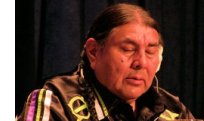 My name is Tom B.K. Goldtooth, Executive Director of the Indigenous Environmental Network. Our Indigenous network represents indigenous communities throughout the world experiencing the affects of climate change. The Indigenous Environmental Network is based in Minnesota, USA. My name is Tom B.K. Goldtooth, Executive Director of the Indigenous Environmental Network. Our Indigenous network represents indigenous communities throughout the world experiencing the affects of climate change. The Indigenous Environmental Network is based in Minnesota, USA.
I am here at United Nations headquarters as part of an international delegation of civil society and social movements invited by President Evo Morales Ayma of the Plurinational State of Bolivia to lift up the importance of the Peoples’ Agreement and the Universal Declaration of the Rights of Mother Earth, that are outcomes of the People’s Global Summit on Climate Change and the Rights of Mother Earth.
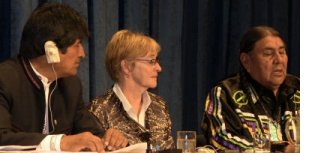 Indigenous peoples from throughout the Americas and throughout the world participated in the Global Summit. Indigenous peoples stood together with the social movement of the world acknowledging that Mother Earth is the source of all life. World leaders and parties to the UN climate negotiations must reevaluate what their relationship is the sacredness of Mother Earth. The draft Universal Declaration of the Rights of Mother Earth developed in Cochabamba is an international framework to ensure mechanisms for the recognition of human rights, the rights of those that cannot speak for themselves and of our Mother Earth. Indigenous peoples from throughout the Americas and throughout the world participated in the Global Summit. Indigenous peoples stood together with the social movement of the world acknowledging that Mother Earth is the source of all life. World leaders and parties to the UN climate negotiations must reevaluate what their relationship is the sacredness of Mother Earth. The draft Universal Declaration of the Rights of Mother Earth developed in Cochabamba is an international framework to ensure mechanisms for the recognition of human rights, the rights of those that cannot speak for themselves and of our Mother Earth.
As representatives of social movements and civil society of the world – we are asking for meaningful and effective participation of civil society and social movements in Cancun and all UN climate change negotiations. The Copenhagen UN climate meeting did not allow this to happen. We are a movement of millions of people throughout the world demanding transparency, inclusion and to have a voice in UN climate negotiations that will create climate policy that directly affects the future of our communities and the world.
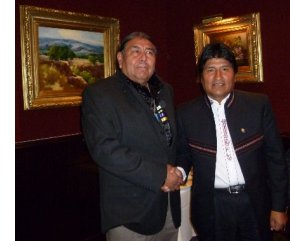 One of the key points of the Cochabamba Peoples’ Agreement was the rejection of carbon market mechanisms within climate agreements and negotiations such as the controversial REDD initiative (Reducing Emissions from Deforestation and Degradation) and REDD+ that want to use forests as a commodity to be traded in a carbon offset regime, as well as Clean Development Mechanism projects. One of the key points of the Cochabamba Peoples’ Agreement was the rejection of carbon market mechanisms within climate agreements and negotiations such as the controversial REDD initiative (Reducing Emissions from Deforestation and Degradation) and REDD+ that want to use forests as a commodity to be traded in a carbon offset regime, as well as Clean Development Mechanism projects.
Indigenous people the world over are suffering from human rights abuses from carbon trading and carbon offsets. Indigenous peoples’ cosmovision and our worldview are concerned of a world that privatizes the air, water and commodifies the sacredness of Mother Earth. We must de-colonize the atmosphere.
The Copenhagen Accord was a high-stakes deal-maker and was really a Copenhagen Steal that did not recognize, nor had any language ensuring the rights of Indigenous Peoples. This will lead to further human rights violations, climate destruction, lost of land and disruption of the livelihood and well-being of indigenous communities from the arctic to the global south.
As Indigenous Peoples, we are the guardians of Mother Earth, and must make principled stands for the global well-being of all people and all life. The adoption of the Cochabamba Peoples’ Agreement and the Universal Declaration on the Rights of Mother Earth is extremely necessary, if we are to survive this climate crisis that will be getting worst in decades to come.
|
|
♦ Press Conference by Bolivia’s President on People’s Congress |
May 7, 2010
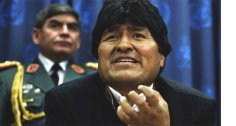 Convinced that recent Government-led climate negotiations had ignored the perspective of the people most affected by global warming, Bolivian President Evo Morales told reporters today that the United Nations should adopt the outcomes of a “people’s summit” he had convened last month in the Andean city of Cochabamba as a more inclusive, people-centred framework for future talks to ensure equitable decision-making and respect for the rights of the planet. Convinced that recent Government-led climate negotiations had ignored the perspective of the people most affected by global warming, Bolivian President Evo Morales told reporters today that the United Nations should adopt the outcomes of a “people’s summit” he had convened last month in the Andean city of Cochabamba as a more inclusive, people-centred framework for future talks to ensure equitable decision-making and respect for the rights of the planet.
“I’m talking about justice,” said President Morales, who was in New York accompanied by a group of social activists to present United Nations Secretary-General Ban Ki-moon with the outcomes of the first World People’s Congress on Climate Change and the Rights of Mother Earth, held in Cochabamba 20-22 April.
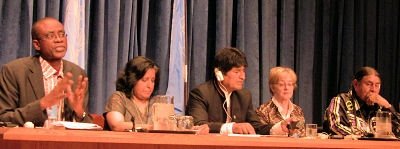
Nnimmo Bassey, Chair of Friends of the Earth International, Tom Goldtooth, Executive Director of Executive Director of the Indigenous Environmental Network, Meena Raman, of the Third World Network, and Maude Barlow, of the Blue Planet Project, joined the President at the press conference.
During the Headquarters press conference following his meeting with the Secretary-General, President Morales, Bolivia’s first indigenous Head of State, said the People’s Congress had been something of an alternative to the fifteenth Conference of States Parties to the United Nations Convention on Climate Change held this past December in Copenhagen, Denmark. That meeting had produced the “Copenhagen Accord”, a product of closed-door diplomatic horse trading that Mr. Morales said ignored the causes of global warming and placed no obligations on those most responsible for putting our planet, Mother Earth, in peril.
He said that, unlike the Copenhagen Accord, which had been reticently approved by an elite group of negotiators, the People’s Agreement had been adopted by some 35,000 representatives of social movements, indigenous peoples and others. Some 9,254 of the participants in the Congress had come from outside South America, representing 140 countries, including 56 Government delegations. “Their outcome document vows to deal with the structural changes needed to really [tackle] global warming,” he said. Continue reading....
Image Credit: Evo Morales opened the grassroots 'people's conference' on climate change. Photograph: Stephen Chernin/AP
The Pachamama
At the U.N., Morales based the Mother Earth proposal on four principles included in the declaration he presented:
The first is “The right to life, which signifies the right to exist. The right of which not one ecosystem, neither one species of animal nor vegetable, not one snow-capped mountain, neither river nor lake would be exterminated or eliminated by an irresponsible attitude of human beings.”
Should Bolivia’s (and Peru’s) high Andean glaciers melt due to global warming, establishing the right of snow-capped mountains to exist will enable Bolivia to continue preserving its national water supplies and protect its living society.
The second principle is that “Mother Earth has to be able to regenerate her bio-capacity.”
The third principle declares “the right to a clean life, which means the right of Mother Earth to live without pollution.”
The fourth principle is “the right to harmony and balance with all and among all. This is the right to be recognized as a part of a system in which all are interdependent.” (For the complete speech, see www.boliviaun.org.)
Morales’ presentation of Bolivia’s initiative has significance for any country where capitalist and U.S. imperialist interests have stolen resources, stripped the land bare and left toxic waste behind. |
|
♦ Shareholder Season Madness |
Power struggle over Canada's 'dirty oil' sands
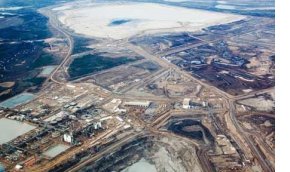 The normally dull company AGM has become an unlikely battleground as green-minded pension fund members take on the energy giants exploiting the controversial tar sands of western Canada. The normally dull company AGM has become an unlikely battleground as green-minded pension fund members take on the energy giants exploiting the controversial tar sands of western Canada.
Christopher Hall is an unlikely rebel. Aged 74, the retired canon of Christ Church Cathedral, Oxford, wears wire-rim glasses and a tweed jacket, and lives with his wife in a cottage in a village just outside Banbury. He reads, he gardens and he enjoys being with his children and grandchildren. It is scarcely the lifestyle of extreme radicalism and yet Canon Christopher Hall is one of a new breed of activists.
The target of his unhappiness is Shell. Canon Hall does not want the global giant mining in Canada's oil sands. He is not alone in this. Canada is the world's second largest source of future oil after Saudi Arabia. The tar sands of Alberta, which cover an area greater than the size of England and Wales, have attracted the world's biggest oil companies: Shell, Total, Statoil and PetroChina. But extracting the oil is costly and fraught with environmental and social difficulties. Continue readying....
Image Above: A view of the Suncor plant showing a 'tailing pond', one of the toxic lakes of wastewater from the oil extraction process.
RBS meeting surrounded by protesters
Anti-poverty and environmental groups have been protesting outside the Royal Bank of Scotland's AGM in Edinburgh.
They are angry at the bank's funding of petroleum companies wanting to extract oil from northern Canadian, and at the lack of say they have in the bank, which is 83% owned by taxpayers. Hayley Millar reports.
New Report Exposes Enbridge Inc’s Destructive Gamble on Eve of Annual Meeting of Shareholders
OTTAWA, ON – In advance of Enbridge Inc.’s Annual Meeting of Shareholders scheduled for Wednesday, May 5th, the Polaris Institute and the Indigenous Environmental Network are releasing a new corporate profile of the company. In the profile, Enbridge Inc’s dirty tar sands gamble is exposed as potentially dangerous in terms of its impacts on the environment and First Nations communities.
The new 69 page profile, Out on the Tar Sands Mainline: Mapping Enbridge’s Web of Pipelines, raises serious questions about the company’s role in relation to the tar sands industry, and especially its future plans to open up Asian markets for dirty tar sands crude via the controversial Gateway pipeline. The profile explores the social costs of this game plan on First Nations communities and the environment and how, based on its track record, Enbridge will use its political clout, revolving door mechanisms and strategic donations to First Nations communities to carry its plans forward. Continue reading....
Clayton Thomas-Mueller at BP Shareholder Meeting

Click image to view video.
Brazen Posturing
Posted by Jess Worth
It’s not often that the people who run transnational corporations face their critics in person. Indeed, it’s the job of a small army of press officers, PR agencies, lawyers and security guards to ensure that they don’t have to. But every now and then, dissent invades their carefully created corporate comfort zone, and the results are always very interesting.
On Thursday, I attended the Annual General Meeting of BP. Britain’s biggest company is famous for practically inventing greenwash with its ‘Beyond Petroleum’ rebrand a decade ago, which did a pretty impressive job of distracting attention from the fact that 98% of the company’s profits were still coming from oil and gas. Continue reading.... |
|
♦ Reports from Cochabamba |
|
♦ James Cameron to tour Athabasca |
Vow comes after he declared project a 'black eye' for Canada
By Etan Vlessing

Click Image to View Interview
TORONTO -- "Avatar" director-turned-eco activist James Cameron looks set to tour the devastation of Alberta's tar sands after declaring the controversial Canadian oil development a "black eye" for Canada.
Alberta native activist George Poitras of the Mikisew First nation on Tuesday said he met this weekend in New York with Cameron at the UN Permanent Forum on Indigenous Issues, and that the Hollywood heavyweight pledged to visit the Athabasca oil sands project first-hand.
Cameron was hosting a special screening of "Avatar" in New York on Saturday night to coincide with the U.N. gathering.
The Canadian-born director last week slammed Alberta for causing a "black eye" to Canada's environmental record as he touted the debut of his sci-fi epic on Blu-ray and DVD on Earth Day, April 22.
Canadian environmentalists have long complained that spillage and seepage at the Alberta's oil sands project in Canada's north is a disaster in the making.
IEN/James Cameron meeting at the Ritz Carlton in NYC
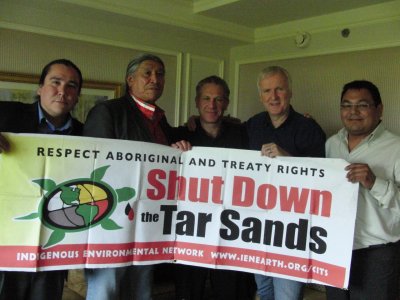
Left to right: Clayton Thomas-Muller, Francious Paulette Fort Smith Landing First Nation, Kenny Bruno, James Cameron, George Poitras, Former Chief of Mikisew Cree First Nation
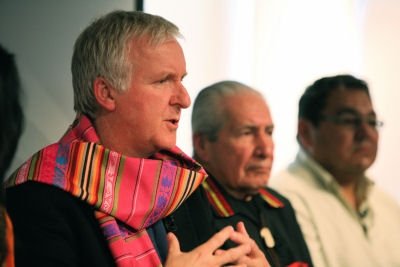
Left to right: James Cameron, Oren Lyons, (Onondaga Nation), Faithkeeper of the Turtle Clan, Six Nations, George Poitras, Former Chief of Mikisew Cree First Nation
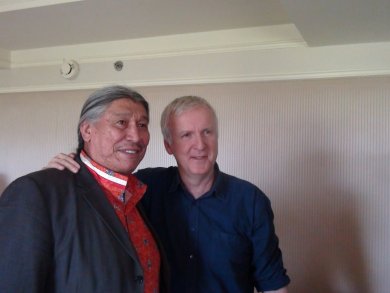
Francious Paulette, Fort Smith Landing First Nation and James Cameron
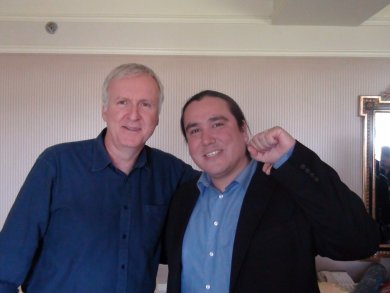
James Cameron and Clayton Thomas-Muller IEN Tar Sands Organizer |
|
♦ United States re-examines opposition to UN Declaration |
By Valerie Taliman, Today correspondent
 NEW YORK – Political tides are turning as international support for the United Nations Declaration on the Rights of Indigenous Peoples continues to grow, putting greater pressure on Canada and the United States to fully endorse it. NEW YORK – Political tides are turning as international support for the United Nations Declaration on the Rights of Indigenous Peoples continues to grow, putting greater pressure on Canada and the United States to fully endorse it.
One day after New Zealand reversed its position and supported the Declaration, U.N. Ambassador Susan Rice announced that the United States is undertaking a review of its opposition.
“I am pleased to announce that the United States has decided to review our position regarding the U.N. Declaration on the Rights of Indigenous Peoples,” she said, addressing the Ninth Session of the United Nations Permanent Forum on Indigenous Issues. Read the entire article....
IMAGE: Susan Rice, U.S. Ambassador to the United Nations, addressed the Ninth Session of the U.N. Permanent Forum on Indigenous Issues April 20. Also pictured is Jodi A. Gillette, associate director, White House Office of Public Engagement and deputy associate director of the Office of Intergovernmental Affairs. |
|
|
|
Join Us On Facebook

|
|
♦ Enbridge Pipeline Spill East of Deer River |
Contact: Marty Cobenais
Indigenous Environmental Network
(218) 760-0284
martyc@ienearth.org
(Leech Lake Reservation) On Friday, April 16, 2010, a report of an oil spill was called in by local firefighters fighting a forest fire 3 miles East of Deer River, MN, on Leech Lake Reservation property. An unknown amount of crude oil leaked out of a 1-inch crack into a wetland area where the 60 year old pipe is located. The pipelines carry crude oil from the Alberta Canada tar sands through MN to Superior WI.
A 25-acre forest fire was reported on Friday afternoon, the cause of the fire in undetermined at this time. While the fire fighters were fighting the blaze they noticed a black sludge on the ground in a wetland area. Upon further investigation they noticed it was crude oil. The fire was burning along the Enbridge Energy crude oil pipeline. The oil that had leaked out started on fire adding to the fire. Luckily, the firefighters were able to put out the fire.
According to the Enbridge Energy Safety Official on the scene today, there are no estimates being released yet on the amount of oil that did leak, but that Enbridge was going to look over their records to try to determine how long the leak may have been there. He also stated that Enbridge Energy didn’t know there was a leak until the fire crews called and notified them. Today workers were placing a temporary sleeve over the crack, but plan to return and replace the 40-foot section of pipe in two weeks.
These kinds of spills, from old and/or exposed pipes in wetland areas, and the apparent lack of sufficient monitoring are among the reasons several Leech Lake Tribal members are taking legal action against Enbridge Energy regarding the “Alberta Clipper Pipeline. Enbridge Energy claims to have state of the art, up to date safety regulations and mechanisms in place and as well as around the clock monitoring of the pipeline pressures to detect leaks immediately, yet leaks like this one can apparently occur for days or more without detection, allowing an unknown amount of oil to leak into vulnerable and sensitive ecosystems and wetlands.
In July, 2009 Leech Lake Member Vikki Howard states” The Leech Lake reservation is 50% water. Water is sacred to all of man-kind, we must protect our water’s from being polluted. It is one of our sacred elements that the Creator has given to us.” The lawsuit also contends that allowing this pipeline to be built through our reservation places “irreparable risks” to our precious water and land base.
“The Indigenous Environmental Network has voiced numerous concerns regarding the stability and safety of these older pipelines. This pipe was put into use in 1949; its now 60 years old, there are places we have seen on the pipeline that are corroded and missing the outer protective layer of asphalt material, right out in the open, exposed in wetland areas. Its very disturbing to see particularly when you consider that there is now a new lease allowing the pipeline to remain in place for another 20 years”, says Marty Cobenais, IEN Pipeline Organizer.
As far as we know, Enbridge has yet to notify the public that this incident occurred. |
|
♦ WMAN Mini Grant
Deadline: June 1, 2010 |
The goal of the Mining Mini-grants Program is to support and enhance the capacity building efforts of mining-impacted communities in the U.S. and Canada to assure that mining projects do not adversely affect human, cultural, and the ecological health of communities.
The applicant must be a grassroots community program with limited funds that has demonstrated the capacity to successfully carry out the project. Individual grants will not exceed $3,000 U.S. and cannot be used for general programmatic or operating expenses.
Applications must be submitted by June 1, 2010. Applicants will be notified of the funding decision within 3 weeks of the application deadline. There will be an “emergency” fund for extremely time-sensitive projects that fall between grant cycles (i.e., needs that could not have been anticipated at the time of the last cycle and cannot wait to be addressed until the next cycle). These grants will be very limited and awarded on a case-by-case basis at the discretion of the Mini-Grant Review Committee.
Click here to download the WMAN/IEN Grassroots Communities Mining Mini-grants program criteria and application.
Any questions? We are happy to help. Please contact either Sarah Keeney, WMAN Network Coordinator at (503) 327-8625 ~ sarahekeeney@comcast.net or Simone Senogles, Indigenous Environmental Network, (218) 751-4967 ~ simone@ienearth.org.
The application below can be emailed to either Sarah Keeney or to Simone Senogles, or it can be sent by regular mail, postmarked by June 1, 2009, October 1, 2009 or February 1, 2010 respectively, to: IEN attn: Mining Mini-grants, PO Box 485, Bemidji, MN 56619. If you are mailing the application, please call Simone or Sarah to let us know to expect it. Thank you! |
|
♦ Passamaquoddy Tribe Members Win Victory in Natural Gas Dispute |
SOUTH ROYALTON, VT –– A group of Passamaquoddy Tribe members in Maine today received notice of an important decision by the United States Bureau of Indian Affairs (BIA) to cancel a long-term lease for the construction of a liquefied natural gas terminal on an area of Passamaquoddy land known as Split Rock. The decision represents a victory for both the group and the Passamaquoddy Tribe.
On Friday, BIA cancelled the Passamaquoddy Tribe’s fifty year lease with an Oklahoma-based company, Quoddy Bay LNG. BIA’s decision comes in the wake of nearly five years of litigation and efforts by Nulankeyutmonen Nkihtaqmikon (NN), a group of members of the Passamaquoddy Tribe living on the Pleasant Point Reservation in northeastern Maine. NN was formed to protect their cultural and spiritual traditions from the harmful effects of the proposed LNG terminal on Passamaquoddy Bay. BIA’s decision was also prompted by the Tribe’s decision in June 2009 to terminate the lease. In its decision, BIA cited Quoddy Bay LNG’s failure to respond to an earlier notice of lease violation. The company has 30 days to vacate the property or file an appeal with the BIA.
“Today’s victory is on behalf of our descendants because it is what our ancestors expect from us,” said Vera Francis, an organizer with NN. “To value and defend that which has sustained us – Passamaquoddy Bay – is what defines and shapes our future.”
Another of NN’s members, Mary Bassett, exclaimed “Split Rock rests easier today!” She stated that NN and its supporters will continue to work hard to protect Passamaquoddy Bay and that “all land, all humans, and animal life deserve a healthy environment.”
Professor Teresa Clemmer, Associate Director of the Vermont Law School’s Environmental and Natural Resources Law Clinic (ENRLC), said BIA’s decision to cancel the lease was a testament to the perseverance of far-sighted tribal members and to the hard work of many student clinicians. On behalf of NN, ENRLC filed suit in 2005 in U.S. District Court in Bangor, Maine. “BIA’s decision represents a big victory for the long-term interests of the Tribe,” Clemmer said, “and is a testament to our clients’ determination and willingness to hang in there for the long haul,” Clemmer said.
NN has battled the proposed natural gas terminal on tribal land at Split Rock ever since the BIA’s original approval in 2005. They have always maintained that the project threatens the ecological health of Passamaquoddy Bay and would destroy an area important to the Tribe’s cultural, spiritual and economic lives.
In the lawsuit, NN contended that the BIA approved the lease authorizing the construction of the LNG terminal without complying with the National Environmental Policy Act and other federal environmental and historic protection laws. Since then, the ENRLC has been attempting to overcome a series of procedural arguments raised by the U.S. Department of Justice in order to reach the merits of the case.
The ENRLC also prevailed in a companion lawsuit involving NN’s Freedom of Information Act requests for records from BIA. A federal judge in Maine recently ruled that the BIA had violated FOIA by failing to promptly release the requested documents.
“The health of the Bay’s unique ecosystems depends upon sound decision-making,” Francis said. “Quite unlike many other cultures, ours is a history enlivened by a bay rich in marine life, tides and beauty. We are the original occupants of this land, and it is our responsibility to keep it that way. We are celebrating the defeat of Quoddy Bay LNG and the lease cancellation. Passamaquoddy Bay is an inappropriate location for a liquefied natural gas terminal.”
CONTACTS:
Madonna Soctomah 207-853-2895
Vera Francis 506-471-2474 |
|
♦ BP's Slick Greenwashing |
By James Ridgeway
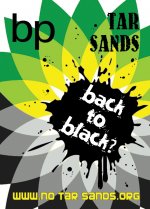
For the last decade, BP has been busily engaged in a multi-million-dollar greenwashing campaign. Changing its name from British Petroleum to BP, the company adopted a new slogan, “Beyond Petroleum,” and began a “rebranding” effort to depict itself as a public-spirited, environmentally sensitive, green energy enterprise, the very model of 21st century corporate responsibility.
It’s going to take more than a name change and a clever ad campaign to erase the image of oil spreading across the Gulf Coast from BP’s offshore rig, and dead wildlife washing up onto beaches. Even as the company magnanimously agreed to cover the costs of cleaning up the mammoth spill, BP on Monday was still insisting that it
wasn’t at fault for the accident that caused it—instead blaming the offshore drilling contractor that operated the rig. So much for corporate accountability.
Before the Deepwater Horizon disaster, BP’s green image was nothing more than a scam. While making miniscule investments in things like solar power, biofuels, and carbon fuel cells that backed its PR claims, BP continued to work relentlessly to expand its oil and gas o
perations. Continue Reading....
|
|
|

 On the Frontline of Climate Change: For many of North America's indigenous activists at the Bolivia summit, the fight against climate change is rooted in local issues
 del.icio.us
 Digg
Digg reddit
 Facebook
 StumbleUpon
 Twitter
 MySpace