|
It's almost 100 degrees in North Carolina and we've passed the midway-through-the-summer mark. We thought you might be starting to think about the next school year, so we we're dropping this "getting ready" issue into your mailbox with some ideas for your classroom.
We've focused a bit on our books this time but are offering some other great resources too! | |
|
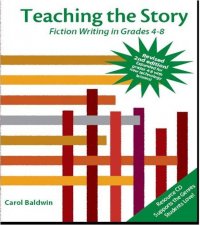
Teaching the Story: A Way to Focus Your Writing Workshop |
|
by Carol
Last November when I taught at NCCAT, I met Rebecca Quick who had taken a workshop from me at the North Carolina Middle School Conference. I was delighted to find out that she had used my book. In this interview and in the video below, she shares how she has used Teaching the Story in her middle school classroom.
Carol: You have taught language arts for thirteen years. How is Teaching the Story different than other materials you have used?
Rebecca: I have many other writing materials which I never know quite when to use. Teaching the Story is very well organized and allows me to stay focused on teaching each story element. The CD provides worksheets that I use as overheads thus simplifying the process of developing a story.
I want to allow my students to write freely, but they get very overwhelmed with the process. Before I used your book I found myself teaching all over the place without a lot of structure. As a result, my students’ writing was all over the place. Now, using Teaching the Story, at the end of each semester my students have a well written short story of which they are proud.
Carol: What was the most significant way that Teaching the Story helped you as a teacher?
Rebecca: It gave me an outline and direction to teach each element of a story. For example, the fact that there was a separate chapter on developing the character and then several mini-lessons to help students develop their character was very helpful.
Teaching the Story is very specific and detailed with lessons that explain and show exactly how to create a setting, develop a character, and create a "real" problem with a "real" solution.
Carol: Was there a particular lesson that was most helpful?
Rebecca: I found that planning the plot helped the students organize their stories. The “Build-a-Plot” handout was one of the most useful instruments. As a teacher, I was able to give the students a visual representation of their story in a very simple format. It allowed me to conference with them and they could adjust their stories as needed.
Carol: How did the book help you to be a more organized teacher?
Rebecca: By taking time to teach each element in a very simple manner my students did not get overwhelmed and could really focus on the key elements of their story. It also helped to have a focus when conferencing. I knew what I had just covered in class and I was able to discuss and give very specific feedback when trying to help them revise.
Carol: What would you say to other language arts teachers?
Rebecca: I believe that Teaching the Story will give direction when teaching the fictional narrative. There are many ways to teach students how to write stories, but you will find that Teaching the Story is very helpful in staying focused and keeping the process simple. At the same time, the book still allows room for your personal style and additional lessons.
| |
|
Video Starring Rebecca Quick |
|
by Carol
Right click on the cover of my book to
open a link to the video.
In it Rebecca shares more insights about how she used my book to focus her creative writing lessons.
| |
|
by Carol
Teaching the Story comes complete with over 70 reproducibles. Each of these handouts can be used either when brainstorming a story, or when you are studying a novel. For example, if your class was reading Comfort, you could ask students to fill out "Create a Character" for Ann Fay or Junior. If there is a category that is not directly addressed in the book, they can imagine what the character would choose (ie, favorite book or TV show.) Students can also make up categories of their own.
Similarly, you can use "Build-a-Plot" to help students analyze the plot of a book. Asking them to pinpoint the events and climax of the story will help them understand the story's structure. This will help them link to the author's craft when it is time for them to write a story
| |
|
INTEGRATE LEARNING WITH HISTORICAL NOVELS |
|
by Joyce
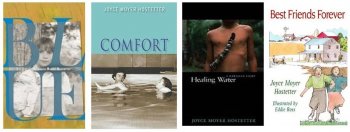
Although many teachers use BLUE in the classroom and are developing cross-curricular responses, it's certainly not the only one of my books with integrated learning potential.
Each of my books is conducive to hands- on exploration of history, science, health, language arts, math, literature, and the arts.
My website includes discussion questions and suggested learning activities for Blue, Comfort, and Healing Water. (all 4th grade and up)
Best Friends Forever (ages 7-10) has discussion questions, craft activities, and recipes in the back of the book, itself.
If you've created learning experiences based on my books and would like to share them with other educators, please email me. I have a blog Next Classroom Over which is designed for this purpose.
| |
|
Healing Water: A Hawaiian Story |
|
by Joyce
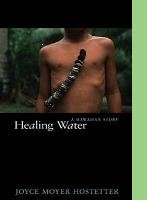
Want to take a tropical break in the middle of your school year? Why not plan a literary trip to Hawaii?
My historical novel, Healing Water takes place on the island of Molokai. The story starts with a heavy topic - leprosy. But it moves from sorrow to hope and on to celebration of life through the healing power of community.
Embedded in this story are cross-curricular learning possibiities. You can explore Educational Activities and also some Discussion Questions at the Healing Water section of my website.
And this ProTeacher Directory offers lots of Hawaii related learning links.
Just think, you can celebrate all that learning with a luau!
I'm Giving Away a copy of Healing Water!
I'm especially interested in getting HEALING WATER into Catholic Schools and homeschools since it does celebrate the contribution of Father Damien, a Catholic priest who was recently canonized.
Send me an email with ideas for reaching Catholic Schools or helpful contact info and I'll enter you into a contest to win a signed copy of Healing Water.
| |
|
Thinking Out Loud on Paper |
|
by Carol 
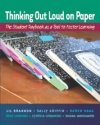
One book that I am reading this summer is Thinking out Loud on Paper: The Student Daybook as a Tool to Foster Learning. Used in all grades, the daybook is a marvelous way to hook students in all subject areas to "think out loud" through writing. I love the concept since it is one that fits with my own experience as a writer and educator.
There are so many wonderful teaching nuggets in this book, but I will just quote from the opening chapter:
"Daybooks have helped us foster ways of learning that allow students the space and freedom to be silly and messy, to be thinkers and writers just for the sake of thinking and writing, to be miners of their thoughts even if just to dig out a golden line from something that they read....The daybook breaks down the typical disconnect that occurs in schools: disconnects between theory and practice, between one grade and the next, between one subject and another, and between the way people really learn and how we often feel obligated to make our students learn in very specific and predetermined ways."
You will find the book, designed for teachers of 4th-12 grade learners, easy to read and easily integrated into your classroom. I would go so far as to say that no language arts teacher should be without a copy. Make sure you enter our conest to win a copy for yourself! | |
|
|
|
Jacqueline Houtman- won a Skype visit with Joyce
Lucie Branham – won a Skype visit with Carol
DaNae Leu– Wild Things, audio book
Linda Anderson – Rainbows, Head Lice, & Pea Green Tile
| |
|
BOOK GIVEAWAY
We are giving away three books this month to help you get ready for the new school year.
The First Days of School by Harry & Rosemary T. Wong.
This book is dripping with enthusiasm and tips for being an effective teacher.
I'm not teaching anymore so I've decided to part with my copy which is used but in good shape. (Joyce)
Thinking out Loud on Paper see book review)
Please share this newsletter with a friend (see Forward to a Friend link below) or tell your friends about us on Facebook. Then email us and we'll enter your name in our drawing. Contest ends on August 1st!
| |
 |
 |
|
Writing Exercise: Switching Viewpoints |
|
by Joyce
Seeing life from another's point of view is a powerful educational experience.
The same event told by two different people can take on a whole different tone and provide unexpected details.
LITERARY EXERCISE:
1. Assign a scene to your student from a classroom novel you are reading.
2. Ask students to rewrite the scene from a different character's viewpoint.
Example: In BLUE when Ann Fay's mom takes her to the polio hospital we read the story from Ann Fay's viewpoint. She's lying on the truck seat with her feet on her mom's lap.
But her mother is actually driving the truck.
- How would that scene change if Momma narrated it?
- What would her Momma see that Ann Fay could not?
- Who would she be thinking about and what emotions would she express?
- How would the sensory details change?
| |
|
Mathematical Literacy: Helping Students Make Meaning in the Middle Grades. According to a review in the February issue of the Journal of Adolescent and Adult Literacy, this book suggests that mathematics is a foreign language for students, and that mathematics teachers can use litearcy practices to teach this language to their students. The authors of the article conclude that this book is a "good starting place for teachers interested in literacy instruction in the mathematics classroom."
The Book Whisperer: Awakening the Inner Reader in Every Child by by Donalyn Miller. This book comes highly recommended by the staff at Gravelly Hill Middle School in Orange County, NC where I (Joyce) spoke last year. It gets great reviews as you'll see if you simply snoop around a bit online.
Can't wait to read it, myself. | |
|
by Carol and Joyce
We're now offering
Writers-in-Residence
programs and would be happy to customize workshops for your school and grade level. Here are some topics to choose from:
- Pump Up the Narrative!
- Writing Memorable Memoirs
- Writing Across the Curriculum: Using Short Fiction to Supplement Science & Social Studies
- Jazz Up your Writing!
- Writing From the 5 Senses
| |
|
BLUE
is now in paperback.

You can order directly from the publisher by calling
877-512-8366
Generous discounts for schools!
And I'm giving away free copies at my blog.
(one each month through May 2011)
Drop in and enter to win.
| |
|
by Joyce
Carol's Teaching the Story is not just for students. In fact, it's been quite helpful to me as I've developed my work-in-progress. I have a habit of barging into a story and simply discovering my character as I go. This is not entirely bad but it's also helpful to put plot, character and other info on paper first.
Carol's "Create a Character" exercise has come in handy for me in creating two of my primary characters. There's something very concrete about questions such as
- What does this character's closet look like?
- What is this character's most irritating habit?
- What is the one thing in this world your character would do anything to avoid?
Hmmmm, good questions!
Thanks to Teaching the Story, I now know my characters much better than I might otherwise!__________________
| | |



 del.icio.us
 Digg
Digg reddit
 Facebook
 StumbleUpon
 Twitter
 MySpace