Help Stop the TransCanada Pipeline! |
Please plan to watch this webcast tonight from 6-8 pm (CST). We will be talking about the Keystone XL pipeline, the Canadian Dirty Tar Sands, aka Blood oil.
CLICK HERE TO WATCH LIVE - 6-8pm CST
Please plan to watch this webcast tonight from 6-8 pm (CST). We will be talking about the Keystone XL pipeline, the Canadian Dirty Tar Sands, aka Blood oil. And then sign the petition at the link below.
IEN's Marty Cobenais will be one of the speakers.
Other Speakers Include:
- Paul Blackburn, Plains Justice
- Duane Hovorka, Nebraska Wildlife Federation
- Ernie Fellows, Nebraska Landowners for Fairness
- Ken Winston, Nebraska Sierra Club
- Jane Kleeb, Bold Nebraska
If you miss it - no worries - we will be posting the entire two hour video on our website!
Nebraskans are speaking out and taking action to help stop the TransCanada pipeline.
We think the pipeline is a bad idea for our state, our land, our water and our economic activity. We do not want to see it built and we want to see the Emergency Response Plan for the current tarsands oil pipeline that is already in the ground in our state.
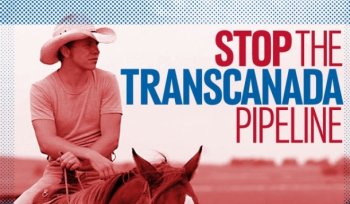
Groups raising concerns and working to stop the pipeline in our state include Nebraska Wildlife Federation, Nebraska Sierra Club, Nebraska Farmers Union, Nebraska Landowners for Fairness, Nebraska Audubon Society, Nebraska Common Cause and Bold Nebraska.
TransCanada, an international company based in Canada, is trying to obtain a permit from the United States government to build a second pipeline in our state. TransCanada refers to this new, proposed pipeline as Keystone XL (the current pipeline in the ground already is called Keystone).
The pipeline carries the most expensive and dirtiest form of oil, called tarsands. It is a think form of oil that requires many chemicals and high heat to push it through the pipeline.
Secretary Clinton, because the pipeline crosses the US/Canada border, must approve the pipeline by granting a permit to TransCanada. Because of federal laws, Clinton must go through certain steps before she makes her decision, which includes various environmental studies and public hearings.
Under the Bush Administration and under Governor Heineman’s administration, a TransCanada pipeline -- called Keystone -- was approved and is currently in the ground with oil flowing. That pipeline is NOT at capacity, so the obvious first question is why build another pipeline?
If the new pipeline is approved, 1.1 million barrels of tarsands oil, the dirtiest form of oil, will be pumping through our state everyday. The current pipeline, when at capacity, will pump 435,000 barrels of oil through our land and water.
We currently have no state laws that regulate oil pipelines. We have no trust fund set aside to help families if their land, water or health are affected. We have no Emergency Response Plan that has been made public. Nebraskans are, right now with the current pipeline in the ground, at risk and at the mercy of TransCanada if/when a leak, spill, blowout or anything else happens with the pipe. Additionally, numerous reports have cited increased rates of cancer at the source of the tarsands production in Canada.
National Wildlife report on overview and dangers of pipeline: View PDF
Plains Justice report on expense of pipeline: View PDF
Questions raised about potential increase in rates of cancer linked to tarsands: View Article
CLICK HERE to sign the Nebraska petition opposing the summit.
CLICK HERE to read more about the pipeline and the dangers it will bring to our state's water, land and economic activity.
|
|
Protestors rail against oil pipelines |
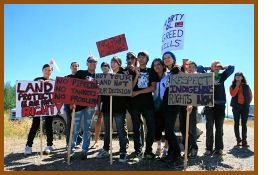
Members of the Wetsuweten Nation, joined by First Nations activists and allies from across the Canada and US - including IEN, RAN, Ruckus, etc. join forces to protest against the expansion of the Enbridge pipeline through Indigenous territories in northern BC and the further expansion of the Tar Sands megaproject. Photos by Ben Powless, Mohawk
Crowds in Smithers watched as more than 100 protesters marched Friday afternoon from the Ministry of Forestry building on Tatlow Road and continued marching down Main Street to the CN Building on Railway Avenue.
Their topic of contention: Pipelines.
"We don't need no - CN Rail pipe!" the protestors shouted. "Hey! Enbridge! Leave our lands alone!"
First Nations from as far as Ontario, North Dakota and Alberta joined members of the Unist'ot'en of the Wet'suwet'en, who organized the march to protest the Enbridge Northern Gateway pipeline.
Protesters also voiced their opposition to a natural gas project by Kinder Morgan, a North American transportation company that plans to transport natural gas from Alberta to BC using CN Rail lines.
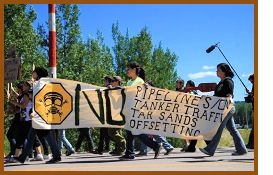 "We're standing up for our salmon, our wildlife, and our wild areas," spokesperson Sue Deranger said. Deranger is a member of the Chipewyan Nation in Athabasca, Alberta, where the oil sands are. "My nation has been destroyed by the tar sands," she said. "We didn't know. But you know what's coming, so let's stop the pipelines!" "We're standing up for our salmon, our wildlife, and our wild areas," spokesperson Sue Deranger said. Deranger is a member of the Chipewyan Nation in Athabasca, Alberta, where the oil sands are. "My nation has been destroyed by the tar sands," she said. "We didn't know. But you know what's coming, so let's stop the pipelines!"
Deranger said that oil sands development has spread cancer throughout her community. A nine-year-old boy died from brain cancer last month, a death she attributes to the oil sands.
Friday's protest was the first in a series of planned protests, Freda Huson, spokesperson for the Unist'ot'en people in the C'ilhts'ekhyu Clan, said. The Unist'ot'en Chiefs have never ceded rights to that land, and they will continue to fight, she said.
The protests are a good way to show support for all surrounding nations, Huson added.
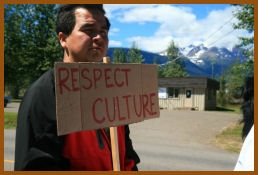 Wayne Thom, who watched the protests march down Main Street, said he fully supported the protest. Wayne Thom, who watched the protests march down Main Street, said he fully supported the protest.
"We don't need that pipeline," he said. "It will destroy the region."
The following is the list of demands that were delivered to the Ministry offices who issue permits and licences for industry and private interests.
1. The Unist’ot’en are a legitimate governing body who have never ceded our surrendered our ancient lands to any party. A regulatory regime will be resurrected to ensure that all interests on ‘Unist’ot’en lands are solely and primarily directed to the rightful owners;
2. The ‘Unist’ot’en law (‘Inuk nu’ot’en) for any outside parties who want to do business on ‘Unist’ot’en Yintah (traditional territories) requires meaningful “Free, Prior, and Informed Consent” with legitimate Clan/House Group membership prior to any development on unceded traditional territories. This is a measure that will be enforced to prevent the infringement of their section 35(1) rights and title and infringement on ‘Unist’ot’en ‘Inik nu’ot’en;
“Our ‘Unist’ot’en members will not sway under the threats and actions of industry and government. My grandmother Christine Holland gave us specific directions to protect our lands – that is exactly what we intend to do,” says hereditary chief Knedebeas - Warner William.
The resurrected regulatory regime will give power to the ‘Unist’ot’en people to manage their lands unimpeded by institutions or agencies who have previously assumed jurisdiction or authority over their traditional lands.
“It is time for the Governments of Canada and B.C. to start honoring our traditional governance system of the ‘Unist’ot’en Chiefs. We have never ceded or surrendered our territory. Distruction of forest, waters, and wildlife will no longer be tolerated. True meaningful consultation must start taking place regarding all our territory,” says spokes person Freda Huson. |
|
Pride of a Nation - Iroquois LaCrosse Team Refused Visa for World Championships in the UK |
This is an excerp from the Sports Illustrated July 19th article Pride of a Nation:

On July 15 the Nationals are scheduled to open the 2010 lacrosse world championships against host England in Manchester, but that's no sure thing. For 27 years the team representing the Iroquois—the confederacy of Mohawk, Oneida, Onondaga, Cayuga, Seneca and Tuscarora nations—has been the sole Native American entity to compete internationally, traveling on Iroquois (or, in their language, Haudenosaunee, meaning People of the Long House) passports and balancing lacrosse's prep school vibe with an aura of history and mystery and loss. But last week, just days before their scheduled departure, the Nationals were told by officials of the U.S. State and Homeland Security departments that they would not be allowed to exit and enter the country on those documents.
The Iroquois in turn rejected an offer to travel on U.S. passports. "We are representing a nation, and we are not going to travel on the passport of a competitor," said Tonya Gonnella Frichner, an Onondaga lawyer and a representative to the U.N. Permanent Forum on Indigenous Issues. As of Monday night neither side had budged, raising the possibility that for the first time since 1990, the world championships would be contested without the game's inventors.
This might seem like a mere bureaucratic snafu, but it represents a serious threat to both the tournament and the Iroquois nation. Despite drawing from a population of only about 125,000 people scattered across northeastern North America and despite lacking the financial clout of lacrosse's international powers, the Iroquois have finished fourth in the last three world championships, and they figured to enter the 30-nation 2010 competition as true contenders. The Nationals are also the Iroquois's most public expression of sovereignty, of their long-held belief that they are an independent people. Beating mighty Team USA or defending champion Canada in Manchester would be sweet, of course. But the mere hope that the Nationals would enter the United Kingdom on their own terms, bless the tournament with a traditional tobacco-burning ceremony and then take the field against the world's best would make claiming the championship almost beside the point. "Winning is not the end-all," says Sid Jamieson, who coached the first Nationals team in the early 1980s. "Just being there is a victory." Read the entire Sports Illustrated story here. |
|
Help Support the UN Declaration on the Rights of Indigenous Peoples |
Get involved with a click!
Send an e-letter to the White House supporting the U.S. endorsement of the UN DECLARATION on the RIGHTS OF INDIGENOUS PEOPLES!
The United States is currently reviewing its position on the United Nations Declaration on the Rights of Indigenous Peoples. Federal officials are taking comments on the Declaration through October, 2010. Now is the time to speak out and to urge the White House to endorse the UN Declaration.
Send an e-letter to President Obama
INDIAN LEADERS and NON-GOVERNMENTAL ORGANIZATIONS:
The Indian Law Resource Center has draft letters and suggested language to use in your letters to the U.S. Department of State.
Click here to see draft letters for Indian and Alaska Native leaders
Click here to see draft letters for Non-governmental Organizations
Kimberly Teehee of the White House Domestic Policy Council responds to questions during discussions on the UN Declaration on the Rights of Indigenous Peoples. |
|
Blowout near Conklin shoots steam and bitumen into the air |
By Darcy Henton and Hanneke Brooymans,
edmontonjournal.com
July 12, 2010
EDMONTON — A well at an oilsands site near Conklin blew out early Saturday afternoon shooting a mist of steam and bitumen about 12 metres into the air.
A Devon Canada spokeswoman said the blowout occurred on their Jackfish steam assisted gravity drainage site and that they managed to shut in the well 36 hours later around midnight on Sunday. The town of Conklin is about eight kilometres from the site of the blowout.
It’s not known how many barrels of bitumen were released, said Nadine Barber. The total cleanup is expected to take two to three weeks.
Harvey Scott, a retired University of Alberta professor who sits as a director on the council of the Keepers of the Athabasca, said local residents are worried the blowout contaminated nearby Sunday Creek and threatens the Christina River.
Barber said a gasoline-type sheen was spotted on the creek and booms were put in downstream, just in case.
“We’ll do all the necessary things to ensure cleanup happens in a timely manner.”
No employees or contractors were injured in the blowout. The jet that burst from the wellhead was approximately 70 per cent steam and 30 per cent bitumen, Barber said. The well that blew out was one of seven on a well pad. The entire well pad was shut in, resulting in the likely loss of several thousand barrels of bitumen.
The Energy Resources Conservation Board put out a news release Monday saying it is investigating the blowout that occurred at the site.
Scott said they are concerned about the intensity of in situ exploration and drilling in the area and not convinced all necessary steps are being taken to ensure surface and groundwater supplies in the area won’t be affected. Continue reading.... |
|
Native American Tribal Lands Could Produce 17.5 Trillion Kilowatt Hours of Electricity From Wind and Solar Power |
Tribal lands make up only five percent of the United States’ total land area, but represent enormous potential for the production of renewable energy. The 55 million acres of land across the nation controlled by Native American tribes can potentially produce an estimated 535 billion kilowatt-hours of electricity from wind power and more than 17 trillion kilowatt-hours from solar energy. These projections are equivalent to more than four times the amount of electricity generated annually in the United States, and represent new economic and employment opportunities for many Native American communities.
The US Department of Energy's Argonne National Laboratory, together with the US Department of the Interior, are working together to help educate future tribal leaders on energy resource development and environmental evaluations by offering several hands-on learning opportunities such as Tribal Energy Internships and the Indian Education Renewable Energy Challenge.
To recruit and train the next generation of tribal energy and natural resource management professionals, Argonne hosts a unique summer internship program – now in its second year – specifically for American Indian and Alaska Native college students.
This year's program includes interns participating from the following tribes: Quapaw, Navajo, Shoshone Bannock, Seneca Nation, Confederated Salish and Kootenai, and Eastern Shoshone, Cherokee.
"Energy production is fundamental to our quality of life and economic security," said Tony Dvorak, director of Argonne's Environmental Science division. "Despite being rich in renewable resource potential, many tribes struggle with poverty and soaring unemployment. This program helps develop renewable energy resources locally that can create jobs and revenue opportunities for tribal communities."
Students spend their summer working at Argonne on a variety of research projects that focus on both renewable and non-renewable energy sources as well as environmental evaluation and analysis. From developing wind and solar energy to learning about fuel cells and hydrogen storage, students have the opportunity to work directly with Argonne mentors on a wide range of technologies while analyzing their potential impacts and economic opportunities. Continue reading.... |
|
Lawmakers Oppose Canadian Pipeline |
New York Times - Environment
By ELISABETH ROSENTHAL Published: July 6, 2010
Facing a decision on a proposed pipeline to bring Canadian crude oil to the United States, the Obama administration is confronting growing resistance from politicians who oppose the project or, at the very least, urge further study before approval.
The massive pipeline, known as Keystone XL, would allow Canada to export an additional 1.1 million barrels a day of oil to the United States. The United States currently imports 1.9 million barrels a day from Canada. Canadian oil sands are expected to become America’s primary source of imported oil this year.
While Canadian oil represents a plentiful source of fossil fuel from a friendly neighbor, it poses environmental dilemmas: much of Canada’s oil is extracted from oil sands in a process that releases higher levels of heat-trapping gases than conventional oil drilling in the United States. In addition, extracting oil from oil sands — also called tar sand — damages the local environment by creating toxic sludge ponds and destroying large areas of boreal forest.
Last month, 50 members of Congress sent a letter to Secretary of State Hillary Rodham Clinton expressing concerns about the pipeline. Representative Henry A. Waxman, Democrat of California and chairman of the House Committee on Energy and Commerce, reiterated those concerns in a letter released by his office on Tuesday.
“This pipeline is a multibillion-dollar investment to expand our reliance on the dirtiest source of transportation fuel currently available,” he wrote in the letter, dated last Friday. “While I strongly support the president’s efforts to move America to a clean energy economy, I am concerned that the Keystone XL pipeline would be a step in the wrong direction.”
Mrs. Clinton is charged with reaching a decision on whether to permit Keystone XL under an executive order that gives the State Department authority to approve transboundary pipelines based on considerations of “national interest.”
In April, the State Department released a draft environmental assessment about Keystone XL. A public comment period recently ended, and over the next few months other federal agencies will be able to weigh in.
In his letter, Mr. Waxman complained primarily that the gas emissions produced by oil extraction in Canada were not considered in the environmental impact assessment.
For the moment, the United States is the primary customer for oil from oil sands, and without Keystone XL, the growth of that industry could be limited. Canada is ultimately planning to build a domestic pipeline to move the oil to its west coast so it can also be exported to Asian countries, primarily China.
Two prior pipelines to bring oil from oil sands to the United States have been approved by the State Department in past years with little public discussion. But with President Obama pledging to reduce the nation’s dependence on fossil fuels and with oil pouring into the Gulf of Mexico from BP’s damaged well, such decisions have taken on new significance.
“Decisions that were previously left to midlevel bureaucrats are now rising to the highest political level,” said Kenny Bruno, the United States coordinator for the No Tar Sands Oil coalition, an alliance of environmental and indigenous groups. “President Obama has done some very good things on issues like energy efficiency. But if he approves this pipeline, it would be a clear two steps back.” |
|
|
|
Take the Pledge! Rethink Alberta is brought to you by an international network of citizen and indigenous groups that oppose the expansion of the Alberta Tar Sands and advocate for its cleanup. Go to the Website - Take the Pledge. IEN is part of this network.
Take the Pledge:
Take the pledge not to visit Alberta and tell your friends and family to do the same.
I pledge not to visit the province of Alberta until the Alberta Government does the following:
- Halts the expansion of the Tar Sands.
- Stops spending millions of dollars on public relations campaigns designed to keep the United States addicted to dirty Tar Sands oil.
- Takes meaningful steps to transition its economy away from dirty Tar Sands oil to clean energy alternatives.
Rethink Alberta is brought to you by an international network of citizen and indigenous groups that oppose the expansion of the Alberta Tar Sands and advocate for its cleanup.
|
|
WATCH - LEARN and JOIN the Conversations!

|
|
From Rising Tide and Carbon Trade Watch... |
Hoodwinked in the Hothouse: False Solutions to Climate Change – FREE DOWNLOAD Available now!

Rising Tide North America and Carbon Trade Watch are pleased to announce the 2nd edition of Hoodwinked in the Hothouse: False Solutions to Climate Change.
This 28-page booklet provides a close-to-comprehensive overview of false solutions to climate change. Fifteen concise articles—complete with photos and illustrations—cover more than 20 false solutions to climate change, from Clean Coal to Biomass incineration, providing an easy-to-read introduction to the ever expanding market place of climate crisis technofixes.
With the incredible pace of the climate policy debate, the 2nd edition provides key updates to crucial topics like REDD (a major new commodification of forests and lands), which was just emerging at the time of initial publication.
Equally important, the booklet expands to more technologies that are being branded as “green” despite the grave dangers associated with them, such as waste incineration, biochar, and genetically engineered “carbon sucking” trees. We’ve also included much more information on real solutions and positive steps communities can we can take to stop the climate crisis.
The booklet includes contributions from ETC Group, the Indigenous Environmental Network, Movement Generation, the Global Alliance for Incinerator Alternatives, and International Rivers as well as art and photography from across the movement for climate justice.
We invite you to download Hoodwinked from the Hothouse today! Also available in it’s entirety in Spanish here! |
|
Comparision of the Cochabamba People’s Agreement and the Copenhagen Accord |
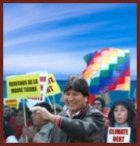
The debate about climate change is divided between the “Copenhagen Accord” that failed to be imposed by a group of countries led by the United States at the Copenhagen Conference held in December 2009, and the “People´s Agreement” that synthesizes the conclusions of the 17 working groups at the World People´s Conference on Climate Change and the Rights of Mother Earth carried out in Cochabamba, Boliva from April 20th to 22nd, 2010.
The “People´s Agreement” stems from an integral vision of climate change, incorporating the issue of the structural causes of the climate crisis, the rupture of harmony with nature, the need to recognize the rights of Mother Earth in order to guarantee human rights, the importance of creating a Tribunal of Climate and Environmental Justice, the development of global democracy so that the people can decide on this issue affecting and the planet and all of humanity.
On the other hand, the Copenhagen Accord represents a step backward with relation to the Kyoto Protocol by proposing a methodology of voluntary commitments for the industrialized countries that are principally responsible for climate change.
Click here to view a complete and easy to read comparison of these. |
|
ORGANIZING FOR A NAVAJO GREEN ECONOMY |
Translating Green Into Navajo: Alternative to Coal Mining and The Campaign for a Navajo Green Economy
Black Mesa Water Coalition featured in newly released Applied Research Center's Navajo green jobs case study | "Translating Green into Navajo"
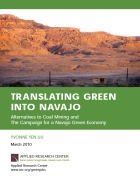
Download TRANSLATING GREEN INTO NAVAJO flyer | PDF |
|
Cultural Foundations Native Expressions speaks out against the Tar Sands |
Why has Cultural Foundations Native Expressions spoken out against the Tar Sands and the BP Oil Spills?
Our question to others is why have you not?
You do not have to be an aboriginal to figure out that the AB Tar Sands extraction is indeed a damaging project where the power of greed overtakes the respect for the earth and respect for life itself.
We have all seen the photographs of the devastation this has caused in Alberta, expanding over an area the size of England.
Over two years ago the Lubicon Nation sent a letter of concern to the Canadian Government, reporting health concerns:
(excerpt from letter by: Bernard Ominayak Chief, Lubicon Lake Indian Nation):
You mention in your report the medical problems being faced by aboriginal people as a result of contaminated water. The water and air in Lubicon Territory have been contaminated by resource exploitation activity and our people have been facing serious medical problems since the mid-1980's including widespread asthma and skin rashes among our children so severe that they cause permanent scarring; a tuberculosis epidemic affecting a third of our people; near-epidemic respiratory and stomach problems; cancers of all kinds and reproduction problems that during one 18 month period included 19 still born Lubicon
Oil spills such as the one focused on today in the Gulf of Mexico are certainly not uncommon, and have been occurring globally for years and despite the knowledge of the devastation that this causes to the waters, lands and life itself governments turn a blind eye in favour of big business for profits, trying to use the power of persuation on us ordinary folks, that it is great a economical benefit for our country.
onkwehonwehneha "The Aboriginal way"
all land, waters and life itself are sacred and must be protected.
In our Quest to
'Promote the Preservation of Traditional Aboriginal Cultures and Heritage
We have all realised that
'WHAT WE DO TODAY AFFECTS THE NEXT SEVEN GENERATIONS'
Ms Wertwyn, Acting Director Cultural Foundation Native Expressions |
|
Find More News, Information, and videos... |
The IEN website is packed with a lot of information we can't fit in our newsetters. Don't forget to log on and read!
Click here to go to our site. |
|
|



 del.icio.us
 Digg
Digg reddit
 Facebook
 StumbleUpon
 Twitter
 MySpace