In Asheville: Pick up plants at Greenlife ($8 delivery fee) or Asheville Local Foods (prices adjusted to include delivery).
Deliveries: We can deliver plants up to four hours away from our nursery for a distance-based delivery fee. Share the delivery fee with your friends or neighbors and get a discount by arranging a group order!
This fall, we would love to deliver plants to Raleigh, Durham, Greensboro, Charlotte, Greenville, Boone, Knoxville, and Atlanta. If you are in or near one of these areas and would like to get in on a group delivery, please let Debbie know. |
|
|
See our curriculum of classes on the website. Bring Chuck in for a private consultation on any of these topics or arrange for a small or large group class. More info? Click here. |
|
|
With a UPN gift certificate, the recipient can get just what they want when they are ready to plant.
Or, let your friends and family know that you'd like a UPN gift certificate for a special tree, bush, or other useful plant.
Gift certificates are available in any denomination of $5.00 or more. We will send a paper certificate in the US mail. If you prefer, we can send a PDF file that you or your recipient can print.
You can pay for gift certificates with a credit card through our secure website, or contact us at info@usefulplants.org or (828) 669-6517 for other options.
|
|
|
We're thrilled to offer the following videos:
Facebook
Useful Plants Nursery is on Facebook! Be a friend and/or fan, hook up with other Useful Plants people, and share your stories.
|
|
|
Useful Plants Nursery is a small, permaculture-based nursery specializing in useful, phytonutritional, food, and medicine plants well-adapted to our Southern Appalachian mountains and surrounding bioregions. Our plants are grown without the use of synthetic pesticides at our nursery located at Earthaven Ecovillage.
I believe that growing your own food and medicine plants is a vitally important strategy and practice for regaining control over our collective and personal lives, our health, and our individual and bioregional economic well being. Our nursery is dedicated to putting those beliefs into practice and truly creating "Liberation through Abundance" as we serve your needs for healthy, useful landscape plants, and work together to reweave the web of life.
-- Chuck Marsh, nurseryperson, permaculture designer, bioregional inhabitant
UPN is a North Carolina certified nursery.
To see a full list of our plants, click here. |
|
|
|
|
Fall Planting Time is Here! |
Fall is the best time to plant trees and shrubs. Although you can plant containerized plants any time of year, planting them in the fall lets them become established with the least amount of effort.
 This month, the Chuckster answers questions about fall planting. Read his answers on the UPN website: This month, the Chuckster answers questions about fall planting. Read his answers on the UPN website:
|
|
|
Plant of the Month: Thornless Blackberries |
by Chuck Marsh
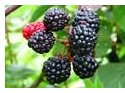 Thornless blackberries are one of the great perennial edible landscaping plants for our area. They’re easy to grow, quite flavorful, highly nutritious, very productive, and fit in nicely as trellised border plants along garden edges, fences, or property edges. Their shiny, dark green leaves are quite attractive as are their white flowers in late spring. Blackberries flower late, thus avoiding spring frost damage and assuring good annual fruit production, even when a late frost takes out your spring blooming fruit. Their flowers provide nectar and pollen for native bees and honeybees, and their dense growth can provide nesting sites for your birds. While wild thorny blackberries can be both delicious and problematic, as anyone knows who has ever tried to remove unwanted wild blackberry plants from their garden. Thornless blackberries are also pain free. Due to their smooth thornless stems, you won’t be coming in from the berry patch all scratched and bleeding with your clothes ripped to shreds. Thornless blackberries are one of the great perennial edible landscaping plants for our area. They’re easy to grow, quite flavorful, highly nutritious, very productive, and fit in nicely as trellised border plants along garden edges, fences, or property edges. Their shiny, dark green leaves are quite attractive as are their white flowers in late spring. Blackberries flower late, thus avoiding spring frost damage and assuring good annual fruit production, even when a late frost takes out your spring blooming fruit. Their flowers provide nectar and pollen for native bees and honeybees, and their dense growth can provide nesting sites for your birds. While wild thorny blackberries can be both delicious and problematic, as anyone knows who has ever tried to remove unwanted wild blackberry plants from their garden. Thornless blackberries are also pain free. Due to their smooth thornless stems, you won’t be coming in from the berry patch all scratched and bleeding with your clothes ripped to shreds.
Thornless blackberries are relatively recent arrivals on the scene, due to the plant breeding work of several universities, who have been introducing new improved varieties regularly. The early varieties weren’t very sweet. The newer varieties, which our nursery carries, have a much better flavor with a good balance of sweetness and tartness. The fruit size of thornless blackberries is quite amazing. Some berries are as big as my thumb and they are all significantly larger than wild blackberry fruit. This means less picking time for you. You can pick a quart of the thornless varieties much faster than you can pick wild ones and a whole lot faster than you can pick a quart of smaller fruit like blueberries.
Read more about blackberries in this newsletter or on the UPN website. Watch for a new blackberry video next week. |
|
 |
|
Market and Event Schedule |
| Date | Event | Location |
|
Sept. 4, 8am - 1pm
|
Asheville City Market |
161 S. Charlotte St., Asheville
|
|
Sept. 11, 8am - 1pm
|
Asheville City Market |
161 S. Charlotte St., Asheville
|
|
Sept. 11
|
OrganicFest
|
Asheville
|
|
Sept. 18, 8am - 1pm
|
Asheville City Market |
161 S. Charlotte St., Asheville |
| Sept. 25, 8am - 1pm |
Asheville City Market |
161 S. Charlotte St., Asheville |
| Sept. 25-26 |
True Nature Country Fair |
Big Ivy Community Center, Barnardsville |
| Oct. 1-3 |
Southeast Women's Herbal Conference |
Camp Rockmont, Black Mountain |
| Oct. 2, 8am - 1pm |
Asheville City Market |
161 S. Charlotte St., Asheville |
| Oct. 2, 9am - 1 pm |
Greenville Native Plant Society Plant Sale |
University Center, Greenville, SC |
|
|
|
UPN on the Road: Philly Orchard Project |
|
|
Useful plants going to Philadelphia
|
by Debbie Lienhart
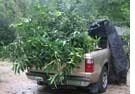
This weekend I had a chance to deliver a truck full of useful plants to Philadelphia and visit two Philly Orchard Project orchards.
The Philly Orchard Project (POP) began in 2007 when Paul Glover, a community organizer who also founded Ithaca Hours, hosted a potluck about the “Philly Orchard Project.” Philadelphia has nearly 25% of its population living below the poverty level, with 50,000 chronically hungry children and 40,000 vacant lots. The idea behind the project was to address both of these problems by growing food on the vacant lots to feed the hungry people.
|
|
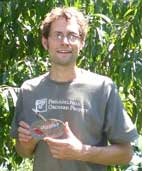
POP Orchard Manager Phil Forsyth
|
POP works with community-based groups and volunteers to plan and plant orchards filled with useful and edible plants. POP provides the plants and training. Community organizations own, maintain, and harvest the orchards, expanding community-based food production. Orchards are planted in formerly vacant lots, community gardens, schoolyards, and other spaces, almost exclusively in low-wealth neighborhoods where people lack access to fresh fruit.
Orchard Director Phil Forsyth, POP’s only staff member, attended the initial potluck and has been working with the organization ever since. Says Forsyth, “This is what I’ve always wanted to do – use my design skills to benefit people normally excluded from the organic and local food movements.” He showed me two of the POP orchards.
 |
|
SHARE orchard and garden
|
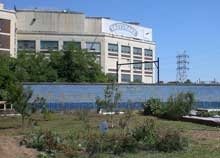
In the SHARE orchard, POP partnered with SHARE, an organization that gives people a break on their grocery bills by exchanging volunteer time for the opportunity to buy affordable food. By volunteering in the garden, some participants also learn how to grow their own food. The orchard includes mulberry, fig, and pear trees from UPN, and shares an area with a vegetable garden. POP and SHARE plan to expand the orchard this fall with berries along the building and more fruit trees in another area.
The Strawberry Mansion Children’s Orchard at Woodford, East Fairmount Park started in 2008 with a forest garden including 10 trees, with shrubs and other understory plants. The East Park Revitalization Alliance, Fairmount Park, and the Naomi Wood Trust collaborated with POP to bring an orchard back to the Strawberry Mansion section of the park, which was once dotted with agricultural estates. EPRA's youth programs maintain and use the orchard for learning and eating. Last year, POP planted another 30 fruit and nut trees adjacent to the children’s orchard. This is the place to go if you want to visit a POP orchard, as the Woodford museum has open hours from 10-4 Tuesday through Sunday.
POP has a busy autumn ahead, with three to four new orchards and half a dozen expansions. For more information, or to volunteer or donate to the project, see the POP website at: http://www.phillyorchards.org |
|
|
|
Thornless Blackberries, continued. |
Nutrition: The new shoots are edible. Blackberry leaf and root tea is astringent and is used for diarrhea, coughs, colds, TB, rheumatism, and as an eye wash. Blackberry fruit are highly nutritious and rank very high on food nutrition lists. The ripe fruit is very high in available antioxidants and high in Vitamin C, b-complex, and folic acid. One serving of blackberries (one cup or 140 gm) provides 50 percent of the vitamin C, 10 percent of the folate, and 22 percent of the fiber required daily. Blackberries are also a good source of potassium, calcium, and iron. In addition, the compound ellagic acid, identified as an anticarcinogen, is found in blackberries. Blackberries are the highest fruit in LDL(low density lipoprotein) cholesterol inhibition effect, thus helping to prevent stroke, heart disease and arteriosclerosis.
Types: There are basically two types of thornless blackberries, erect or upright varieties such as ‘Apache’ and ‘Oachita’ and the trailing or vining varieties, such as ‘Triple Crown’. The vining types are best grown on a two wire trellis or a tall fence, whereas the erect types can stand alone or be grown on a one wire trellis to keep them from leaning out when laden with fruit.
Planting: Blackberries prefer full sun and well drained soil. The most suitable soils are sandy loam or loam soils high in organic matter(2 to 4%) having a pH of 6.0 to 6.5. They won’t do well in wet soil conditions. If you have a heavy clay soil, it would be best if you added significant amounts of organic matter to the clay and raised or mounded the plants or beds above existing soil levels. We use a blended organic fertilizer for regular fertilization at 6 week intervals from early spring through mid summer Be sure to add 1+ cup of rock or colloidal phosphate into the hole at planting time. Adequate water can be the greatest limiting factor in blackberry production, particularly during fruit growth and development. We use drip irrigation with two one gal./hr drip emitters spaced 1 foot away from each side of the plant that are on for ½ hour twice a week and that seems to be quite adequate. Be sure to mulch your blackberry plants and control the weeds around them.
Pruning: Blackberries flower and fruit on their floracanescanes also called second year canes. The primacanes, or first year canes, will produce fruit the next year as floracanes. For good annual production you will need to have both primacanes and floracanes on your plants. When your plants finish fruiting for the season, prune out that years floracanes to the ground to make room for the current primacanes, and collect and burn the pruned off floracanes to prevent disease in your blackberry patch. Tip nip the primacanes to encourage lateral branching throughout the growing season and in late winter cut the laterals back to 12” to keep the plants more compact. If you’re trellising your plants, use posts 20’ apart. For trailing varieties, use two wires at 3’ and 5’ high. For upright varieties, use only one wire at 4’high. Space trailing plants 10’ apart and upright plants 3’ apart. Though it tends toward chemical approaches for commercial growers, the NC Cooperative Extension Service’s online publication #AG-401 will prove helpful for both home gardeners and potential commercial growers. Be sure to check out Useful Plants Nursery’s videos on tip nipping and pruning and trellising Triple Crown blackberries. |
|
|
|
|
|