Look for Bolchazy-Carducci Publishers' Exhibit at Conferences in 2010–2011 |
CAAS - Classical Association of the Atlantic States
October 7–9, 2010
Hilton Newark Airport
Elizabethtown, NJ
Representative:
Donald Sprague
BCP Author Judith Hallett will preside over and present at a workshop on Professional Citizenship in Classics on Friday the 8th.
Congratulations to BCP Author David Murphy who will be honored with an Ovatio at Saturday's luncheon.
BCP author Hans-Friedrich Mueller and his Union College colleagues will present a panel entitled "Engineering, Entrepreneurship, Environment, and Ethics in the Classics Curriculum" on Saturday, October 9.
OCC - Ohio Classical Conference
October 15–16, 2010
Campus of Ohio State University, Blackwell Inn
Columbus, OH
Representative: Peter Sipes
ICC - Illinois Classical Conference
October 15–17, 2010
Knox College
Galesburg, IL
Representative: Allan Bolchazy
On Fri., Oct. 15, BCP Author James Chochola presents "The Value of Classics in Today's World."
On Sat., Oct. 16, BCP Author Thomas Sienkewicz presents "Using Clickers in the Elementary Latin Classroom"
CAES - Classical Association of the Empire State
October 21–23, 2010
Union College
Schenectady, NY
Representatives: Drs. Lou and Marie Bolchazy
Fri., Oct. 22 - BCP Publisher Dr. Lou Bolchazy presents
"Why Gilgamesh?"
CAMWS - Southern Section - Classical Association of Middle West and South - Southern Section
October 28–30, 2010
University of Richmond
Richmond, VA
Representatives:Donald Sprague andJudy Armstrong
BCP Author Elizabeth Heimbach, BCP Author Thomas Sienkewicz, and BCP Editor Donald Sprague will present papers at Session 12A on Saturday the 30th respectively entitled "Ubinam gentium sumus: Maps in the Latin Classroom, "Using Clickers in the Elementary Latin Classroom," and "Picture Perfect."
TCA - Texas Classical Association
November 5–6, 2010
AT&T Executive Education and Conference Center
Austin, TX
Representative: Rose Williams
BCP Author Rose Williams will be presenting a paper entitled “Roman Influence in the Hispanic New World” from 3:45–4:15 on the 6th.
TFLTA - Tennessee Foreign Language Teaching Association
November 5–6, 2010
Franklin Cool Springs Marriott
Franklin, TN
Representative: Donald Sprague
BCP Authors Milena Minkova and Terence Tunberg will be presenting a workshop entitled "Latine legere, Latine scribere, Latine loqui" on November 5 and a presentation entitled "Teaching Latin in its Whole Continuity" on November 6.
CANE - Classical Association of New England
March 18–19, 2011
Mount Holyoke College
South Hadley, MA
Representative: Donald Sprague
Home School Conferences and other Meetings in 2011 will be announced in a future issue.
|
|
FREE Webinars for Latin for the New Millennium |
Tuesday, October 12, 2010, 6:30-8:00 ET – The aural/oral components of the Latin for the New Millennium series by Terence Tunberg, PhD.
Latin for the New Millennium coauthor Terence Tunberg, celebrated neoLatinist and Conventicula Latina director, discusses the aural/oral components of the series. Dr. Tunberg will address such issues as how best to incorporate oral Latin in your LNM classroom. He will also demonstrate a few of the oral activities delineated in the LNM Teacher's Manual.
Tuesday, October 19, 2010 – An Overview Look at Latin for the New Millennium and its components by Donald E. Sprague, editor.
For more information about and to register for LNM Free webinars click here
|
|
Check out this
"What is a Webinar?"
Video
|
|
Free Bolchazy-Carducci Roman Calendar |
Bolchazy-Carducci’s annual school year calendar is in print and has been mailed. If you have not received one and would like one, please email info@bolchazy.com.
In addition to the calendar pages done in the Roman way and to information about Bolchazy-Carducci books, the calendar also lists a number of Latin proverbs, mottoes, and phrases on every other page. Many teachers use these sayings in class for a variety of purposes—to encourage students to consider the thoughts of the ancients, to practice pronunciation and reading aloud, to have an opening class routine for every day of the school year, to point out a new (or for review) grammatical or syntactical topic, to review vocabulary items, etc.
Teachers often wonder where to access a variety of these sayings. The Bolchazy-Carducci Calendar is one source. Heimbach’s Latin Everywhere, Everyday is another print source that can be obtained from BCP. Latin Proverbs: Wisdom from Ancient to Modern Times is both in print and available as an app for the iPhone and Words of Wisdom is on CD.
|
|
Latin for the New Millennium, Level 3 |
Helena Dettmer (University of Iowa) and I have started writing a Level 3 textbook for the Latin for the New Millennium series. In this space in each issue of eLitterae, I will keep all of you up-to-date on the progress of this book.
This textbook will be divided into several sections, each of them focusing on a particular author. We were asked first to write one section that could be sent to several Latin 3 teachers for their input and that could be piloted by one other Latin 3 teacher. Since the time to write this one section was very short so that the pilot teacher could begin to teach from this section at the start of the school year, Helena and I decided to write the Catullus section first. Catullus is Helena’s specialty and my favorite author, and thus we were able to write this section with ease. Our coauthoring the Bolchazy-Carducci A Catullus Workbook also contributed to our ability to produce the Catullus section quickly.
Nevertheless, there were some challenges in writing the Catullus section. As this textbook is intended for Level 3 students, most of whom have not encountered very much unadapted Latin literature other than the Nepos readings of LNM 2, we had to make sure that the footnotes were ample, clear to read, and addressed the students’ needs. We also knew that students at this level are often still confused about certain grammatical concepts. Thus, we added grammar sections where necessary and exercises so that the students could practice with the grammatical and syntactical concepts.
One of the benefits of working on the writing of the Catullus section was learning new things about Catullus’ poems. Helena had previously written an article about the intersection between meaning and wordplay in Catullus’ poetry. I suggested that we include some of this fascinating analysis in the Catullus section.
We are now beginning work on the Cicero section of this book while the Catullus section is being piloted and reviewed. We are looking forward to receiving feedback. I will keep you posted on how this project is progressing.
LeaAnn Osburn
|
|
Preview Bolchazy-Carducci Titles |
Preview Bolchazy-Carducci titles before you buy using Google Preview. How does Google Preview work?
Video
|
|
iPodius - Bolchazy-Carducci Publishers online shop for: audio, software, video, and teacher created materials.
|
|
Become a FAN of Bolchazy-Carducci Publishers, visit our Facebook Fan page for the latest news from BCP.
BCP Facebook Fan Page |
|
|
|
Dear Friends and Colleagues,
I am pleased to return to a more active role in writing and editing articles for eLitterae. In the past few years Andrew Reinhard did a marvelous job featuring electronic and online sources for classicists in eLitterae. While I will continue to include these types of sources as much as I can, I also plan to return to the roots where eLitterae began—namely to include pedagogical articles.
In this issue, I have written two new articles that will recur in future issues. One is a teaching tip for Latin for the New Millennium. If you use LNM in your classroom and have a teaching tip you are willing to share, please send it to me at Leaannbhs@aol.com. The other is a blog-like article that will keep you up to date on the progress of Latin for the New Millennium, Level 3.
As in other issues of eLitterae, Bolchazy-Carducci’s newest book in print, the Cicero: A Legamus Transitional Reader is highlighted. Check out my interview with its authors, Mark Haynes and Judith Sebesta. This issue offers so much news, including a list of 2010 conferences where you can find a Bolchazy-Carducci exhibit, Allan Bolchazy’s piece on NJCL, the announcement about the BCP school year calendar, Don Sprague’s upcoming Latin for the New Millennium tour, a description of upcoming free webinars, and the discount items for this month that a new clickable Table of Contents has been included in order to relieve the need for long scrolling.
Enjoy!
LeaAnn A. Osburn |
|
Special Discount for eLitterae Subscribers |
Special Offer
Bolchazy-Carducci Publishers is offering a 20% discount to eLitterae subscribers when you buy a single copy of the Cicero: A Legamus Transitional Reader that has just come out in print. Look below for an interview with the authors of this book.
Cicero: A Legamus Transitional Reader
Judith Sebesta and Mark Haynes
xxii + 226 pp. (2010) Paperback ISBN 978-0-86516-656-1 $36.00 $29.00
One copy, prepaid, no returns, not available to distributors. Offer expires 10/31/10
Throwback Offer
With a backlist of over 400 Classics titles, Bolchazy-Carducci has a number of old chestnuts that deserve your attention. We offer a monthly special on one of these favorites. Order by October 15th to save a whopping 75% on a single copy of Bolchazy-Carducci’s Cicero: De Senectute by Charles E. Bennett.
Cicero: De Senectute Charles E. Bennett vii + 159 pp. (1922, Reprint 2002) Paperback ISBN 978-0-86516-001-9 $29.00 $7.25
One copy, prepaid, no returns, not available to distributors. Offer expires 10/15/10 |
|
Cicero A Legamus Transitional Reader
An Interview with the Authors |
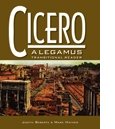 I am pleased to introduce you, the readers of eLitterae, to the Cicero A Legamus Transitional Reader. Now in print, it is the last of the originally planned readers in the series. The Cicero A Legamus Reader is also the only Latin prose author to be included thus far in the Legamus Readers. As a result, the Cicero A Legamus Reader differs from the others in a few significant ways but remains true to the goal of the series—to help students make the transition to reading unadapted Latin in the most painless way. I am pleased to introduce you, the readers of eLitterae, to the Cicero A Legamus Transitional Reader. Now in print, it is the last of the originally planned readers in the series. The Cicero A Legamus Reader is also the only Latin prose author to be included thus far in the Legamus Readers. As a result, the Cicero A Legamus Reader differs from the others in a few significant ways but remains true to the goal of the series—to help students make the transition to reading unadapted Latin in the most painless way.
I conducted an interview with the coauthors of the Cicero A Legamus Transitional Reader, Mark Haynes and Judith Sebesta, via email last week. Their responses to my questions reveal what was in the authors’ minds as they were writing and how this reader is distinctive.
1. LAO: How long did it take to write the Cicero A Legamus Transitional Reader?
JS: Mark and I conferred in the spring of 2006 and discussed the project with Ken Kitchell and Tom Sienkewicz at the 2006 ACL Institute.
2. LAO: Did you meet with your coauthor in person in order to plan or write the Cicero A Legamus Transitional Reader or did you correspond via email? What process did you and your coauthor use to write this book?
MH: Throughout the planning and the initial writing of the text, we used both e-mail and face-to-face meetings. During the final year of editing and re-writing we used Skype almost exclusively. Skype allowed us to share screens and discuss the text over the Internet. We could work together in person without having to travel. Since Judith lives in Vermillion, South Dakota and I live in Omaha, Nebraska, we spent a lot of time traveling during the first few years. If only we had known about Skype and its screen-sharing ability earlier, we could have saved ourselves a lot of money in gas.
After deciding on a general outline for the book and the Latin passages that we planned to use for each section, the writing of each chapter was pretty straight forward. We divided up the sections that we planned for each chapter such as the sections on historical background, the grammar review, the exercises, etc. Then, in between the times that we met, we would each work on the individual sections that we had assigned each other. If we ran into problems, we could usually handle them by e-mail. When we came back together again for our next meeting, we would go through the sections word by word as we revised and edited together.
3. LAO: How do you think having a coauthor improved the Cicero A Legamus Transitional Reader?
JS: Having a coauthor enabled us to “bounce” ideas off of one another, improve the style of writing, clarify the grammatical explanations, and devise better (we hope) open-ended discussion questions. From my point of view, having an experienced, master secondary teacher like Mark was invaluable, for the Legamus readers are aimed at secondary students (Editor's Note: We are pleased that this approach works well on the college level and that colleges have also used these texts.) Secondary teachers know what engages students, what contemporary cultural references we could make. For example, in discussing figures of speech, we make reference to current hit songs and ads with which students are familiar. That is an area with which I am not familiar.
MH: I think it helped enormously because we came together from a different experience and point of view. I almost always felt re-energized after our meetings as a result of that process of reworking and refining ideas together. For example, we rewrote various approaches to the Latin passages in Helping You Read What Cicero Wrote toward the beginning of the text more times than I can remember. If I had been doing that by myself, it would have been very disheartening, but being able to go back to the text and rearrange it once again with Judith kept it interesting and produced a much better result.
4. LAO: Does the Cicero A Legamus Transitional Reader follow the same methodology as the other readers in the Legamus series or are there some ways in which it differs from the other readers?
MH: The further we got into writing the text, the more we realized that we had to adjust our approach. The Legamus Readers already published when we began writing had focused solely on poetry. The problems that students first have when confronting Cicero’s periodic style differ considerably from the problems they face in dealing with a text of Virgil or Catullus. A poetic text tends to come in smaller blocks of meaning, and the problems often arise from vocabulary, metaphorical language, elliptical expression, and the separation of nouns from their modifiers. The Legamus approach of using special fonts to show agreements, inserting understood words into the text, and keeping the explanatory notes and vocabulary close for easy reference works very well for poetry. In prose, while some of these same difficulties can perplex a student meeting the text for the first time, students are just as likely to struggle with the length of the sentences and find themselves lost in the tangle of subordinate clauses. As a result they often confuse the relationship between those clauses. In order to help students with this problem, we found that we had to add to the Legamus method of dealing with the text by breaking up the sentences a bit more for the students by developing a method that we chose to call “the pass through” approach.
5. LAO: What is the pass through method and how does it help students to understand the Pro Archia?
JS: The pass through method aims to help students get a sense of how Cicero builds his periodic sentences. While a periodic sentence does not have to be long and complex with many dependent clauses and/or extended phrases, certainly many of Cicero’s sentences are long and complex. When seen on a page, these long sentences are visually discouraging. We readers of today forget that his style was new to his contemporaries and that many of them, initially, found his style difficult to follow. Moreover, Cicero spoke these sentences, clarifying his structure with changes in tone, in rhythm, and with pauses and gestures. This aural and visual aid is not available to students reading his textbook (though, of course, a useful class exercise would be to implement such changes, pauses, and gestures in oral recitation.)
The pass through method presents students with the kernel of a clause, i.e., the fundamental structure of the clause. Once students grasp that fundamental structure, the next pass through presents that structure with longer phrases, and dependent clauses, in order to show gradually how Cicero elaborates on that fundamental structure until his sentence is completely presented in all its complexity. By adding sequential “building blocks” we try to show students how Cicero constructs his complex sentence. In chapter five we switch from the pass through method to giving the sentence, if short, in its entirety; longer sentences we present in shorter sense units. We also use some translation prompts to help students. Our hope is that with students having seen how clauses are built up in complexity through the pass through method, and with students having been presented with individual clauses (rather than the entire lengthy sentence all at once), they will begin to read with increased confidence in their translating skills. In chapters eleven and twelve we present Cicero’s prose as he wrote it, and we hope our method has by then helped students deal even more confidently with his style and sentence structure.
6. LAO: What criteria did you use in writing the vocabulary notes for each Latin selection?
MH: We tried to keep the notes as simple and straightforward as possible while providing students with just enough information to understand what they were reading.
7. LAO: What criteria did you use in writing the grammar notes for each Latin selection?
JS: We tried to use common terminology of the different constructions and to cover constructions that students might not have covered in class and constructions that our students have found difficult to keep in mind. We focused particularly on the uses of the subjunctive, because it is often difficult for students to keep all of these uses in mind.
8. LAO: Why are there grammar explanations and exercises in each chapter? What purpose do they serve?
MH: As teachers we know that the review and reinforcement of grammar forms and syntax is essential in developing good readers. I have often thought that the art of teaching is the ability to say the same thing a thousand different ways. We have incorporated these grammar reviews and exercises, just as all the other Legamus Readers have before us, as a way of reinforcing and practicing the grammar that they, in theory at least, already know.
9. LAO: Your reader contains a good amount of information about Cicero's writing style. Why should students learn about his style?
JS: His contemporaries recognized Cicero as the leading speaker because of his style, through which he could present complex ideas straightforwardly and arouse feelings in his audience. Without some idea of his style, his sentences seem to have many “locked doors” on them; the more one understands his style the more doors are opened. Secondly, writing with style makes one’s writing more attractive and clear to the reader. Students can certainly implement some of Cicero’s style in their own writing. Lincoln, Kennedy, Obama, Churchill, and many other influential speakers and writers have found that studying the style of other speakers and writers improves their own.
10. LAO: There is quite a bit of historical background to the Pro Archia and its arguments. How did you address this in your reader?
MH: There were times, for example when Cicero listed a number of famous Romans with whom Archias had been associated, that we simply had to add a separate section in the text explaining who these characters were and why Cicero would want to mention them. We decided to call these sections “Keep This History in Mind,” a title that had not been used in previous Legamus Transitional Readers. This is also a good example of how having a coauthor made the text much better because Judith knows her history amazingly well and supplied a number of interesting anecdotes that both supplement and complement the text.
11. LAO: Is there anything else you would like to say about the Cicero A Legamus Transitional Reader?
MH: We are well aware of the argument that says we need to read Latin as Latin and to encourage students to read the passage until it makes sense as Latin without consciously translating into English until after understanding takes place. This is, of course, the goal that every Latin teacher has for her or his students, but it doesn’t happen apart from a background of understanding the relationships between words and their grammatical structures. In the Cicero A Legamus Transitional Reader, we have made a conscious attempt to move students along the path towards understanding the relationships between the clauses in a periodic sentence. We begin by using the “pass throughs” to show those relationships a little at a time, then we allow them to visualize them together, and finally we present the clauses as they appear in Cicero’s text. We hope that this reader will serve as a transitional step towards Latin literacy for students.
JS: Mark and I have commented to each other several times how much we learned in writing this text, whether about Latin, contemporary culture, some aspects of American history, etc. Most of all, I think, we gained a deeper appreciation of Cicero as a speaker. How I wish we had a recording of Cicero speaking!
About the Authors
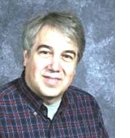 Mark Haynes has taught Latin and chaired the Foreign Language Department at Creighton Prep in Omaha for over twenty years. CAMWS honored him in 2003 with the Eunice Kraft Award for Excellence in Secondary School Teaching. Mark Haynes has taught Latin and chaired the Foreign Language Department at Creighton Prep in Omaha for over twenty years. CAMWS honored him in 2003 with the Eunice Kraft Award for Excellence in Secondary School Teaching.
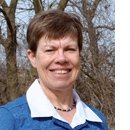 Judith Lynn Sebesta has served as Professor of Classics and History Department Chair at the University of South Dakota. Her outstanding teaching earned her the 2003 Belbas-Larson Award, Professor of the Year 2003, and the 2004 Cutler Award in Liberal Arts. She was a 2008 recipient of the American Classical League Emeritus/Emerita Award. Judith Lynn Sebesta has served as Professor of Classics and History Department Chair at the University of South Dakota. Her outstanding teaching earned her the 2003 Belbas-Larson Award, Professor of the Year 2003, and the 2004 Cutler Award in Liberal Arts. She was a 2008 recipient of the American Classical League Emeritus/Emerita Award.
|
|
Latin for the New Millennium Teaching Tip |
In order to review the nominative, accusative, and genitive cases and at the same time bring together the Latin stories from Chapters One, Two, and Three, this oral exercise may be used.
Ask the students the following questions in Latin, after instructing them to reply in Latin.
Question Possible Answers
| 1. Quis est frater Rōmulī? |
Remus or Remus est frater Rōmulī. |
| 2. Quis est Mars? |
Mars est deus or Mars est pater Rōmulī et Remī.
|
| 3. Quis est filius Rhēae Silviae? |
Rōmulus est fīlius Rhēae Silviae or Remus est fīlius. |
| 4. Quid aedificant Romulus et Remus? |
Rōmam aedificant. |
| 5. Quis est frater Menaechmī? |
Menaechmus-Sosicles or Menaechmus-Sosicles est frater Menaechmī. |
| 6. Quid videt Messeniō? |
Menaechmum or Messeniō videt Menaechmum. |
| 7. Quis est pater Aeschinī? |
Demea or Demea est pater Aeschinī. |
| 8. Quis est frater Aeschinī? |
Ctesipho or Ctesipho est frater Aeschinī. |
| 9. Ubi habitat Demea? |
in agrīs or Demea habitat in agrīs. |
NB: If the teacher thinks that the students may forget the family relationships in the three stories, instruct the students to draw simple family trees of the three families on a piece of paper. The students may have this aid in front of them as they participate in this oral review exercise. |
|
Latin for the New Millennium
Teachers Tour 2011! |
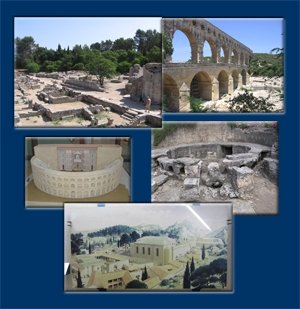
Mark your calendar for July 1–12, 2011 and set your sights on a fantastic teacher learning adventure. Join LNM editor Don Sprague for an exploration of Cisalpine and Transalpine Gaul—northern Italy and Provence—places rich in classical associations and Roman remains.
Deepen your own understanding of LNM and the full continuum of the Latin cultural and literary tradition. This learning adventure is specially designed to include sites relevant to LNM but not regularly covered by study tours.
In Italy, the tour will include the Etruscans’ Piacenza, Catullus’ Verona and Sirmio, Vergil’s Mantua, the early Christian and Ostrogoth sites of Ravenna, the medieval university of Bologna, Lorenzo Valla’s Pavia, Padua where Vesalius and Copernicus studied and Galileo taught, and Columbus’ Genoa.
Following the Roman route to Provence you'll see such stunning Roman remains as Augustus’ Trophee des Alpes, the baths and amphitheater of Nice, the Pont du Gard, the aqueducts and water-driven mill of Bebergal, the town of Glanum, Arles with its fabulous museum and amphitheater, the Maison Caree of Nimes, and Orange’s triumphal arch and spectacular theater. You’ll also visit Petrarch’s Avignon and Entremont, a pre-Roman Gallic settlement.
Your tour will evoke Hannibal, Caesar, Augustus, Catullus, Vergil, Livy, Boethius, Petrarch, Valla, Copernicus and so many more. Prior to departure, each participant will receive a detailed itinerary correlated to LNM Levels 1, 2, and 3. Site visits will include teaching tips and making connections to the LNM curriculum. You’ll return home eager to enrich your lesson plans and enthused to start school.
The group will travel on its own air-conditioned motor coach and will stay at first class, air-conditioned hotels. The tour will feed the mind, the experience will feed the soul, and the cuisine and wines of Provence and Northern Italy will delight the palette.
A veteran tour leader, for over thirty years, Sprague has led high school students and adult learners to classical sites throughout Europe. Tour crafter Sprague has customized this learning adventure to complement and enhance the Latin for the New Millennium curriculum.
Put yourself on the mailing list for the detailed itinerary and other tour specifics, email dsprague@bolchazy.com. Participation will be on a first come, first served basis. To maximize the experience and value, the tour is envisioned as a group of twenty. We will be pleased to communicate on your behalf with any professional development funders. |
|
Bolchazy-Carducci Publishers at 2010 National Junior Classical League (NJCL) Convention |
Where else can one go and find students and their teachers roaming around in togas and gladiator costumes? How about the National Junior Classical League, an organization of middle school and high school students sponsored by the American Classical League that encourages an interest in and an appreciation of the language, literature, and culture of ancient Greece and Rome.
Bolchazy-Carducci Publishers (BCP) sent Allan Bolchazy, Vice President and Betty Brendel, Inventory Logistics Manager to exhibit books at the 2010 National Junior Classical League Convention held at North Dakota State University in Fargo, ND from July 27 to August 1, 2010.
People were clamoring for our new A Roman Map Workbook by Elizabeth Heimbach. This workbook introduces students to the geography of Rome and the Roman world, and helps the student make connections to Roman history and literature.
Teachers were able to get their hands on our very popular introductory Latin series, Latin for the New Millennium, written by world-renowned Latinists Terence Tunberg and Milena Minkova. The series provides a fusion approach to Latin combining the best practices of the reading method, the traditional grammar approach, and a cumulative vocabulary foundation that will ensure a smooth transition to upper-level literature courses.
BCP gave away bookmarks showing our forthcoming Caesar Legamus, A Caesar Workbook and an AP* Caesar text, all of which will be published in time for the changes in the AP* Curriculum.
Students and teachers alike were delighted to see our Follow Your Fates Series —The Wrath of Achilles, The Exile of Aeneas, and The Journey of Odysseus. Written by Latin teacher Ed DeHoratius and illustrated by award-winning comic book artist Brian Delandro Hardison, each book allows you to follow your own fate, with one path bringing you success and satisfaction, with the other paths bringing you death, defeat, shame or eternal regret.
BCP followed their own fates and took the path to success and satisfaction by attending the 2010 NJCL convention.
We hope to see you next year at the NJCL Convention to be held July 25 to July 30, 2011 at Eastern Kentucky University in Richmond, KY.
Allan Bolchazy
*AP is a registered trademark of the College Entrance Examination Board, which was not involved in the production of, and does not endorse, this product.
|
|
|