In Asheville: Pick up plants at Greenlife ($8 delivery fee) or Asheville Local Foods (prices adjusted to include delivery).
Deliveries: We can deliver plants up to four hours away from our nursery for a distance-based delivery fee. Share the delivery fee with your friends or neighbors and get a discount by arranging a group order!
This fall, we would love to deliver plants to Raleigh, Durham, Greensboro, Charlotte, Greenville, Boone, Knoxville, and Atlanta. If you are in or near one of these areas and would like to get in on a group delivery, please let Debbie know. |
|
|
See our curriculum of classes on the website. Bring Chuck in for a private consultation on any of these topics or arrange for a small or large group class. More info? Click here. |
|
|
With a UPN gift certificate, the recipient can get just what they want when they are ready to plant.
Or, let your friends and family know that you'd like a UPN gift certificate for a special tree, bush, or other useful plant.
Gift certificates are available in any denomination of $5.00 or more. We will send a paper certificate in the US mail. If you prefer, we can send a PDF file that you or your recipient can print.
You can pay for gift certificates with a credit card through our secure website, or contact us at info@usefulplants.org or (828) 669-6517 for other options.
|
|
|
We're thrilled to offer the following videos:
Facebook
Useful Plants Nursery is on Facebook! Be a friend and/or fan, hook up with other Useful Plants people, and share your stories.
|
|
|
Useful Plants Nursery is a small, permaculture-based nursery specializing in useful, phytonutritional, food, and medicine plants well-adapted to our Southern Appalachian mountains and surrounding bioregions. Our plants are grown without the use of synthetic pesticides at our nursery located at Earthaven Ecovillage.
I believe that growing your own food and medicine plants is a vitally important strategy and practice for regaining control over our collective and personal lives, our health, and our individual and bioregional economic well being. Our nursery is dedicated to putting those beliefs into practice and truly creating "Liberation through Abundance" as we serve your needs for healthy, useful landscape plants, and work together to reweave the web of life.
-- Chuck Marsh, nurseryperson, permaculture designer, bioregional inhabitant
UPN is a North Carolina certified nursery.
To see a full list of our plants, click here. |
|
|
|
|
Fall Planting Time is Here! |
Fall is the best time to plant trees and shrubs. Although you can plant containerized plants any time of year, planting them in the fall lets them become established with the least amount of effort.
|
|
|
UPN is pleased to announce a partnership with Bill Whipple and his Barkslip Micro-Nursery. Bill has been part of our extended nursery family for years. UPN and the Barkslip Micronursery will jointly host the annual "Dig up" of Bill's fruit trees on November 20. Watch for additional details in our November newsletter.
UPN currently propagates about 20 percent of the plants we sell, with a goal of locally propagating 80 percent of the plants in five years. Our association with Bill's nursery increases our local edible plant security and reduces the carbon footprint of the nursery. "I just want to grow trees," says Bill.
In addition, to develop more local sources of edible plants, UPN is identifying other local suppliers and building a new propagation greenhouse, partially funded by a 2010 WNC AgOptions grant. |
|
|
Plant of the Month: Persimmons |
by Chuck Marsh
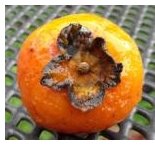
Now, as we start to wind down a really great fruit year, as the late apples, and autumn olives, and jujubes come in, I begin to think of persimmons, the final fresh fruit of the year. I see them coloring on the trees now in early October, like little tree pumpkins. A few may already be ripe, but most will await the kiss of frost to really reach their peak ripeness, and then many will continue to hang on the trees long after the last leaves of fall have fallen to the ground.
For persimmons to reach their peak flavor, we must wait. As anyone who has ever tried a less than fully ripe American persimmon knows, eating one at anything less than full melting ripeness is to experience what the word astringent means. The wait is certainly worth it though. American persimmons are our sweetest native fruit. They’re not just sweet, but have an intoxicating complex flavor all their own. Upon eating a really good one, I’ll be momentarily lost to the world, as I give myself over to a delectable ecstatic fruit moment.
There are basically three types of persimmons of interest to the home grower. American persimmons (Diospyros virginiana), Asian persimmons (Diospyros kaki), and hybrids of the two. They all have their place in the landscape.
American persimmons are excellent landscape ornamentals with attractive small creamy yellow flowers in late spring, shiny dark green leaves, deeply plated bark, beautiful red to orange to burgundy fall foliage color and those delectable orange globular fruit, hanging on into the grey of early winter. They grow tall, rather than wide, and while you can easily keep them at a small tree stature with regular pruning, left unpruned, they will slowly grow toward the heavens, dispensing their ripe fruit from above with a splat onto the ground. To cushion their fall have the area under the tree’s drip zone well mulched. Check daily for fallen fruit or the coons and possums will get them, as they are a favorite of wild critters.
Persimmons are dioecious, with separate male and female plants. Obviously only the females will bear fruit, but having some males around may be necessary to get fruit from a female tree. Buying seedlings, is a crapshoot. You’ll have to plant multiple plants to assure some will give you fruit, and then wait a long time for them to reach fruiting age. A better solution is to buy grafted trees of selected varieties. Some, like the one we carry, the variety ‘Meader’, will fruit without being pollinated. Grafted trees will also come into fruit production much earlier than seedlings.
The larger fruited Asian persimmons, though not quite as hardy as their American cousins, with some varieties growing well into zone 6, are every bit as wonderful fruits and are quite beautiful plants as well. There are basically two types of Asian persimmon fruit, astringent and non-astringent, each with its unique qualities. The astringent varieties must fully ripen like American persimmons, but are larger and every bit as flavorful as their cousins. The non-astringent varieties, while not as sweet, can be eaten while they are still firm with no astringency. ‘Fuyu’ and ‘Jiro’ are a familiar varieties of this type.
And then there are the Asian-American hybrids which bring the best qualities of both to the table. The hybrids, mostly developed in Russia and the Ukraine, have larger, very tasty astringent till ripe fruit than the American ones, though the fruit is not as large as Asian persimmons and the plants are smaller than American persimmons. The hybrids get extra hardiness from their American genes. While currently out of stock on the Asian and hybrid persimmons, we hope to have them back in inventory late in the spring of 2011. |
|
 |
|
Market and Event Schedule |
| Date | Event | Location |
|
Oct. 23, 8am - 1pm
|
Asheville City Market |
161 S. Charlotte St., Asheville
|
|
Oct. 30, 8am - 1pm
|
Asheville City Market |
161 S. Charlotte St., Asheville
|
|
Nov. 7
|
Plant Jam
|
Useful Plants Nursery, near Black Mountain
|
|
Nov. 13
|
Workshop with Bountiful Backyards |
Durham |
| Nov. 20 |
Dig Up Day and plant sale |
Barkslip Micro-Nursery, Asheville |
|
|
|
Ask the Chuckster: Preparing for winter |
by Chuck Marsh
 How do I prepare my useful plants for winter? How do I prepare my useful plants for winter?
Good question. All the signs are pointing toward a colder, temperature wise, winter than we’ve seen in a while. The farmer’s almanac is predicting colder temps with several Alberta clippers (super cold and windy) in store for us this winter. I don’t think we’ll see as much snow as last winter, as we seem to be in a dryer phase now. Expect cold and warm cycles, rather than the extended cold we had last winter.
That said, mulch all your woodies and perennials well with a fresh 2-3” deep layer of your favorite mulching material out to their drip zone, being sure to keep the mulch 6” away from the trunks of your fruit trees to prevent borers and rodent damage over the winter. If you have low mineral soils, as many of us do, send in a soil test now and apply any needed soil amendments before mulching. These amendments could include earthworm castings, agricultural lime, rock or colloidal phosphate, greensand, granite dust or quarry screenings, seahumic (granular seaweed and humates), and liquid seaweed soil drenches. My favorite seaweed product is Natures NOG, available from Fifth Season Garden Supply, Useful Plants, or the manufacturer, Senn, Senn, and Senn in Clemson, SC. Seaweed will help plants handle stress and improve winter hardiness when applied in the fall or early winter. Don’t use seaweed concentrates with fish emulsion this time of year or you risk producing new growth when we want plants going dormant for the winter.
To avoid winter rodent damage to your trees, you can make cylinders out of ¼" mesh hardware cloth 1-2’ high and surround the base trunks of your trees from just below ground level with these cages for the winter.
We’ll discuss winter protection for less stem hardy plants in our November newsletter. The nursery should have a video for you in early November showing you several methods for winter protecting figs and other sensitive plants.
What about pruning this time of year?
I’d only do limited corrective pruning this time of year. Save your winter pruning till the worst of the cold is over, say late February or early March. Refer to past UPN newsletters and videos for more pruning details. Never winter or spring prune dogwoods such as Kousa dogwood or Cornelian Cherries or they’ll bleed from the pruning cuts when the sap rises.
What about fertilizing when fall or winter planting?
Definitely don’t give your plants any nitrogen this time of year. They need to stop growing now and be preparing to hunker down for winter. Since this is such a great planting time that you really shouldn’t miss, you’ll need to amend our growing season planting instructions to avoid pushing them into growth during a warm spell this fall. In a nutshell this is what I’d recommend as a planting fertilizer blend this fall:
- Seaumic granular seaweed and humates
- Natures NOG liquid seaweed/humate soil drench at planting
Mix all the powdered or granular ingredients into the soil dug and mixed for the plant hole so that the backfill will have these nutrients evenly distributed. Also surface apply the rock powders to the area around the plant that extends beyond the planting hole. This is the future root zone.
There are always exceptions. Particularly in the case of plants that require well drained soil, blueberries and other acid loving plants, or really bad soil problems. See our planting videos and planting instructions for the details on planting blueberries. |
|
|
|
|
|