In Asheville: Pick up plants at Greenlife ($8 delivery fee) or Asheville Local Foods (prices adjusted to include delivery).
Deliveries: We can deliver plants up to four hours away from our nursery for a distance-based delivery fee. Share the delivery fee with your friends or neighbors and get a discount by arranging a group order!
This fall, we would love to deliver plants to Raleigh, Durham, Greensboro, Charlotte, Greenville, Boone, Knoxville, and Atlanta. If you are in or near one of these areas and would like to get in on a group delivery, please let Debbie know. |
|
|
See our curriculum of classes on the website. Bring Chuck in for a private consultation on any of these topics or arrange for a small or large group class. More info? Click here. |
|
|
With a UPN gift certificate, the recipient can get just what they want when they are ready to plant.
Or, let your friends and family know that you'd like a UPN gift certificate for a special tree, bush, or other useful plant.
Gift certificates are available in any denomination of $5.00 or more. We will send a paper certificate in the US mail. If you prefer, we can send a PDF file that you or your recipient can print.
You can pay for gift certificates with a credit card through our secure website, or contact us at info@usefulplants.org or (828) 669-6517 for other options.
|
|
|
We're thrilled to offer the following videos:
Facebook
Useful Plants Nursery is on Facebook! Be a friend and/or fan, hook up with other Useful Plants people, and share your stories.
|
|
|
Useful Plants Nursery is a small, permaculture-based nursery specializing in useful, phytonutritional, food, and medicine plants well-adapted to our Southern Appalachian mountains and surrounding bioregions. Our plants are grown without the use of synthetic pesticides at our nursery located at Earthaven Ecovillage.
I believe that growing your own food and medicine plants is a vitally important strategy and practice for regaining control over our collective and personal lives, our health, and our individual and bioregional economic well being. Our nursery is dedicated to putting those beliefs into practice and truly creating "Liberation through Abundance" as we serve your needs for healthy, useful landscape plants, and work together to reweave the web of life.
-- Chuck Marsh, nurseryperson, permaculture designer, bioregional inhabitant
UPN is a North Carolina certified nursery.
To see a full list of our plants, click here. |
|
|
Useful Plants Nursery
111 Another Way
Black Mountain, NC 28711
828.669.6517
www.usefulplants.org
info@usefulplants.org |
|
|
|
|
Fall Planting Time is Here! |
Fall is the best time to plant trees and shrubs. Although you can plant containerized plants any time of year, planting them in the fall lets them become established with the least amount of effort.
Next Piedmont Delivery: November 13. Contact us if you want plants.
|
|
|
Three Big November Events! |
Fall Plant Jam and Sale: November 6, 9-3
The Plant Jam features our largest selection and best prices of the year. The event, held at our nursery near Black Mountain, includes:
- Walk and talk through the nursery with Chuck Marsh as he presents his favorite plants
- Free design consultations with Living Systems Design associate Marie Reilly
- Tasty snacks and warm drinks
- 5% cash discount on all plants
- Discounts on most plants. See our website for details.
- Visit the nursery without an appointment and meet the UPN crew.
More Plant Jam details:
Durham Workshop and Edible Park Planting: November 13
Join our partner, Bountiful Backyards, and UPN founder Chuck Marsh in a workshop and planting of Durham's first edible park at Leigh Farm. Contact Bountiful Backyards at 919.619.9862 for details and to register for the workshop.
Contact UPN to order plants for pickup at the park. (You don't need to attend the workshop to pick up plants. If you can't pick up plants Saturday, we can leave them with Bountiful Backyards for later pickup.)
Dig up Day in Asheville: November 20
Join UPN at Barkslip Micro-Nursery in Asheville as we help dig up Bill Whipple's apple, pear, and cherry trees so you can take them home and plant them at your site. Since many of these trees are one-of-a-kind, preordering lets you reserve the trees you want.
Bill likes to talk with people who are purchasing trees to ensure that they are going to a suitable site. You can call Bill at 828.713.2424 or send him email at whipplebill@hotmail.com
You can send your check and order to Bill at:
Useful Plants Nursery
111 Another Way
Black Mountain, NC 28711
Or you can order and pay online through the Useful Plants website.
UPN will bring plants for sale at the Dig up Day. Contact UPN to order plants for pickup at this event. |
|
 |
|
Plant of the Month: Pears |
by Debbie Lienhart with Bill Whipple
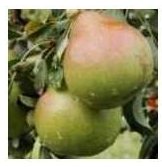
“A pair of au peres peered out from the pier while they pared a pair of pears.”
This month we celebrate pears with Professor T-Bud Barkslip, aka Bill Whipple. Bill says European pears embody the divine feminine – they ripen from the inside out, presenting a great mystery.
Bill has 5 acres of pears, apples, and all manner of other fruits and nuts making up his orchard in West Virginia. “Pears have much less disease problems than apples and are easier to grow without spray,” he says, “except fire blight!” Fire blight is a disease caused by bacteria (erwinia amylovora) that usually starts in the flowers and moves through the twigs and into the branches. The bacteria are spread by insects, animals, rain splash, and even gardeners during the early spring through early summer when the bacteria emerge from their dormant period.
Since the remedy for fire blight, once it has gotten out of hand, entails spraying antibiotics, the best strategy is to ensure that pear trees have moderate to slow growth, with plenty of sun light and air flow from proper pruning. This starts with planting the trees in a site with good air flow, plenty of sun, and not in a frost pocket. Leaving generous space between pear trees helps too. If your site is marginal (shady and damp), Bill recommends planting disease resistant varieties, such as Magness or Potomac. On a good site, you can try some of the more exotic varieties.
Pear trees need good early pruning. Bill prunes so his bottom branches start at about four feet high to provide good air flow underneath, and then prunes the overall tree in a vase shape, removing any redundant and crossing branches. Pruning in a vase shape provides good air flow and sun to the center of the tree, and keeps the tree shorter for easier picking.
Since European pears ripen from the inside out, they need to be picked before they are ripe. Bill looks for several signs to determine when to pick his pears. The main sign is a change in the background color of the fruit. In addition, the seeds will turn brown and the little spots on the pears will get bigger. Some people notice that the pear will give a little when pressed near the stem. Quite often with a new pear variety, it takes a couple of years to figure out optimum harvest time in your specific location. Windfalls usually don’t ripen well. Experiment and keep good notes.
Asian pears are similar to European pears, but ripen on the tree so they can be picked and eaten right away. Asian pear trees have held up well in the Asheville edible park and the Earthaven forest garden – two challenging sites. They are disease resistant, bear fruit profusely at an early age, but suffer from being early bloomers.
Most European and Asian pear trees require a pollinator – a different variety of pear tree that blooms at the same time, though there are a few self-pollinating varieties, including Keiffer European pears and Shinko Asian pears. Bradford pears can pollinate European pears that bloom at the same time, which is relatively early.
Bill has been growing many varieties of pears, along with apples and cherries, at his Barkslip Micro-Nursery in West Asheville. On November 20 the Barkslip Nursery and Useful Plants Nursery will have a “Dig up Day” event when the dormant trees will be dug up and sold. Most trees are sold before the event so put your order in early, but walk-ins are welcome. Bill likes to talk with each person before they buy a tree so he can be sure it will have a suitable site. |
|
|
|
Market and Event Schedule |
| Date | Event | Location |
|
Nov. 6
|
Plant Jam
|
Useful Plants Nursery, near Black Mountain
|
|
Nov. 13
|
Workshop with Bountiful Backyards |
Durham |
| Nov. 20 |
Dig Up Day and plant sale |
Barkslip Micro-Nursery, Asheville |
|
|
|
Ask the Chuckster: Winter Protection Strategies for Figs and Other Cold-sensitive Plants |
by Chuck Marsh, UPN founder and horticulturist
 As a permaculturist and plant lover, I love pushing the edges of the possible, and I love working with other adventurous gardeners who delight in also pushing their horticultural edges. I’m also practical enough to do my edge pushing in ways that will lead to successful outcomes. If the edge you’re pushing is to grow marginally hardy plants in your garden till global warming catches up and it becomes easy, then it’s wise to make informed decisions and develop strategies that have a high probability of success. As a permaculturist and plant lover, I love pushing the edges of the possible, and I love working with other adventurous gardeners who delight in also pushing their horticultural edges. I’m also practical enough to do my edge pushing in ways that will lead to successful outcomes. If the edge you’re pushing is to grow marginally hardy plants in your garden till global warming catches up and it becomes easy, then it’s wise to make informed decisions and develop strategies that have a high probability of success.
First, to make good horticultural choices, know your place and its winter microclimate. What’s easy in the Piedmont and requires no special strategies, is possible in the Asheville area at elevations below 2500’, yet may require special winterization strategies to succeed in the higher elevations of our mountains and points north.
I want to use figs to illustrate this approach to gardening. The same process and techniques would also apply to growing the hardier citruses, pomegranates, and tea camellias to mention a few. The first goal of winter protecting figs is to protect the plant so that you’ll get plenty of fruit next year. It is particularly important to protect young or recently planted plants from cold temperature winter stem damage. Figs are root hardy with mulch to around -15 degrees F. Fig stems and branches will die at 5 degrees F, and will suffer cold damage at temperatures below 10 or 12 degrees F. Practically, what this means is that, though your fig plant may survive and regrow from the roots with harsh winter temperatures, your likelihood of getting many or any ripe figs that year will be minimal if you live in the mountains or points north.
Since our goal is to cultivate an abundance of delightfully ripe figs for our gustatory delight, I recommend the following strategies for winter protection.
1. BRING ‘EM IN: Grow compact varieties such as ‘Negronne’ or ‘Vern’s Brown Turkey’ in containers and bring the whole plant into an unheated space that will stay above 22 degrees F, such as a garage, basement, crawl space, or greenhouse for the winter. Do this after the plant goes dormant and keep it occasionally watered. This is a lot of trouble, since you will need to keep container grown plants regularly watered and pruned outdoors during the growing season.
2. USE MICROCLIMATE: Choose a good microclimate for growing figs in the ground. Grown outdoors, choose a sunny location, protected from winter winds, with good soil drainage, and a heavy winter mulch. Most years around our area, this will do the trick, particularly as the plant matures. You should still be prepared to run out and do one of the following protection strategies if we get into bitterly cold temperatures.
3. TIMING: Cover or winter protect your plants, particularly during their first few years of life in your landscape. For our area, near Asheville, NC, I recommend protecting your fig plants from around Thanksgiving until early to mid March. This period will vary some depending on where you live and how the season is playing out.
4. THE LEAF BAG METHOD: For small young figs going through their first winter, the leaf bag method is the easiest and quickest. Collect from curbside, or fill your own 30 gallon size plastic leaf bags with dry leaves and twist tie closed the top of the filled bags. Then invert the bags, so the twist tied end is down to keep the leaves in the bag dry, and snug two or three of these bags up against the fig plant’s stems and branches. Then use some garden twine tied around the bags to cinch the bags tightly to the fig plant. The leaves in the bags will act to insulate the plants stems and roots and prevent any tissue death through the winter. For larger plants use more filled leaf bags. This method will work for plants up to 3-4’ tall.
5. TIE AND WRAP: This is a good method that will work well for small to large plants, though can be quite a project for really large plants. I always recommend annual light pruning to keep your plants compact and easy to harvest. First tie the branches of your fig plant up with strapping or heavy garden twine. This pulls the plant’s flexible stems in tightly and makes them easier to wrap. Tie the string or strapping at the bottom of the fig and spiral the strapping around the plant. Cinch and tighten as you go up. Then tie the strapping or twine off to a sturdy upper branch at the top. I prefer strapping as it is less likely to damage the plant’s bark. You have probably seen Christmas trees or nursery trees in transit tied up this way. The next step is to put down a heavy mulch of leaves around the fig’s root zone and up the main stem a foot or so. Now you’re ready to wrap your plant. The best material to wrap your plant with is a heavy nursery winter protection blanket fabric with good insulative properties. This HARD TO FIND material, as well as strapping, is available from Useful Plants Nursery. Call or check the website for pricing and info. Other wrapping materials that you can use are old acrylic or wool blankets, which will have good insulative properties, or old sheets, fabrics or burlap, which will primarily provide wind dessication protection, but may be enough protection for milder winter areas. Never use plastic or old plastic tarps to wrap your plants! To wrap your plants, use spring clips or clothespins to attach one edge of the fabric to the plant’s branches, then wrap the fabric around the plant several times and use several more spring clips to attach the final edge of the fabric to the bundle. Or you might need to wrap some more strapping around to secure the fabric. The more wrapped layers of the insulative material you use, the better insulated the plant will be.
6. WINTER PROTECTION FRAMES: These are basically temporary frames that you build around your fig plant to protect it from winter wind and cold. They can be filled with leaves in colder climates to provide additional insulation and then occasionally topped off with more leaves as the leaves settle, if necessary. There are basically three styles: wire cages, pyramidal frames, and box frames. To reduce the size of these frames for larger plants, you may want to tie your plants up and prune off some of the plant’s top growth to make it fit the frame.
7. WIRE CAGES: Make a cylindrical wire cage around the plant with either chickenwire or welded wire fencing. Secure it with stakes or rebar driven into the ground to keep it from toppling in snow or wind. Fill the cage with leaves, being sure to tuck any branches that reach the outside edge back into the leaves so they are not exposed to winter winds. Secure a piece of plastic over the top of the cage to keep the leaves dry so they don’t settle when wet and then you’re done.
8. PYRAMIDAL FRAMES: Make a four-sided pyramid over the plant with bamboo or wooden poles, rebar, fiberglass rods, or 2”x2” framing lumber. Secure this frame to the ground by burying the ends, or using landscape staples, or spikes to hold it down. Heavily mulch the plant’s root zone and on up the stem with leaves. Then attach an insulative fabric or winter protection blanket to the frame with spring clips or staples, wrap the fabric for a turn or two around the frame and finish off the fabric attachment with spring clips or staples. You might use landscape stapes to secure the bottom edges to the ground.
9. BOX FRAMES: This simple system, similar to pyramidal framing, involves driving four posts in a square pattern around your plant and covering it with a winter protection fabric on the sides and top. Make sure the posts are a little taller than the plant when finished. If you use wood posts, you can staple the fabric to the posts, if you use metal or rebar posts, you can use spring clips or wire ties to secure the fabric material.
Then get ready for an abundant fig harvest next year. Useful Plants Nursery will have some videos up soon illustrating how to construct these various winter protection systems. While some of these protection systems might be considered eyesores, they all present opportunities to combine beauty and function when you turn them into art projects. Let your imagination fly and envision future fruit! May figs fill your dreams.
Many blessings on you and your family this winter. |
|
|
|
|
|