A Holiday-Themed
Latin Text |
The Feast of St. Nicholas is December 6.
On the evening prior, children traditionally put their shoes out for the visit of Santa Claus. Good children awaken to find their shoes filled with treats while coal fills the shoes of those children deemed “naughty.”
Nīcolāus dē Myrā (c. 270 AD to c. 345 AD)
Adapted from Symeon Metaphrastes, Stories of Christianity
Nīcolāus dē Myrā erat Epīscopus Ecclēsiae Christiānae urbis Myrae in Āsiā Minōre. Persecūtiōnem Rōmānī Imperātōris Dioclētiānī Nīcolāus tulit. Quandō Cōnstantīnus factus est prīmus Christiānus Imperātor Rōmānōrum, Nīcolāus līberātus est* et iterum Christiānōs in Myrā cūrāvit. Mortuus est sextō diē Decembris.
Nīcolāus hominēs dīlēxit. Praecipuē līberōs amāvit. Fābulae dē eō multae sunt. Divītiās dē patre habuit, et dōna, praecipuē in nātālī Iēsū, līberīs dedit. Post mortem Nīcolāī, hominēs dōna dedērunt in nātālī Iesū et dīxērunt, “Sunt dōna Sānctī Nīcolāī.”
In multās terrās fābulae Sānctī Nīcolāī portātae sunt. Fōrmae nōminis eius sunt “Sinterklaus” et “Santa Claus.”
Nicholas of Myra was Bishop of the Christian Church of the city of Myra in Asia Minor. He endured the persecution of the Roman Emperor Diocletian. When Constantine was made the first Christian Emperor of the Romans, Nicholas was freed and again took care of the Christians in Myra. He died on the sixth of December. Nicholas loved people. He especially loved children. The stories about him are many. He had riches from his parents, and he gave gifts to children, especially on the birthday of Jesus. After the death of Nicholas, people gave gifts on the birthday of Jesus and said, “They are gifts of Saint Nicholas.”
The stories of Saint Nicholas were carried into many lands. Forms of his name are “Sinterklaus” and “Santa Claus.”
The Latin reading is excerpted from A Beginning Latin Christian Reader: De Bonis Cogitationibus; the translation from its teacher’s guide. |
|
Look for Bolchazy-Carducci Publishers' Exhibit at Conferences in 2010–2011 |
AIA-APA Joint Annual Meeting - Archaeological Institute of America and American Philological Association
January 6–9, 2011
San Antonio, TX
Representatives: Lou, Marie, and Allan Bolchazy
Round Table discussion on Latin for the New Millennium on January 8.
Athens v Sparta, January 8, 8:00 p.m. at
Casbeers, 1150 South Alamo Street, San Antonio, 78210
CANE - Classical Association of New England
March 18–19, 2011
Mount Holyoke College
South Hadley, MA
Representative: Donald Sprague
SCOLT-LFLTA – Southern Conference on Language Teaching-Louisiana Foreign Language Teachers Association
March 10–12, 2011
Baton Rouge, LA
Representative: Donald Sprague
Dickinson Latin Workshop Spring 2011
Saturday, March 26, 2011
Dickinson College
Carlisle, PA
Julius Caesar in his Time: The General as Historian
Hans-Friedrich Mueller, Union College
Author of BCP AP* Caesar Text and coauthor of Caesar: A Transitional LEGAMUS Reader
Dickinson College, Tome 115, 10:00 am to 5:00 pm.
This workshop considers Caesar both as a historical figure and as an author. It will include strategies for teaching Caesar in a sophisticated and interesting way, and updates on how scholars and historians have reevaluated his career and works in recent years. Special attention will be given to themes shared with the Aeneid.
For more information click here.
CAMWS – Classical Association of the Middle West and South
April 6–9, 2011
Grand Rapids, MI
Amway Grand Plaza at the invitation of Grand Valley State and Calvin College
Representatives: Lou, Marie, and Allan Bolchazy
Panel: “Latin in Small Packages: Expanding and Varying Advanced Latin Curricular Options” organized by BC Readers Series Editor Ronnie Ancona.
Series authors will explore the BC Latin Readers’ “small package” approach to Latin curricula, which has as one of its aims to expand and vary what can be taught at the advanced level.
SWCOLT – Southwestern Conference on Language Teaching
April 7–9, 2011
Fort Worth, Texas
Representatives: Donald Sprague and Rose Williams
Rose Williams will give a talk entitled “Latin and Roman Ideals in the Hispanic New World.”
Home School Conferences and other Meetings in 2011 will be announced in a future issue.
|
|
FREE Webinars for Latin for the New Millennium |
Tuesday, January 25 and Tuesday, February 8, 2011, 6:00-8:00 ET – An Overview Look at Latin for the New Millennium and Its Components by Donald E. Sprague, editor.
For more information about and to register for LNM Free webinars click here
|
|
Check out this
"What is a Webinar?"
Video
|
|
Latin for the New Millennium, Level 3 |
Writing a level 3 textbook necessitates that many pedagogical principles be considered in a very careful, thoughtful fashion. As Helena Dettmer and I continue to work on the Cicero section of LNM 3, some of the issues that we are reflecting upon and discussing follow.
Should any of the unadapted passages in LNM 3 be a passage that was given in adapted form in LNM 1 or LNM 2?
Pros—A passage given in modified form earlier in the series automatically gives the student context for reading the unadapted version. In addition, students will see how the ancients originally wrote something in comparison to how a revised version presented the same thing.
Cons—For many students Latin 3 and 4 are the last Latin courses they will take. Why should we repeat a story already given in the series when there is such an abundance of important and exciting texts in Latin? Is this wasting the precious amount of time a student has to devote to his/her study of Latin? Do we run the risk of students feeling "they've been there, done that"?
If two or more sets of notes on more than one passage are on the same page, should vocabulary words given in the first set of notes be given again in a second set of notes?
Pros—Students will not need to look around on a page and thereby risk being distracted if the vocabulary entry is given each time it is needed.
Cons—After being given a word’s definition, shouldn’t the student be able to recall that word while still on the same page? Is this spoon-feeding the student too much?
When selecting passages for inclusion in the text and being mindful of the size of the passage that students will be reading, should less important sections be excised to make room for more important sections?
Pros—More important sections are of greater value to a student’s education. Such sections often include major historical facts, noteworthy rhetorical style, and significant cultural matter.
Cons—Excising a part of the text may distort what the author is saying. Featuring only the best sections from an author may lead students to think that a given author always writes such precious gems.
If any eLitterae subscriber would like to weigh in with his/her opinion on the three topics described above, please do so by emailing me at Leaannbhs@aol.com.
LeaAnn Osburn
|
|
Bolchazy-Carducci Offers Summer Professional Development Opportunity |
Latin teachers of all levels are invited to join Bolchazy-Carducci's Latin Teachers Tour 2011. From July 1 to July 12, this tour will offer teachers the opportunity to experience firsthand significant Roman and post-antique sites in Cisalpine and Transalpine Gaul. While expanding our knowledge of things Roman, we'll be enjoying the fine cuisine of northern Italy and Provence. The tour qualifies for ACL and APA scholarship funding. Check out the day-by-day itinerary. |
|
National Exam Application/Registration Deadlines |
SCRIBO, an International Latin Composition Contest, registration deadline is December 15, 2010.
National Mythology Exam
January 15, 2011 - Postmark
www.etclassics.org/nme.html
2011 NJCL On-Line Exam
National Roman Civilization Exam
January 15, 2011
website: www.njcl.org
2011 National Latin Exam
January 18, 2011 - Postmark
National Latin Exam
University of Mary Washington
1301 College Avenue
Fredericksburg VA 22401
website: www.nle.org
2011 National Greek Exam
January 18, 2011 - Postmark
website: nge.aclclassics.org
2011 Exploratory Latin Exam
March 1, 2011 - Postmark
website: www.etclassics.org/ele.html |
|
Free Bolchazy-Carducci Roman Calendar |
Bolchazy-Carducci’s annual school year calendar is in print and has been mailed. If you have not received one and would like one, please email info@bolchazy.com.
|
|
Preview Bolchazy-Carducci Titles |
Preview Bolchazy-Carducci titles before you buy using Google Preview. How does Google Preview work?
Video
|
|
iPodius - Bolchazy-Carducci Publishers online shop for: audio, software, video, and teacher created materials.
|
|

Become a FAN of Bolchazy-Carducci Publishers, visit our Facebook Fan page for the latest news from BCP.
BCP Facebook Fan Page |
|
|
|
Dear Friends and Colleagues,
Another month has come and gone. So, indeed, tempus fugit.
In this issue you will read about the history of the LEGAMUS books and the newest arrivals in the series. Classical tidbits—a new feature in eLitterae—will delight you, I am sure. Among the recurring articles in eLitterae is an exercise to use with your students in the Classics Corner, a new tip in the LNM Teaching Tip section, a summary of ongoing discussions in the LNM 3 section, reports on the last three of the fall conferences attended by Bolchazy-Carducci representatives, and an updated calendar of exhibits Bolchazy-Carducci Publishers is attending. We offer two special discounts and two throwback deals of the month—both exclusively offered to eLitterae subscribers.
Enjoy! and we trust your Thanksgiving was a great start to the holiday season.
LeaAnn Osburn |
|
Special Discount for eLitterae Subscribers |
Special Offer
Bolchazy-Carducci Publishers is offering 20% off single copies of the Legamus Teacher's Guides.
Catullus: A LEGAMUS Transitional Reader Teacher's Guide
Sean Smith
viii + 68 pp. (2010) Paperback
ISBN 978-0-86516-671-4 $31.00 $25.00
Horace: A LEGAMUS Transitional Reader Teacher's Guide
David J. Murphy
viii + 76 pp. (2010) Paperback
ISBN 978-0-86516-732-2 $31.00 $25.00
Vergil: A LEGAMUS Transitional Reader Teacher's Guide
Karen Lee Singh and LeaAnn A. Osburn
x + 72 pp. (2010) Paperback
ISBN 978-0-86516-579-3 $31.00 $25.00
Ovid: A LEGAMUS Transitional Reader Teacher's Guide
Denise Davis-Henry and Caroline Perkins
viii + 52 pp. (2010) Paperback
ISBN 978-0-86516-734-6 $31.00 $25.00
Make sure to mention that you are an eLitterae subscriber if you place your order by phone or fax. If you place your order via www.BOLCHAZY.com the eLitterae sale price will be charged at checkout.
One copy, prepaid, no returns, not available to distributors. Offer expires 12/31/10
Throwback Offer
The LEGAMUS readers are among the newest of Latin readers in print. But order one copy of one or both of these all-time favorites by December 15, and receive 50% off a single copy of each or both. Plus shipping.
Civis Romanus: A Reader for the First Two Years of Latin
James M. Cobban and Ronald Colebourn
xii + 128 pp. (2003 reprint, 1920) Paperback
ISBN 978-0-86516-569-4 $28.00 $14.00
Rome and Her Kings: Livy I: Graded Selection
C. E. Freeman and W. D. Lowe
110 pp. (1988, Reprint 2000) Paperback
ISBN 978-0-86516-450-5 $24.00 $12.00
Make sure to mention that you are an eLitterae subscriber if you place your order by phone or fax. If you place your order via www.BOLCHAZY.com the eLitterae sale price will be charged at checkout.
One copy, prepaid, no returns, not available to distributors. Offer expires 12/15/10 |
|
The LEGAMUS Series, 2000–2010: Quid Novi Nunc? History of the LEGAMUS Series |
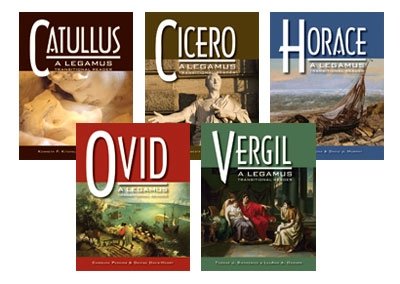
A decade ago as we were just entering the new millennium, Latin educators were concerned about how to make the transition from introductory Latin to reading classical authors better suited to student needs. Bolchazy-Carducci Publishers sponsored a committee, named the Legamus committee, to foster these discussions. A series of guidelines on the special needs of transitional readers evolved and Bolchazy-Carducci Publishers began a series of transitional author books that followed these guidelines. The Vergil LEGAMUS Transitional Reader was published in 2004, the Catullus Reader came out in 2006, The Ovid and Horace Readers in 2008, and the Cicero Reader in 2010. These were the original books projected for the series.
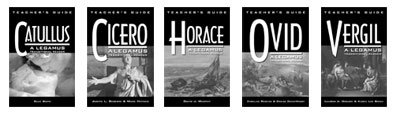
It was not too long after the first books in the Legamus series were out that requests began to arrive in the Bolchazy office for teacher’s guides to the readers. By 2010, the Vergil, Horace, Ovid, and Catullus teacher’s guides were available for purchase. The Cicero teacher’s guide is currently being typeset and is expected to be in print soon. In addition to the translation for each passage of text, all the directions, questions, and exercises from the student reader are reprinted in the teacher’s guide and are then followed by answers and suggested responses. Some of the suggested responses are not simple answers but are more like mini-essays that are full of the authors’ thoughts about some aspect of a passage. Here is an answer written by Dr. Karen Lee Singh in the Vergil LEGAMUS Transitional Reader Teacher’s Guide.
Question: In line 209 (spem vultū simulat, permit altum corde dolōrem) of Book One of Vergil’s Aeneid, why do you think Vergil uses chiasmus? In what ways might this figure of speech enhance the meaning?
Answer: This is a tripartite chiasmus and sets up a triple antithesis.
Spem is the first word in the line and dolōrem is the last, two opposites which also anticipate the internal opposites in the line. The first and last word placement is emphatic.
The word vultū is the outward body language which emphasizes his positive words, while corde is the inward unseen place where his negative feelings lie.
The middle of the chiasmus contrasts simulat, which again depicts Aeneas’ outward, uplifting attitude, with premit, which stresses the effort Aeneas has to make to keep his grief and care hidden from his men. The juxtaposition of these two verbs emphasizes the contrast.
Thus the first three words in the chiasmus are positive but a pretence, while the last three are negative but real. |
|
Greek Transitional Readers |
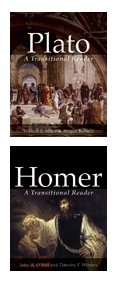 During the decade in which the LEGAMUS Transitional Readers were being developed, written, and published, various classicists voiced the opinion that many of the same difficulties that students face when making the transition to unadapted Latin also face Greek students. In response to these concerns, the original plan for the LEGAMUS Series inspired the transitional readers on Plato and Homer. During the decade in which the LEGAMUS Transitional Readers were being developed, written, and published, various classicists voiced the opinion that many of the same difficulties that students face when making the transition to unadapted Latin also face Greek students. In response to these concerns, the original plan for the LEGAMUS Series inspired the transitional readers on Plato and Homer.
Plato: A Transitional Reader was written by Wilfred E. Major and Abigail Roberts.
Six Greek passages—four from the Republic, the summary of the Republic in the Timaeus, and the beginning of the Euthyphro, which sets the scene for the Apology—are included. Multiple versions of each passage and basic outlines of each passage lead the student to reading the unadapted version and to an ability to read full Platonic dialogues as well as other authors' work in unadapted Greek. This reader also features an introduction to Plato, facing notes and vocabulary, grammar reviews, a guide to the dialogues of Plato, and a list of the 50 most common words and of the 500 most common words in Plato.
Homer: A Transitional Reader was written by John H. O’Neil and Timothy F. Winters
This reader aids students in making the transition from reading Attic Greek to Homeric Greek. Fifteen passages from the Iliad progress from shorter to longer sections of text and to unaltered text. Each section of text is preceded by an English reading that resolves metrical and dialectical challenges. Thought questions, facing notes and vocabulary, and grammar reviews and exercises are included. |
|
Caesar LEGAMUS Transitional Reader |
When the AP Program announced that the new Latin exam for June 2013 would include Caesar, Bolchazy-Carducci sought authors for a Caesar LEGAMUS book. Authors Hans Friedrich-Mueller, of Union College and a veteran of high school teaching as well, and veteran author Rose Williams, a seasoned high school and college teacher, are currently working on this book. Watch this newsletter for updates on this new book scheduled for printing in time for the new AP* syllabus. |
|
From Boy to Man
 In each issue, the Classics Corner presents an item of pedagogical interest to classicists. In this issue, an exercise that might suit the needs of your students at some time during the curriculum they follow is given. In each issue, the Classics Corner presents an item of pedagogical interest to classicists. In this issue, an exercise that might suit the needs of your students at some time during the curriculum they follow is given.
This sequencing exercise has been taken from Bolchazy-Carducci’s 2007 To Be A Roman by Margaret Brucia and Gregory Daugherty. Their book presents twenty chapters, seventeen of them each on a daily life topic followed by creative and objective type exercises. This particular exercise is from Chapter 18: Stages in the Lives of Boys and Men. Take a look at this book and its useful exercises.
Arrange the following events in the life of a hypothetical Roman aristocratic male in chronological order.
_____ He serves in the army.
_____ He is elected consul.
_____ He wears a toga virilis to the Forum for the first time.
_____ He receives the bulla.
_____ He is elected quaestor.
_____ His father picks him up from the floor.
_____ He wears a toga candida for the first time.
_____ He shaves his beard at the Juvenalia.
_____ He is no longer permitted to vote in public elections.
_____ He dedicates the first clippings of his beard to the household gods.
_____ He is elected praetor.
_____ He marries just in time to avoid paying a fine for being single.
_____ He walks to school with his paedagogus.
NB: The To Be A Roman Teacher's Guide is scheduled to arrive in the warehouse by mid-December 2010. |
|
We will share our fun tidbits with eLitterae subscribers whenever we can. The first one was submitted by executive editor Don Sprague as was the second one, which he found in the October-November 2010 issue of Boomer Magazine. We welcome tidbits that eLitterae readers would like to share. Send them to me at Leaannbhs@aol.com.
Football and Eta Sigma Phi
Legendary Penn State football coach Joe Paterno this season celebrated his 400th football victory when his Nittany Lions beat Northwestern. Latin teachers and their students might be interested to know that the venerable coach is a great fan of Vergil whom he encountered as a senior at the Jesuits' Brooklyn Prep. Wayne State professor Michelle Ronnick savors a special connection she has with "Joe Pa." While serving as a visiting professor at Penn State, Dr. Ronnick presided over the iconic coach's induction as an honorary member of Eta Sigma Phi, the classics honor society for college students.
Secretariat's Intended Name

Photo courtesy of Wikimedia Commons
Disney's movie Secretariat: The Impossible True Story celebrates this remarkable racehorse. Latinists will be pleased to learn that his owner, Penny Chenery Tweedy's original choice for this horse’s name was Deo Volente. Unfortunately, it, along with several subsequent choices, was rejected by the Jockey Club, to which all thoroughbred names must be submitted for approval. |
|
Latin for the New Millennium Teaching Tip |
Here is a teaching tip for LNM 2 but it may be applied to other places in both LNM 1 and LNM 2.
Chapter 5 of LNM 2 presents indirect commands and on p. 99 a study tip points out the similarities and differences between indirect statements, indirect questions, and indirect commands.
Ask the students to look at the pictures and complete the following sentences. Note that the Latin sentences are set up to require the student to use the three constructions. Remind students to consider the sequence of tenses as they write the completion to the sentences. Students may use the glossaries at the back of the book or the Reading Vocabulary on p. 91
Picture of a tree—p. 92
Video arborem . . .
Oro ut folia . . .
Rogo cur . . .
Forest scene—p. 95
Vir dixit . . .
Vir monuit ne . . .
Vir nescivit quid . . .
Grapes and jars—p. 99
Putamus uvas . . .
Imperavimus servis ut . . .
Rogamus quo modo . . . |
|
CAMWS—SS: Classical Association of the Middle West and South—Southern Section |
The beautiful city of Richmond, Virginia served as host for the October 28–30 biennial meeting of the Classical Association of the Middle West and South—Southern Section. A jam-packed schedule of paper sessions, special events, and excellent workshops fed the spirit while the local host committee (the University of Richmond and the Centennial Meeting of the Classical Association of Virginia) did a terrific job of feeding the corporeal by landing excellent accommodations and good rates at the Omni.
The Omni's location places guests at the head of several blocks of outstanding restaurants that were celebrating restaurant week and offering three course meals for the week's rate of $25.10. Needless to say, Judy Armstrong, Bolchazy-Carducci's Director of Business Development, and I took full advantage of the location and restaurant week!
Indeed, the scheduling of the conference allowed us to take advantage of some of Richmond's cultural and historical riches—the State Capitol building, classically-inspired Thomas Jefferson architecture; the Virginia Museum of Arts, a collection representative of the span of art history from the ancient world to the modern with many a work mythologically-inspired; and St. John's Church where John Patrick Henry delivered his revolution-inflaming "Give me Liberty or give me Death!" Inspired by Dr. Mary Pendergraft’s (Wake Forest University) Presidential Address topic, “The Glory that was Greece and the Grandeur that was Rome: Edgar Allan Poe and the Classics,” we squeezed in a visit to the Poe Museum as well. Both Judy and I have put Richmond on our future vacation lists. Next time, we’ll be sure to include Monticello and the University of Virginia, which are about an hour's drive away.
The conference was as enriching as its site. CAMWS-SS offered a program chockfull of presentations to appeal to every classicist's general and special interest. Saturday's attendance was swelled with Virginia teachers who came to celebrate the centennial of the Virginia Classical Association. The ebullient and gracious Davina McClain (author of our Graphic Greek Grammar Cards) proved herself a most efficient conference organizer. Kudos to C.J. Johnson, conference intern, who served so ably as Davina's right arm. I attended Georgia Irby-Massie's presentation, "Aeneas' Shield: The Politics of Cartography" and Julian Jones' "What Vergil Did for the Trojan Horse." Professor Irby-Massie wrote one of the scholarly essays for LNM 2. Friday morning I presided over a session of papers entitled "Revenge of the Myth"—the interesting papers ranged from Robert Sklenar in appropriate decadent couture talking about the decadent poet Czech Karel Hlavàcek's Ithaca to Alexander Loney's discussion of the postmodern Odyssey of Zachary Mason. On Saturday, I attended "AP* Latin Changes: A Panel," which session featured a talented group of high school teachers. I also attended Jane Crawford's timely presentation on "Caesar's Correspondence with Cicero" and Madeline Henry's "Caesar in the New World." I enjoyed meeting Professor Crawford with whom I worked in the editing of A Cicero Workbook and its teacher's manual and Madeline Henry, coauthor of Bolchazy-Carducci’s Horace Satire I.9—the Boor.
The last session of the conference included a triumvirate of Bolchazy-Carducci authors/editors: Tom Sienkewicz, coauthor of the Vergil LEGAMUS Transitional Reader, who demonstrated the use of clickers in the elementary Latin classroom; Elizabeth Heimbach, author of Latin Everywhere, Everyday and A Roman Map Workbook, who talked about using maps in the Latin classroom; and your humble reporter who demonstrated various ways of using visuals in the Latin curriculum.
This was the first experience of CAMWS-SS for both Judy and me. We not only enjoyed the opportunity to discuss and exhibit Bolchazy-Carducci's books but more importantly the opportunity to connect with people we knew only from email and the telephone as well as to meet teachers, professors, and grad students. Judy helped Herb Benario track down the luggage his airline had misplaced and he and I shared memories of the Vergilian tour of Roman Britain he and his wife Janice had directed. I enjoyed meeting Elizabeth Heimbach as we chatted about the teacher's guide for A Roman Map Workbook that we were both proofreading. Greg Daugherty stopped by to ask about the teacher's guide for To Be a Roman while Anne Groton and Judy chatted about the success of 38 Latin Stories. Judy Hallett, who is coauthoring the BC Reader: A Roman Women Reader with Sheila Dickinson, caught me up on events since our last chat at October's CAAS meeting.
We thoroughly enjoyed CAMWS-SS and Richmond and heartily recommend both to you. Congratulations to Virginia classicists on their centenary anniversary—ad multos annos! The classics thrive in Virginia where teachers gather regularly at regional meetings as well as at the statewide annual meeting.
*AP is a registered trademark of the College Entrance Examination Board, which was not involved in the production of, and does not endorse, this product. |
|
TCA: Texas Classical Association 2010 |
On November 6, about 80 Texas professors, teachers, and graduate students of classics met at the AT&T Conference Center in Austin, Texas.
Simon Burris of Baylor University, whose university will host TCA next year, is the new Vice President of TCA. He has a special interest in Greek poetry, so Bolchazy’s new Homer and Plato transitional readers interested him as well as a number of other attendees.
The program was a lively one, beginning with a rousing Horace reading by Dr. Bill Nethercutt of UT and ranging through such topics as “Comparing Turnus and Pompey,” “Self-Image of Roman Provincial Women,” and “The Self in Senecan Tragedy.” Rose Williams gave the second presentation, “The Roman Influence in the Hispanic New World.” Her talk was very well received with teachers and even professors, such as Dr. Nethercutt, saying that they were not aware of the strong Roman influence in the southern part of the Western Hemisphere and the fine Latin literature produced here. Mary Pendergraft, who was the keynote speaker, made a point of mentioning how many comments she heard about the presentation during the day. Dr. Pendergraft gave the keynote speech “The New Latin AP* Course: When? What? Why? Who?” When teachers began to ask her Caesar questions, Dr. Pendergraft called on Rose Williams to tell the convention about Bolchazy-Carducci’s new Caesar works in process. There was no other publisher to whom she could point who is doing anything like this, and teachers and professors were very impressed with Bolchazy’s new texts being prepared.
At the business meeting it was announced that the ExCET test for teacher certification, which nobody is going to miss, has gone forever. ETS is preparing a new one, TExES. Dr. Tim Moore of UT invited Rose Williams to come to Austin and participate in its construction.
*AP is a registered trademark of the College Entrance Examination Board, which was not involved in the production of, and does not endorse, this product. |
|
TFLTA: Tennessee Foreign Language Teachers Association 2010 |
The Franklin Marriott Cool Springs near Nashville buzzed with the sounds of German, French, Spanish, Chinese, and, of course, Latin as the Tennessee Foreign Language Teachers Association held its 43rd Annual Conference "Live the Language, Learn by Doing" November 5th and 6th. Retired Latin teacher Jean Quirk serves as the exhibit coordinator for TFLTA and one could not hope for a more efficient, helpful, or welcoming host. Tennessee's dedicated Latin teachers readily expressed their appreciation for Bolchazy-Carducci providing the opportunity for them to peruse and purchase our books. BCP was the only exhibitor presenting Latin print materials. BCP collaborator, CC Couch, offered a range of foreign language music CDs including our Carmina Popularia and O Abies: Christmas Carols in Latin.
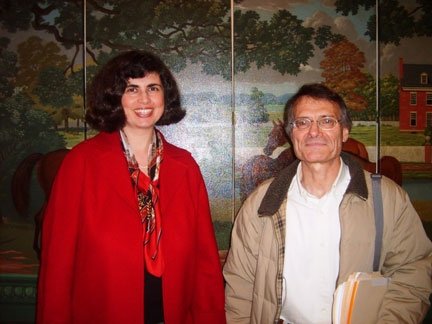
LNM authors Milena Minkova and Terry Tunberg pose following their successful Latin workshop at TFLTA.
Friday's sessions included three-hour workshops for each language. LNM authors, Milena Minkova and Terence Tunberg, explained how a person who experiences Latin in all of its dimensions: reading, writing, and speaking from the beginning will more quickly progress towards a firm command of the language. Such integrated language they explained produces a student able to read more efficiently and with a greater appreciation of nuances. While inquiries at the Bolchazy-Carducci exhibit precluded my attendance at the workshop, reports from the participants with whom I chatted were enthusiastic and laudatory. After the workshop, it was my genuine pleasure to join Terry and Milena for lunch. After a myriad of emails, multiple phone calls, and prep for and participation in a webinar on LNM and aural/oral Latin, I was finally meeting these two passionate Latinists face-to-face! We discussed a range of LNM matters including the inclusion of neo-Latin in LNM Level 3. On Saturday, I made sure to attend Milena and Terry's Tennessee Classical Association's featured talk on post-antique Latin. They are passionate advocates for including post-antique Latin in the high school and university experience of all Latin students. From the buzz after the session, it was clear they had made some converts and affirmed others.
I also attended Geoffrey Steadman's talk "Caesar on Trial." The Farragut High School, Knoxville teacher explained how he has used Caesar as an excellent review of intermediate grammar and vocabulary as well as a great immersion in rhetorical analysis and commentary. The talk's title is based on how Steadman invites the students to evaluate what Caesar had done in the course of his campaign against the Galls—was he guilty of genocide? of crimes against humanity?
University of Tennessee classics professor Chris Craig whom I had met at CAMWS-SS presided over the conference as his final act as president of TFLTA. Professor Craig's remarks at meals and meetings revealed both his commitment to foreign language study in Tennessee and his genteel manner and respect for his colleagues throughout the state.
The conference afforded me the opportunity to meet the dedicated Latin teachers of the state and to pick the brains of Memphis teachers Dawn LaFon and Reagan Ryder who enthused about the positive impact Latin for the New Millennium is having on their students. Interestingly, in the course of the LNM adoption process, this marked my sixth visit to Tennessee in the past year and a half.
Donald Sprague |
|
|