In Asheville: On Wednesdays, pick up plants at Greenlife ($8 delivery fee) or Asheville Local Foods (prices adjusted to include delivery). Weather permitting.
Deliveries: We can deliver plants up to four hours away from our nursery for a distance-based delivery fee. Share the delivery fee with your friends or neighbors and get a discount by arranging a group order! |
|
|
See our curriculum of classes on the website. Bring Chuck in for a private consultation on any of these topics or arrange for a small or large group class. More info? Click here. |
|
|
With a UPN gift certificate, the recipient can get just what they want when they are ready to plant.
Or, let your friends and family know that you'd like a UPN gift certificate for a special tree, bush, or other useful plant.
Gift certificates are available in any denomination of $5.00 or more. We will send a paper certificate in the US mail. If you prefer, we can send a PDF file that you or your recipient can print.
You can pay for gift certificates with a credit card through our secure website, or contact us at info@usefulplants.org or (828) 669-6517 for other options.
|
|
|
We're thrilled to offer the following videos:
Facebook
Useful Plants Nursery is on Facebook! Be a friend and/or fan, hook up with other Useful Plants people, and share your stories.
|
|
|
Useful Plants Nursery is a small, permaculture-based nursery specializing in useful, phytonutritional, food, and medicine plants well-adapted to our Southern Appalachian mountains and surrounding bioregions. Our plants are grown without the use of synthetic pesticides at our nursery located at Earthaven Ecovillage.
I believe that growing your own food and medicine plants is a vitally important strategy and practice for regaining control over our collective and personal lives, our health, and our individual and bioregional economic well being. Our nursery is dedicated to putting those beliefs into practice and truly creating "Liberation through Abundance" as we serve your needs for healthy, useful landscape plants, and work together to reweave the web of life.
-- Chuck Marsh, nurseryperson, permaculture designer, bioregional inhabitant
UPN is a North Carolina certified nursery.
To see a full list of our plants, click here. |
|
|
Useful Plants Nursery
111 Another Way
Black Mountain, NC 28711
828.669.6517
www.usefulplants.org
info@usefulplants.org |
|
|
|
|
We are half way between the Winter Solstice and the Spring Equinox. The days are getting longer and the plants are waking up!
|
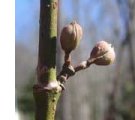
Cornelian cherry buds. They'll be the first blooms in the nursery.
|
 |
|
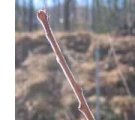
Fuzz on nanking cherry stems. Soon they will be covered with flowers and fuzzy leaves.
|
|
|
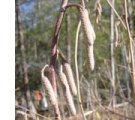
Hazelnut catkins. Soon they will be yellow with pollen.
|
|
At the nursery, we're getting ready for spring too - collecting scion wood for grafting, planting specimen trees, and preparing for workshops and festivals.
We look forward to seeing you at Dave Jacke's free talk in a couple weeks or at the Organic Growers School in early March.
Customer survey
To serve you better, we created a customer survey. It only takes a couple minutes and the responses are completely anonymous - we don't even ask for your email address.
To complete the survey, please click this link. |
|
|
Plant of the month: Chokeberry |
by Debbie Lienhart, Nursery Manager
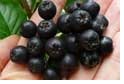 This month we celebrate Aronia melanocarpa, also known as chokeberry or aronia berry. This Southern Appalachian native is often found growing with blueberries in high elevation balds. It grows in any garden soil and is one of the few Useful Plants that is happy in poorly drained soil, making it a great wetland plant. It wants full sun to part shade. This month we celebrate Aronia melanocarpa, also known as chokeberry or aronia berry. This Southern Appalachian native is often found growing with blueberries in high elevation balds. It grows in any garden soil and is one of the few Useful Plants that is happy in poorly drained soil, making it a great wetland plant. It wants full sun to part shade.
The multi-stemmed plants grow to 5 - 7 feet tall and are attractive all year. In spring, the beautiful white flower clusters attract bees and other beneficial insects. Through the summer the glossy green leaves are complemented by large blue-black fruit clusters. In fall the leaves become bright red, and in winter the sculptural quality of the branches is clearly visible. This is definitely a plant to place where you can enjoy its year round beauty.
The berries are tasty - neither tart nor sweet. The berries are borne in abundance from an early age, making aronias one of the more satisfying plants for early gratification in an edible landscape. Most of the aronias in the nursery bear while still at the nursery and I like to pick a few berries for a nibble when I pass by them. The berries are very popular in Europe for healthy juice production and we are hearing of orchards being developed in our region. The berries are extremely rich in antioxidants and anthocyanins, and with their high pectin content make tasty and nutritious jams, provided you don't eat them all first!
For more information, see the UPN website. |
|
 |
|
Ask the Chuckster: Useful plant advice from Chuck Marsh |
by Chuck Marsh, UPN founder and horticulturist

February is when the garden season really starts for shrubs, trees, and vines. It’s a great time for planting, and the bigger the plant, the more helpful it is to plant it early so it can establish itself before the heat of summer. We have planting instructions on the website and planting videos if you need a refresher.
February is also the earliest time to be thinking about pruning most fruit trees and grape vines. I only do light corrective pruning on trees and shrubs this time of year because you’re cutting off potentially fruiting wood. I do heavier pruning in the summer. The time to prune is just after the hard freezes (temps below 20 degrees F) are over and before the sap starts to rise. In the Piedmont this could be near the beginning of the month; here it’s usually mid-February.
What do you mean by “light corrective pruning”?
This is the minimal pruning necessary for trees and shrubs to establish their structure. In addition to removing dead, damaged, or diseased wood, young trees often need pruning so they don’t get too leggy, and older shrubs need some of their older branches retired in favor of newer, more vigorous branches. You can read a more complete explanation in my pruning article from last year’s newsletter and see how to prune young trees and shrubs in our videos.
What about muscadines?
With muscadines I wait just a little later for pruning – late February or early March around here. That’s a couple weeks after the time for pruning the fruit trees. The basic way to prune muscadines is down to four buds from the previous year’s growth. Those four buds will produce the flowers for this year’s fruit. Since all grapes bear on the previous seasons growth, this late winter pruning must be done on an annual basis to keep your grapes producing well.
What about a new muscadine? How do I get it started growing on a trellis?
With a new plant, you’ll need two or three years for it to grow its permanent architecture. The first year keep the vine growing up a stake until it’s at least 18” higher than the trellis wire. For muscadines on trellis a single wire 4 ½ feet above ground level is recommended. Prune off the vine just below the wire so the plant will start growing lateral branches. Start training one lateral branch in each direction along the wire for 10 feet. Depending on when you plant and start training, getting this far could take a couple years. In following years, prune off any side branches growing on the trunk, and then prune all of the branches that grew off the lateral branches to four buds annually in late winter.
What about a muscadine growing on an arbor?
Muscadines do really well on arbors or pergolas. The training is similar in that you still want to grow a permanent structure of one to three main stems with lateral branches. Once you have that in place, you just keep pruning back to four buds of the previous seasons growth annually in late winter. As the vine matures and gets thicker you’ll probably want to thin out some of the older branches and remove crowded laterals to maintain openness.
Is pruning all grapes the same?
All grapes will flower and fruit on the previous seasons growth. All grapes need to be pruned annually to maintain their productivity, by pruning back to two to four buds on the lateral branches in late winter. Beyond that, there are numerous trellising systems that have been developed for different types of grapes and production systems.
The NC Cooperative Extension Service’s website has some good information and illustrations on basic grape trellising and growing systems, including this comprehensive Caring for Backyard Muscadine Vines document. |
|
|
|
Winter is a great time to learn about growing fruit plants and plan your edible landscape and our region is blessed with many learning events.
Garden Like a Forest with Dave Jacke, February 12 & 13
Learn from Dave Jacke, author of Edible Forest Gardens, about designing forest gardens in a rare local appearance at Warren Wilson College.
-
Gardening Like a Forest: Home-Scale Ecological Food Production. Saturday, February 12, 7-9 pm, Free admission.
This talk introduces the vision of forest gardening with some scientific background, a few living examples, and a sampling of some useful perennial edibles you can use in your own garden.
-
Ecosystem Agriculture: Patterns, Principles, and Practices. Sunday, February 13, 9am - 5pm. Just a few spaces remain.
This is an introductory workshop for gardeners, designers, and students of gardening, ecology, and design.
For more information and registration, see the Living Systems Design website.
5th Annual Barkslip's Fruit School
Join Professor T. Bud Barkslip, aka Bill Whipple, for the 2011 fruit school in Asheville. Classes start in late January and go through April. In addition to classes in fruit tree care, pruning, and grafting, this year's program adds workshops on maple sugaring and woodworking. For more information see the Fruit School website.
1st Annual NC Conference on Sustainable Viticulture, February 23
This workshop on February 23 at AB Tech features Charlie Caldwell, a third-generation grape grower from Iowa, along with Chuck Blethen, co-owner of Jewel of the Blue Ridge vineyard, Rudy Mullis, Manager of the Muscadine Group at Hinnant Family Vineyard & Winery (a major processor of neutraceuticals from grape pommace); Hannah Burrack, Assistant Professor and Extension Specialist for NC State University Department of Entomology; and Jessica Gualano, owner of The Wine Studio of Asheville. Online registration is required at http://NCSustainableViticultureConference.eventbrite.com
18th Organic Growers School, March 5 & 6
The unofficial beginning of spring for WNC gardeners, Organic Growers School is returning to UNCA on March 5 & 6 for another great conference. Join over 1500 farmers, gardeners, chefs, food activists, and conscious consumers for the largest sustainable living conference in the Southeastern US. This year's conference includes new tracks in fruit production, urban farming, primitive skills, and poultry. For more information see the OGS website.
Living Skills Immersion, March 18-27
A 9-day workshop with Zev Friedman and Natalie Bogwater at Earthaven Ecovillage. Topics include permaculture in the wild, homesteading and primitive skills, wildfoods foraging and cookery, functional communication, firebuilding and tending, and more. For more information see www.WildAbundance.net.
|
|
|
|
|
|