Classical Conferences and Meetings in 2011 |
ACL - American Classical League
64th Annual Institute
June 25–27, 2011
University of Minnesota
Radisson University Hotel
Minneapolis, MN
Representatives: Drs. Lou and Marie Bolchazy; other B-C attendees: Jody Cull, Laurel DeVries, and Don Sprague
-
Panel: Sun., June 26 - "The Riches of Neo-Latin: Why Don't We Use Them?" Milena Minkova, Terence Tunberg, Rose Williams
-
Panel: Sun., June 26 - "Effective Secondary Latin Materials" — Rose Williams, Panel Chair
"An Efficient Oral Component in Secondary Latin" Terence Tunberg
"Grammar in the Secondary Latin Program" Milena Minkova
"A Well Rounded Latin III Text" Helena Dettmer
"Electronic Components for the Secondary Latin Program" Donald Sprague
"Enrichment Texts Both Grammatical and Cultural" Rose Williams
- Talk: Sun., June 26 - "Conquering and Creating Gaul: Caesar's Use of Geographical Description in the Bellum Gallicum" Debra Nousek
National Junior Classical League Annual Convention
July 25–30, 2011
Eastern Kentucky University
Richmond KY
Representatives: Allan Bolchazy and Laurel De Vries
ICC—Illinois Classical Conference
October 7–9
University of Illinois
Champaign-Urbana, IL
Representative: Don Sprague and Laurel De Vries
CAAS—Classical Association of the Atlantic States
October 13–15
Baltimore Marriott Hunt Valley
Hunt Valley, MD
Representative: Don Sprague
CAES - Classical Association of the Empire State
October 14-16, 2011
Rochester Riverside Convention Center
Rochester Hyatt Regency
Rochester, NY
Representatives: Drs. Lou and Marie Bolchazy
Other 2011 meetings will be announced in future issues.
Information taken from www.BOLCHAZY.com |
|
 |
|
Interesting Tidbits to Share |
You never know where you'll find an allusion to the classics . . .
"She Hannibaled my Fabius!" on 30 Rock
The May 26 episode of 30 Rock pitted Liz Lemon (Tina Fey) and Jack Donaghy (Alec Baldwin) in a sparring match regarding the adult nature of their respective relationships. Jack takes pride in his "Fabian" approach, which he realizes he needs to explain to Liz. At the episode's end, when Jack realizes he might have been out-psyched by his wife Avery and her surprise attack in the form of the visit of an interior decorator to Jack's office, he exclaims, "She Hannibaled my Fabius!"
The June/July 2011 Saveur featured a traditional vintner from the Italian region of Friuli. Like his fellow Friuli native and celebrated winemaker Francesco Josko Gravner, Paolo Vodopivec uses terra cotta amphorae lined with beeswax to ferment his grapes. He imports these amphorae from the Republic of Georgia where, through the centuries, vintners have used this ancient form of vessel. Classicists readily recognize amphorae! Vodopivec's wine would make for a unique toast to the school year but only if you wish to splurge! His celebrated Vodopivec Vitovska Ampora 2006 sells for $85 a bottle.
Attending ACL this June? Be sure to attend Reginald Foster's special assembly session entitled Lingua Latina Nobis Conservanda est—NUNC! on Sunday, June 26.
|
|
|
|
Tuesday, June 7, 2011
6:30-8:00 ET
The Aural/oral Components of the Latin for the New Millennium Series
Latin for the New Millennium coauthors Milena Minkova and Terence Tunberg, celebrated neoLatinist and Conventicula Latina directors, discuss the aural/oral components of the series. Drs. Minkova and Tunberg will address such issues as how best to incorporate oral Latin in your LNM classroom. They will also demonstrate some of the oral activities delineated in the LNM Teacher's Manuals.
- Participation is free. All webinars provide an opportunity for participants to ask questions.
- Learn lots—attend each presentation. We’re happy to provide documentation of your participation for your supervisor(s).
- All you need to participate in these webinars is high-speed Internet access, computer speakers/ headphones, and your access code, which we will provide to you once you register.
Thursday, June 16
6:00–7:30 PM ET - BACK BY POPULAR DEMAND!
Games, Activities, and Projects for Levels 1 and 2 Latin for the New Millennium Series
Kelly Northrup of the Webb School, Bell Buckle, Tennessee, an LNM enthusiast and frequent contributor to the LNM Teachers' Lounge. Due to popular demand, Kelly has agreed to present her Games, Activities and Projects webinar, again, for those who couldn't attend this webinar on April 19th.
For more information about and to register for free webinars click here |
|
|
|
Special Summer Professional Growth Opportunities |
Summer is a great time for teachers to enhance their own skills and knowledge. We recommend your considering the following opportunities offered by our authors and collaborators.
Latin for the New Millennium authors Terry Tunberg and Milena Minkova, renowned sponsors of Latin conventicula will be conducting a session at Dickinson College, July 5–11, and, at their home base in Lexington at the University of Kentucky, the 15th anniversary conventiculum, July 21–29.
Following the conventiculum at Dickinson, Dickinson Professors Christopher Francese and Meghan Reedy will lead a five-day, July 13–17 reading of Tacitus' Germania.
Jacqueline Carlon and her colleagues at UMass Boston will present Conventiculum Bostoniense: Latin by the Sea at UMass Dartmouth, July 30–August 7.
For more information on each of these download this informational pdf.
Author of B-C Caesar texts for the new AP* curriculum, Hans-Friedrich Mueller is offering a graduate course in Caesar: CLS 660 Julius Caesar in his Time: The General as Historian. The course will be conducted online and run from June 21–August 5, 2011 through Union Graduate College. Hans is an engaging instructor with a deep passion for Caesar. Download the informational pdf. |
|
|
|
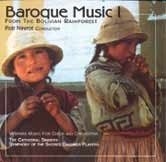
Latin in the “New” World
Baroque Music from the Bolivian Rainforest
Vespers Music for Choir, Soloists, and Orchestra
Performed by the Cathedral Singers
Richard Proulx, Music Director
and
The Symphony of the Shores Chamber Players
Piotr Nawrot, Conductor
When the Jesuits brought their music and instruments to the New World, they joined with the highly talented Guarnani and Chiquito indigenous peoples to produce liturgical music which was, as Fr. Piotr Nawrot writes, "a luxuriant blend of Indian and European, indigenous and foreign, old and new."
The 1986 film The Mission starring Robert DeNiro cast popular attention on this beautiful music sung in liturgical Latin in the Jesuit reductions of South America. These selections from a stirring performance by the Cathedral Singers and the Symphony of the Shores Chamber Players offer a glimpse into this fusion of baroque and native rhythms and melodies.
Enjoy!
(click links to hear audio)
#9 Laudate Pueri (Anonymous) 4:51
# 18 Benedicamus Domino (Anonymous) 1:40 |
|
|
|
Bolchazy-Carducci textbooks are now available through Google and Xplana eBookstores, with more titles going digital every day! Each eBook offers a variety of tools to enhance the learning process, and eBook distributors are continually adding new features.
What do B-C eBooks currently offer?
eBooks have the same content as our traditional books in print, with these enhancements:

• Searchable
• Adjust text size, typeface, line space
• Free samples of books
• Worry-free archive
• Available on any computer with an internet connection
• Readable on:
- the web (via Windows or MAC computers)
- iPhone, iPad and iPod touch
- Android
- eBook Devices: Barnes & Noble Nook and Reader™ from Sony
Google ebook information: http://books.google.com/help/ebooks/overview.html
Google ebook store: http://books.google.com/ebooks

• Searchable
• Adjust text size, typeface, line space
•Add notes, customized highlights, and other annotations—all of which are added to the embedded annotation manager for convenient access
• Worry-free archive
• Available on any computer with an internet connection
• Readable on:
- the web (via Windows or MAC computers)
- tablet computers (any device that is Flash compatible)
Xplana ebook information: http://tinyurl.com/4qlyhye
Xplana ebook store: http://shop.xplana.com/
How do I purchase a B-C eBook?
Simple! When you are browsing through www.Bolchazy.com, any time you see Google or Xplana eBook logo, click on the logo, and you will automatically be directed to a webpage where you can purchase the eBook.
Can I purchase direct from the distributor?
Yes! If you prefer, you can link directly to our eBook providers’ websites and search by title, by author, or by Bolchazy-Carducci Publishers to locate the title you would like to purchase. The Google eBooks store offers a preview of the book, including the table of contents and select pages.
What hardware is required?
You can read eBooks on a Mac, PC, iPhone, iPad, Android, or a variety of eReaders. |
|
|
|
Illinois Classical Conference |
ICC President and LNM 3 Consultant Becki Wick invites all Illinois classics teachers and colleagues from neighboring states to the upcoming annual meeting of the Illinois Classical Conference hosted by the University of Illinois, Champaign-Urbana, IL, October 7–9.
ICC has lined up Professor Lothar Haselberger, an architectural historian at the University of Pennsylvania, to give the keynote address on Saturday after lunch. Haselberger's specialties include the Temple of Apollo at Didyma and Augustan architecture with an emphasis on the Pantheon. |
|
|
Bolchazy-Carducci
Links of Interest |
Free Bolchazy-Carducci Roman Calendar
Be sure to place your name on the mailing list for Bolchazy-Carducci’s annual school year calendar. We are currently developing the 2011-2012 calendar and will mail them as school begins.
Preview Bolchazy-Carducci Titles

Preview Bolchazy-Carducci titles before you buy using Google Preview.
Downloadable Products
iPodius - Bolchazy-Carducci Publishers online shop for: audio, software, video, and teacher created materials.

BCP Facebook Fan Page
Become a FAN of Bolchazy-Carducci Publishers, visit our Facebook Fan page for the latest news from BCP. |
|
|
|
|
From the Editor
A Memorial Day Reflection |
Dear Colleagues and Friends,
As the nation takes time to honor those who have died in the service of their country and we also remember our dear departed friends and relatives, we mourn the untimely death of classicist Richard E. Prior. An Associate Professor of Classics at Furman University, Dr. Prior died, at age 47, on August 24 from pneumonia. He was coauthor of B-C's Servius' Commentary on Book Four of Virgil's Aeneid: An Annotated Translation. For a moving tribute to this talented scholar, see Eta Sigma Phi's winter issue of Nuntius.
Let us celebrate a life richly lived, a mind deeply cultivated, and a teacher who deeply touched his students.
Our book Rest Lightly: An Anthology of Latin and Greek Tomb Inscriptions offers a moving set of reflections on the nature of life and a life beyond. A favorite of mine (page 48) from the ancient Greek follows.
Sleep holds you fast
Blessed and beloved, noble Sabinus.
And you live on as a hero.
You have not become a corpse.
You sleep well as if alive.
Under the trees amidst the tombs of your ancestors,
For the souls of the truly pious
Go on living.
EG 433
(from Syria, 2nd century CE)
With this issue of eLitterae and the next couple, we'll be introducing some new faces at Bolchazy-Carducci. Read below about our new customer service professional and bookkeeper, Julie Jensen.
As the school year winds down, we at Bolchazy-Carducci Publishers wish you a smooth wrap-up. May your summer be relaxing and rewarding. Enjoy some good "reads" for your personal pleasure and edification. Brainstorm about some new activities for your classes.
All best,
Don Sprague |
|
|
|
An eLitterae Email Interview (Part 2) with Debra Nousek, A Caesar Workbook Coauthor |
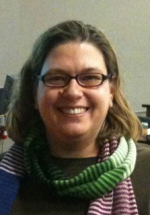
(For Part 1 of Dr. Nousek's interview, check out the April
eLitterae.)
DES: Many of today’s high school teachers have never taught Caesar. What pointers would you give them? How would you allay their fears?
DN: For teachers who have taught other common high school authors in the past, such as Vergil, Catullus or Cicero, Caesar’s language will present little difficulty in syntax or, for the most part, vocabulary. He will give readers a good workout in indirect discourse, though, so I’d suggest brushing up on those rules for the sequence of tenses! For those who worry about making Caesar “interesting,” I’d encourage them to approach the text of Caesar as they would any other author, keeping an eye out for literary themes, mechanisms for structuring the narrative, characterization of major figures, the role of the natural world, the role of Fortune. Remember that for the Romans, historical narratives were entertaining and literary, not dry and boring. Caesar’s text might seem repetitive at first, but there are some passages that really show off Caesar’s literary brilliance, such as the gerundive tour-de-force of BG 2.20, or the colorful ride to victory as Caesar saves the day in the legendary fight against Vercingetorix in BG 7.88. Caesar is an author whose text provides a solid foundation in Latin grammar and at the same time practically embeds the reader in the narrative: with a little imagination, you can see yourself in the camp alongside the legions and their great general.
DES: The students at Western Ontario University celebrated your teaching with an award. Tell us what you like most about teaching.
DN: The best thing about teaching is that it allows me to bring the ancient world to life for students whose only experience of Greece or Rome might have come from the recent spate of classically themed movies. I like to draw upon these contemporary cultural phenomena and delve deeper into what we know of the historical reality behind them. But what I really like is the ways that the students challenge me to uncover the answers to the questions that most interest them: when I teach the large introductory survey of Classical Civilization, I set up an electronic question box where students can submit questions on any aspect of the ancient world. My teaching assistants and I then try to find the answers and report back. I might be the one teaching the class, but it’s the students who help me to keep learning more.
DES: What's the next project due to receive your attention and enthusiasm?
DN: After I finish the Caesar monograph this summer, I think I’ll part ways with him for a little while to work on some quite different projects. I want to spend some time on Cicero’s Verrines and I have an article in the beginning stages on the figure of Amata in Aeneid 7. In the more distant future, I’m planning my second book, on the use of disease imagery in political discourse in Greece and Rome.
Professor Nousek teaches at Western Ontario University in Canada. She earned her BA at the University of Alberta, her MA at the University of California at Santa Barbara, and her PhD from Rutgers University. Professor Nousek is a specialist in Roman history and the republic and has published on Caesar as well as delivered papers on a variety of topics including Caesar. A Caesar devotee, even her teaching webpage begins with an image from the Gallic War, see http://publish.uwo.ca/~dnousek/. At Western Ontario, she was named to the Teaching Honor Roll through the University Students' Council.
Check out Professor Nousek's ACL talk, see Conference Listings. |
|
|
|
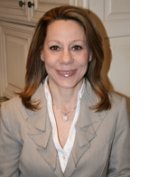 In April 2011, Julie Jensen joined the Bolchazy-Carducci Publishers team. Julie graduated from University of Illinois – Chicago with a BS in Accounting and worked in the corporate world for several companies in their accounting departments. Julie is from the Chicago area and is married with two sons. She enjoys the outdoors and keeping fit. Julie stays busy attending her children’s various activities and helping out in their schools. She has also volunteered for her son’s baseball and football teams, serving as business manager. Recently Julie enjoyed a special opportunity—helping Rainbows (an international non-profit organization that focuses on emotional healing among children grieving a loss from a life-altering crisis) with an event called The Power of the Purse, It’s all About Me! In April 2011, Julie Jensen joined the Bolchazy-Carducci Publishers team. Julie graduated from University of Illinois – Chicago with a BS in Accounting and worked in the corporate world for several companies in their accounting departments. Julie is from the Chicago area and is married with two sons. She enjoys the outdoors and keeping fit. Julie stays busy attending her children’s various activities and helping out in their schools. She has also volunteered for her son’s baseball and football teams, serving as business manager. Recently Julie enjoyed a special opportunity—helping Rainbows (an international non-profit organization that focuses on emotional healing among children grieving a loss from a life-altering crisis) with an event called The Power of the Purse, It’s all About Me!
We are pleased to welcome Julie Jensen as a customer service professional and bookkeeper. |
|
|
Discount Special for eLitterae Subscribers |
Bolchazy-Carducci Publishers is offering 33% off
Vergil’s Aeneid: Hero War Humanity.
The College Board requires reading Vergil's Aeneid in English for the new 2012–2013 AP* syllabus, and this rendition reads like a novel, but has the vividness of poetic language, with attractive and accessible reader aids complete with indices and questions.
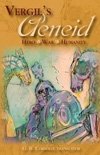
Vergil’s Aeneid: Hero War Humanity
translated by G. B. Cobbold
xviii + 366 pp. (2005) 5" x 7 3/4" Paperback
ISBN 978-0-86516-596-0 $15.00 $10.00
One copy, prepaid, no returns, not available to distributors.
Offer expires 07/01/11
Make sure to mention that you are an eLitterae subscriber if you place your order by phone or fax. If you place your order via www.BOLCHAZY.com the eLitterae sale price will be charged at checkout. |
|
|
Testimonial for Cobbold's Translation |
When Christine Conklin stopped by the Bolchazy-Carducci booth at CAMWS-Southern Section this past fall, she picked up a display copy of Cobbold's translation and sang its praises. Subsequently, I followed up with Magistra Conklin and asked for a written testimonial. She agreed and sought the input of her students. Teacher and student collective remarks are printed below.
Annually some 50 to 70 students take AP* Vergil at Thomas Jefferson High School for Science and Technology in Alexandria, Virginia. The post-AP* Latin V class usually numbers 20 to 25. Kudos on those outstanding enrollments!
Why we like Cobbold:
- Prose translation—faithful to the Latin (yet) engaging to read. Students are interested in actual content rather than bogged-down in difficult poetic syntax.
- Style—written in an epic style, yet concrete enough for the student interested in a ‘rather literal translation.’ Excellent job of rendering similes!!
- Quotes (little boxes) from literal translation
- Reference for students when the AP has gaps in the reading, e.g., all of book 3, parts of book 4, parts of 6.
- Line numbers are especially useful and helpful to students because they are able to reference the Latin text. Helps to ‘enhance’ the understanding of the Latin.
- Section headings are very useful and help the student to reference particular episodes.
- Invaluable resource for introducing the layman reader to Latin poetry and Vergil’s epic.
- Useful as review tool/resource for the AP* Exam and throughout the course filling in gaps
A 'SINE QUA NON'!! |
|
|
|
CAMWS 2011 Conference Report |
All three Bolchazys and Laurie Keenan attended the 2011 CAMWS conference. Since it was held in Grand Rapids, Michigan, we were able to drive there. We had six tables so the book display could more readily accommodate folks who wanted peruse our materials.
Author Presentations
New Resources and Methods for Teaching Greek
Lou and I attended this panel, which was chaired by Wilfred Major. All four of the authors of our Greek transitional readers—Homer: A Transitional Reader and Plato: A Transitional Reader—gave nice presentations. Although the session was held from 8–10 p.m. on Thursday evening, nevertheless, the eight participants were quite enthusiastic and stayed beyond 10 p.m. to make suggestions to both the presenters and to Lou and me, the publishers.
Latin in Small Packages: Expanding and
Varying Advanced Latin Curricular Options
Lou, Laurie, and I attended this panel, which was chaired by Ronnie Ancona. She had lined up some very big names from our BC Latin Reader Series for the session: Alison Keith (A Latin Epic Reader), Josiah Osgood (A Suetonius Reader), James Ker (A Seneca Reader), and James May (A Cicero Reader). Again the time slot was not ideal—the last time slot on the last day by which time many conferees had to leave before the session began in order to make their flights. Nonetheless, the session was well attended, with more than 30 participants. Ronnie gave a very nice introduction and the panelists gave very fine talks in the order shown above.
Lou, Allan, and I enjoyed the banquet. Michael Gagarin presided; Mark Williams, Dean at Calvin College, welcomed the group; Julia Hejduk, the CAMWS president-elect, gave a response; James May, as is his custom, presented the Ovationes; and David Tandy, CAMWS president, delivered the presidential address. In the course of the conference, we interviewed seven candidates for an editor position, attended presentations given by the applicants, and appreciated hearing from colleagues who came to the booth to recommend a particular candidate.
Marie Bolchazy |
|
|
|
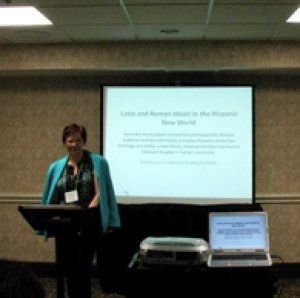
Rose Williams delivering her talk, “Latin and Roman Ideals in the Hispanic New World.”
Fort Worth, Texas—"Where the West Begins"—drew teachers from across the west to the annual meeting of the Southwest Conference on Language Teaching. The host hotel, a Hilton, soberly reminds guests of its historical significance, of "when America lost its innocence." President John F. Kennedy and First Lady Jacqueline Kennedy stayed at the then Hotel Texas the night before their fateful drive to Dallas. I remember well hearing this sad news as a second grader and being glued to the television. Indeed, I grew upset with my parents for not taking me from Boston to DC to see the President lying in state at the Capitol.
At the conference, at long last, I met the inimitable Rose Williams. I have worked with Rose as her editor for the LNM enrichment texts and A Beginning Christian Latin Reader: De Bonis Cogitationibus via email and telephone for several years. So, the time we spent together at the B-C booth and over meals afforded us ample opportunity to get to know one another and share our teaching experience and love of the classics.
While only a few Latin teachers attended the conference, we were impressed with the thoughtfulness of their Spanish colleagues and department chairs, who stopped by the booth and picked up catalogues for their school's Latin teachers. Rose chatted with the Spanish teachers about the connections to Latin and invited them to attend her presentation, “Latin and Roman Ideals in the Hispanic New World.” A number took her up on the invitation, enjoyed the talk, and recommended a subsequent webinar version to their colleagues back at school.
A highlight of our time in Fort Worth was a visit to the Kimbell Art Museum with its magnificent collection of treasures including DaVinci's first painting, at age 13 or 14, of St. Anthony in the Desert. Walking around downtown Fort Worth proved a treat for me with its magnificent art deco architecture. The early twentieth-century oil boom financed this burst of building that has been carefully preserved.
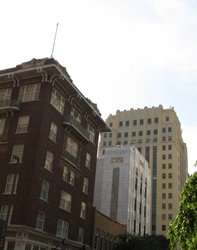
Three Art Deco high-rise beauties in downtown Fort Worth: the Ashton Hotel, the Kress Building, and the Sinclair Building. |
|
|
|
Veniemus Videbimus Vicemus
As the new AP* syllabus for 2012–2013 looms closer on the horizon, we encourage teachers to take heart. Bolchazy-Carducci's three new texts—Caesar: A LEGAMUS Transitional Reader by Rose Williams and Hans-Friedrich Mueller, A Caesar Workbook by Debra Nousek and Rose Williams, and CAESAR: Selections from DE BELLO GALLICO—are moving along! The LEGAMUS text will include selections from De Bello Gallico as well as from De Bello Civili while the selections in the other two texts (which work hand-in-glove) are those dictated by the new AP* syllabus.
Teachers looking to brush up their Caesar (do we have a song in the making?) should check out some terrific sites:
And, you may also consider taking Professor Hans-Friedrich Mueller's online graduate course on Caesar. See the professional development opportunities in this issue. |
|
|
|
Insights on the Development of Latin for the New Millennium,
Level 3 |
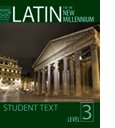
We are pleased to report that the pieces continue to fall in place as we compile the author units for LNM 3. Our team of teacher consultants has vetted the Catullus and Cicero sections.
Students from the pilot classrooms have responded positively to these two units and their teachers look forward to the final product. The Vergil unit has been sent on to the consultants for their feedback. Helena Dettmer is putting the finishing touches on the Horace section while LeaAnn Osburn is working on the Ovid unit.
A short break from the daily routine found me in Phoenix for a few days this month visiting my goddaughter and her four-month old son. Cool weather tempered memories of 100-degree heat on my last visit and my goddaughter’s graduation from Phoenix Country Day School some fourteen years ago. The visit afforded the opportunity for some social time as well as editor/author consultation with LeaAnn Osburn, who, I am pleased to say, has happily settled into life in the desert. We met over dinner at her son Eric’s restaurant in downtown Phoenix—The Centurion. Over a delicious meal prepared by Culinary Institute of America grad Eric, LeaAnn and I reminisced about our teaching days and addressed various issues pertinent to LNM, Level 3.
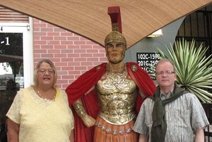
LeaAnn Osburn and Don Sprague meet at The Centurion in downtown Phoenix. |
|
|
|
Latin for the New Millennium Teaching Tips |
Our colleague Kelly Northrup from the Webb School, Bell Buckle, Tennessee, has allowed me to share her Facebook project on the Roman gods and goddesses. While this project is geared towards the Olympians of LNM 1, it could just as easily be used for the classical heroes and dynastic figures of LNM 2. This type of project serves as a great review activity and a perfect way to channel the creative "antsiness" that the warm weather generates. This facebook project would work as a good review for the authors of either LNM 1 or 2, as well as for the historical figures presented in the LNM 2 Nepos readings from the Life of Atticus.
Kelly's Facebook project sheet with grading rubrics:
Gods and Goddesses Project
Latin I (LNM)
Goal: To learn more about the Roman Pantheon
Process
1. Research all Roman gods and goddesses to learn what each (generically) represents.
2. Become an expert in one god or goddess and create a mock Facebook page for him/her including:
- a. a picture (using www.faceyourmanga.com, create an avatar)
- b. friends (Which gods/goddesses/heroes would be friends with your god/goddess? Create avatars for gods/goddesses from Olympus and just list names of friends from earth)
- c. wall posts (What events in your god/goddess’s life would appear on his/her wall?)
- d. interests and activities (What special things is your god/goddess associated with?)
- e. a status update (Be creative!)
- f. flair (What cute things would your god/goddess put on his/her page?)
- g. a mini-feed (What stories would your god/goddess have?)
Timeline:
You will have part of class on Tuesday and Wednesday of this week to work on this project. The rest will need to be done at home. You will email me your final product by Wednesday night at midnight. We will share our Facebook pages on Friday in class on the projector. If yours has not been turned in, you will not share it in class and will thus automatically lose 5 points.
The Grade:
_____/10 Research sheet for all gods/goddesses.
_____/25 Facebook page (complete, accurate, creative, appropriate, awesome!)
_____/5 Shared in class on Friday
Total: 40 points (The equivalent of two quizzes)
Rubric for Facebook page grading:
_____/2.5 Picture of god/goddess
_____/2.5 Friends (at least 4 mangas)
_____/2.5 Wall posts (at least 3 good)
_____/5 Interests/Activities/Info
_____/2.5 Status
_____/2.5 Flair (at least 2 good pictures)
_____/5 Minifeed (at least 4 good stories)
_____/2.5 Family
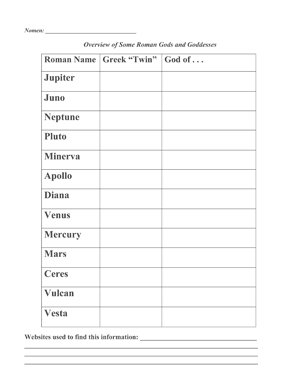
(click here to download printable PDF of Kelly Northrup's Gods and Goddesses worksheet)
Classroom teachers can check out other projects Kelly has posted in the LNM Teachers' Lounge. Other teachers have shared classroom activities, projects, and the like here as well. Enter a topic of interest like "indirect statement" in the search tool.
For Kelly's Facebook template, click here.
*AP is a registered trademark of the College Entrance Examination Board, which was not involved in the production of, and does not endorse this product. |
|
|
|
|
|