Classical Conferences and Meetings in 2011 |
|
|
Interesting Tidbits to Share |
John Adams, Latin Master
Just the other day, my sister sent me the following interesting tidbit from the Quincy, Massachusetts Patriot Ledger.
On July 3, 1776, a visitor to Philadelphia wrote his wife back home on their Quincy farm about the previous day’s decision by the Continental Congress to declare the 13 American colonies “Free and Independent States.”
“The second day of July, 1776, will be the most memorable epoch in the history of America,” John Adams predicted in his letter to Abigail.
“I am apt to believe that it will be celebrated by succeeding generations as the great anniversary festival. It ought to be commemorated as the day of deliverance, by solemn acts of devotion to God Almighty. It ought to be solemnized with pomp and parade, with shows, games, sports, guns, bells, bonfires, and illuminations, from one end of this continent to the other, from this time forward forever more.”
www.masshist.org/
If he only knew.
Check out that website, it contains a wonderful electronic archive of John Adams' writings. When I searched "Latin," some thirty-five citations popped up. The one I thought we Latin teachers would appreciate comes from Adams' biography.
In the publick Exercises at Commencement, I was somewhat remarked as a Respondent, and Mr. Maccarty of Worcester who was empowered by the Select Men of that Town to procure them a Latin Master for their Grammar School engaged me to undertake it. About three Weeks after commencement in 1755, when I was not yet twenty Years of Age, a horse was sent me from Worcester and a Man to attend me. We made the journey about Sixty miles in one day and I entered on my Office. For three months I boarded with one Green at the Expence of the Town and by the Arrangement of the Select Men.
(John Adams autobiography, part 1, "John Adams," through 1776, sheet 4 of 53 [electronic edition]. Adams Family Papers: An Electronic Archive. Massachusetts Historical Society.
Adams taught Latin by day for two years and by night studied the law, which profession he pursued along with farmer and government official.
Trader Joe's: Odyssey of Flavor
Another instance of "you'll never know where you'll find a classical reference." While driving home from the airport and listening to the radio, an ad caught my ear. Trader Joe's ad for the Independence Day Weekend discussed the simile in the Odyssey 20.23–28 where Odysseus is likened both to a cook grilling a sausage and the sausage itself. The ad, of course, wanted to promote Trader Joe's variety of sausages and finished inviting listeners to try Trader Joe's "Odyssey of Flavor."
This simile is a favorite of mine and regularly seizes my students' imagination. I can't wait to tell my Kennedy-King Great Books class about the Trader Joe's allusion.
A quick check of the Trader Joe's website proclaims that their ads "are low-key ads where real Trader Joe's crew members telling real stories about Trader Joe's products." . . . makes one wonder if the mind behind this ad wasn't a student of the classics.
Personal note, editor colleague and carpool companion, Laurie Keenan and I regularly stop at Trader Joe's on our way home from the B-C office. |
|
 |
|
Tour of xplana™: A Look inside Latin for the New Millennium eTextbook
Join us on Tuesday, July 12, 6:00-7:30 PM ET or Thursday, July 28, 6:00-7:30 PM ET
Presented by Jody Cull, Production and eLearning Manager, Bolchazy-Carducci Publishers.
- Participation is free. All webinars provide an opportunity for participants to ask questions.
- Learn lots—attend each presentation. We’re happy to provide documentation of your participation for your supervisor(s).
- All you need to participate in these webinars is high-speed Internet access, computer speakers/ headphones, and your access code, which we will provide to you once you register.
For more information about and to register for free webinars click here |
|
|
Special Summer Professional Growth Opportunities |
Summer is a great time for teachers to enhance their own skills and knowledge. We recommend your considering the following opportunities offered by our authors and collaborators.
Latin for the New Millennium authors Terry Tunberg and Milena Minkova, renowned sponsors of Latin conventicula will be conducting a session at Dickinson College, July 5–11, and, at their home base in Lexington at the University of Kentucky, the 15th anniversary conventiculum, July 21–29.
Following the conventiculum at Dickinson, Dickinson Professors Christopher Francese and Meghan Reedy will lead a five-day, July 13–17 reading of Tacitus' Germania.
Jacqueline Carlon and her colleagues at UMass Boston will present Conventiculum Bostoniense: Latin by the Sea at UMass Dartmouth, July 30–August 7.
For more information on each of these download this informational pdf. |
|
|
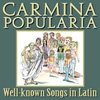
One of our most popular CDs features Nashville musicians: CC Couch on vocals and the masterful musical arrangements of Teddy Irwin. Your kids will love hearing these songs sung in Latin and even the most timid will be motivated to sing along!
Check out these two tunes:
Oh, When the Saints Go Marching In
Polly Wolly Doodle
For more information visit: Carmina Popularia |
|
|
Bolchazy-Carducci textbooks are now available through Google and Xplana eBookstores, with more titles going digital every day! Each eBook offers a variety of tools to enhance the learning process, and eBook distributors are continually adding new features.
What do B-C eBooks currently offer?
eBooks have the same content as our traditional books in print, with these enhancements:

• Searchable
• Adjust text size, typeface, line space
• Free samples of books
• Worry-free archive
• Available on any computer with an internet connection
• Readable on:
- the web (via Windows or MAC computers)
- iPhone, iPad and iPod touch
- Android
- eBook Devices: Barnes & Noble Nook and Reader™ from Sony
Google ebook information: http://books.google.com/help/ebooks/overview.html
Google ebook store: http://books.google.com/ebooks
• Searchable
• Adjust text size, typeface, line space
•Add notes, customized highlights, and other annotations—all of which are added to the embedded annotation manager for convenient access
• Worry-free archive
• Available on any computer with an internet connection
• Readable on:
- the web (via Windows or MAC computers)
- tablet computers (any device that is Flash compatible)
Xplana ebook information: http://tinyurl.com/4qlyhye
Xplana ebook store: http://shop.xplana.com/
How do I purchase a B-C eBook?
Simple! When you are browsing through www.Bolchazy.com, any time you see Google or Xplana eBook logo, click on the logo, and you will automatically be directed to a webpage where you can purchase the eBook.
Can I purchase direct from the distributor?
Yes! If you prefer, you can link directly to our eBook providers’ websites and search by title, by author, or by Bolchazy-Carducci Publishers to locate the title you would like to purchase. The Google eBooks store offers a preview of the book, including the table of contents and select pages.
What hardware is required?
You can read eBooks on a Mac, PC, iPhone, iPad, Android, or a variety of eReaders. |
|
|
|
Illinois Classical Conference |
ICC President and LNM 3 Consultant Becki Wick invites all Illinois classics teachers and colleagues from neighboring states to the upcoming annual meeting of the Illinois Classical Conference hosted by the University of Illinois, Champaign-Urbana, IL, October 7–9.
ICC has lined up Professor Lothar Haselberger, an architectural historian at the University of Pennsylvania, to give the keynote address on Saturday after lunch. Haselberger's specialties include the Temple of Apollo at Didyma and Augustan architecture with an emphasis on the Pantheon. |
|
|
Bolchazy-Carducci
Links of Interest |
Free Bolchazy-Carducci Roman Calendar
Be sure to place your name on the mailing list for Bolchazy-Carducci’s annual school year calendar. We are currently developing the 2011-2012 calendar and will mail them as school begins.
Preview Bolchazy-Carducci Titles

Preview Bolchazy-Carducci titles before you buy using Google Preview.
Downloadable Products
iPodius - Bolchazy-Carducci Publishers online shop for: audio, software, video, and a treasure trove of teacher created materials in the Agora.

BCP Facebook Fan Page
Become a FAN of Bolchazy-Carducci Publishers, visit our Facebook Fan page for the latest news from BCP. |
|
|
|
|
Dear Colleagues and Friends,
I've always been a people person and have enjoyed conversing with folks, learning their stories, vicariously sharing their experiences, enriching my own life and perspective. My work with Bolchazy-Carducci Publishers regularly provides me opportunities to come to know our colleagues in classics teaching. Sometimes such contact is via email or a phone conversation, other times at a conference staffing the book display or chatting over a meal. While these conversations provide valuable insights into how our texts and other products are implemented in the classroom and suggestions about what else teachers would like to be made available, I especially appreciate the personal contact and the personal stories of success in bringing Latin alive for students.
Indulge me as I share two stories. Our request for teachers to send us any errors found in Latin for the New Millennium, Level 2 last May elicited an email from a former student with whom I had fallen out of contact. Yes, he was using LNM and very much enjoyed it. I also learned that he was teaching Latin at the Head-Royce School in Oakland and that he and his wife had just welcomed a baby girl, their first, into the rhythm of life. I was pleased to note that he had married the lovely young woman I met a number of years ago when he was pursuing his graduate work at Berkeley. Dr. Lisowski was one of those students from whom a teacher is regularly enriched by his insights. His work in AP Vergil was exceptional but another instance especially stands out for me. In our special Greek I/II class, he observed that oMICRON meant "little o" and oMEGA, "big o." I still smile recalling that observation, something I had never noted, as a perfect example of learning from one's students! Thaddeus loved learning and I am sure is inspiring his students with his enthusiasm and his knowledge. I look forward to catching up with him face to face this summer when he returns to Chicago to visit with his family.
Last week, I had lunch with Charlie Barlow who teaches at Christ the King Jesuit College Preparatory High School in Chicago. Charlie wanted to pick my brain about taking a group to Rome and I wanted to hear about Christ the King's experience with LNM. Christ the King is a "Cristo Rey" model school serving an underserved population on Chicago's westside. The students attend classes four days a week and one day a week work at a Chicago business. Five students share such a job and the money they earn helps meet the cost of tuition. Latin is the only language offered at Christ the King and students are required to take three years. Charlie's eyes sparkled when he shared how his students loved walking the halls and reciting from the Carmina Burana as a complement to reading the LNM 2 selection from the Archpoet. With similar enthusiasm, he recounted the philology assignment he gave to accompany Lorenzo Valla and how amazed his students were upon learning how often a Latin word appears intact in a modern language. Herewith, Charlie's endorsement of LNM, "LNM was much more engaging and student-friendly than the other textbooks we were using. The diversity of readings, the use of Roman and medieval literature, and the clearly laid out grammar sections all helped our students to do much better than last year." As you can imagine, I was very pleased to hear that.
Thanks for your indulgence! Enjoy the holiday weekend as we celebrate that brave experiment in democracy our founding fathers envisioned 235 years ago!
All best,
Don Sprague |
|
|
|
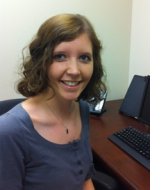 Laurel De Vries served as an intern at Bolchazy-Carducci Publishers last summer. Following her graduation from Calvin College in May with a BA in classical languages and English, Laurel returns as a full-time editor intern. While at Calvin, Laurel earned the Ralph Stob and Boertje Family Scholarship and the CAMWS Award for Excellence in Classical Studies, as well as the Roger W. Heyns Presidential Scholarship. She graduated with honors in classical languages. Laurel will be attending conferences, assisting with editing, and taking a class at the University of Chicago’s editing program. In the fall she will student-teach as part of a Latin pedagogy class. Laurel grew up in Holland, Michigan, and is the oldest of three children. She enjoys swing dancing, cooking, and reading literature, both classical and modern. Laurel De Vries served as an intern at Bolchazy-Carducci Publishers last summer. Following her graduation from Calvin College in May with a BA in classical languages and English, Laurel returns as a full-time editor intern. While at Calvin, Laurel earned the Ralph Stob and Boertje Family Scholarship and the CAMWS Award for Excellence in Classical Studies, as well as the Roger W. Heyns Presidential Scholarship. She graduated with honors in classical languages. Laurel will be attending conferences, assisting with editing, and taking a class at the University of Chicago’s editing program. In the fall she will student-teach as part of a Latin pedagogy class. Laurel grew up in Holland, Michigan, and is the oldest of three children. She enjoys swing dancing, cooking, and reading literature, both classical and modern.
If you're attending NJCL, or ICC please be sure to stop by the B-C book display and introduce yourself to Laurel. If you visited our booth at ACL, you saw Laurel if you did not meet her. |
|
|
|
LNM Provides Firm Foundation in Vergilian Vocabulary |
One of the key strengths of Latin for the New Millennium is the foundation it provides for subsequent advanced study of Latin authors and genres. Because Latin for the New Millennium presents Latin adapted from the Roman authors and from the post-antique authors who prided themselves on their classical Latinity, its vocabulary is a rich one that will serve students well as they undertake the literary studies of Latin 3 and Latin 4. LNM students undertake their advanced studies also armed with a firm foundation in grammar and syntax, with confidence as readers of Latin, and with an understanding of the context of the full continuum of Latin literature.
In order to demonstrate this literary rich vocabulary, we undertook a study that correlates the vocabulary of Latin for the New Millennium, Levels 1 and 2, with the frequency lists created by Clyde Pharr and published in his 1964 groundbreaking Vergil’s Aeneid, Books I–VI. The table printed below delineates this correlation.
| Pharr Frequency List of Vergilian words |
Total # Vergilian words in LNM 1
and 2 Vocabulary to Learn
|
Total # Vergilian words in LNM 1 and 2 Latin readings but not Vocabulary to Learn |
Total # Vergilian words encountered in LNM 1 and 2 (sum of columns2 & 3) |
| 24+ occurrences 265 words |
204
77%
|
29
11%
|
233
88%
|
|
12–23 occurrences
275 words
|
112
41%
|
18
6%
|
130
47%
|
|
6–11 occurrences
479 words
|
109
23%
|
44
9%
|
153
32%
|
Please note that LNM Level 3 (forthcoming 2012) with its presentation of the unadapted Latin of Caesar, Catullus, Cicero, Horace, Ovid, Vergil, and some Renaissance authors will add significantly to this vocabulary foundation. Stay tuned, we'll be sure to report on this in a later issue. And, we've planned a similar correlation between LNM and Caesar's vocabulary.
[Thanks to Peter Sipes for his contribution to this correlation project.] |
|
|
|
46th International Congress on Medieval Studies Report |
Not having attended the conference since 2004, I was very much looking forward to returning, and although the weather decided to steam and then thoroughly soak the bulk of the event, it still offered up an excellent opportunity to get back in touch with the medieval academic community, friends, and our eager Bolchazy-Carducci patrons.
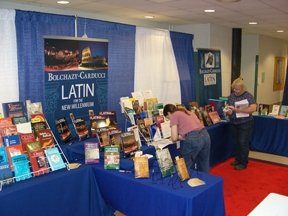
Chris Velez and Betty Brendel put the finishing touches on the B-C booth.
Wednesday’s setup day, although long and hot, was thankfully uneventful, and my wife Chris and I commented to Betty Brendel (B-C Inventory/Logistics Manager), that having a larger booth really helps to display our extensive product line better, and offers a more comfortable environment for attendees to peruse our displays.
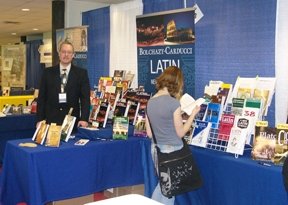
Adam Velez mans the B-C book display.
On Thursday, when the doors officially opened, the hall filled quickly and the event got off to a strong start, with a lot of energy—and business was brisk.
As always, however, the pace and number of attendees in the hall slowed during the bulk of the daytime hours as the majority of them attended the sessions, but late afternoons picked up again, and especially during “wine hour” the energy continually renewed, and everyone was obviously having a good time—and was very happy to be there.
Throughout the conference, interest in our products from the children’s books to Latin for the New Millennium was both wide and strong. Aesop’s Fables in Latin especially garnered a lot of attention and we quickly sold the copies we had brought with us. We also noted renewed interest for Medieval Mosaic. And, especially interesting was the interest in LNM from young, soon-to-be teachers, looking for a Latin method for after they graduate and begin their teaching careers. Most commented that they had grown up with Wheelock, but were looking for something different for their own teaching. As well, we had several inquiries from college instructors looking potentially to add Latin into their medieval studies curricula, and to brush up on their own Latin skills.
It was gratifying to see a good number of new students coming by to see us for the first time, having been directed to us by either their instructors, previous students, or having worked with our material in high school.
Thanks to Chris volunteering to help us run the booth, I was able to attend two of the event’s sessions, including a panel whose papers discussed several aspects of Fiore dei Liberi’s fencing treatise Fior di Battaglia (The Flower of Battle) from 1409, and another looking at how re-enactment/re-construction can offer new insights into academic research, especially helping to better understand and interpret historical documents. The two papers used modern equestrian knowledge, and theater, respectively, to make their points.
It was wonderful to be back at the conference, and although the weather was definitely a challenge, even causing several presenters and other attendees to cancel, we did have an excellent time, and made many new contacts, customers, and friends. I’m already looking forward to the prospect of returning next year.
Adam Velez
Senior Graphic Designer/IT Coordinator |
|
|
|
Discount Special for eLitterae Subscribers |
Bolchazy-Carducci Publishers is offering
FREE SHIPPING on
The Door in the Wall—a novel on the life of Julius Caesar.
Set yourself to thinking Caesar! This historical novel about Caesar is a vivid and exciting read. Carefully based on historical documents, The Door in the Wall provides insight into the turbulent times that molded Julius Caesar.
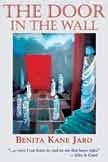
The Door in the Wall
by Benita Kane Jaro
xiv + 250 pp. (2002) 6" x 9" Paperback
ISBN 978-0-86516-533-5 $10.00
FREE SHIPPING and HANDLING! A $7.00 Savings!
One copy, prepaid, no returns, not available to distributors.
Offer expires 08/01/11
Make sure to mention that you are an eLitterae subscriber if you place your order by phone or fax. If you place your order via www.BOLCHAZY.com the eLitterae the free shipping offer will be noted at checkout. |
|
|
Fun Chiasms
How's this for an interesting example of a chiasm in English?
From billionaire investor guru, Warren Buffet:
"Be fearful when others are greedy and be greedy when others are fearful."
Men's Book, Spring 2011
And, another from my former colleague, Bud Phillips, who taught English at Loyola Academy, Wilmette, IL for thirty-plus years.
"Failing to prepare is preparing to fail!"
A Gladiator's Epitaph
Check out this NPR interview with Roman history expert Michael Carter whose analysis of a gladiator's epitaph contrasts sharply with the Hollywood image of a gladiator.
http://www.theworld.org/2011/06/the-death-of-a-gladiator/
A Roman Map Workbook
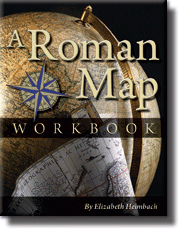 One of our most popular recent publications is Elizabeth Heimbach's A Roman Map Workbook. The text presents twenty maps specially designed for high school Latin students. Heimbach provides a narrative introduction to each map and its significance. Every classroom should have a resource set of these texts as the maps and their subject matter complement each year of Latin study. The correlation tables printed below provide a list of the twenty maps. Please note that a Teacher's Guide complements the student edition and provides access to a website with electronic versions of the maps including crossword puzzles. One of our most popular recent publications is Elizabeth Heimbach's A Roman Map Workbook. The text presents twenty maps specially designed for high school Latin students. Heimbach provides a narrative introduction to each map and its significance. Every classroom should have a resource set of these texts as the maps and their subject matter complement each year of Latin study. The correlation tables printed below provide a list of the twenty maps. Please note that a Teacher's Guide complements the student edition and provides access to a website with electronic versions of the maps including crossword puzzles.
Those of you who use Latin for the New Millennium will find the correlation published below a useful resource. We are, of course, quite pleased with the six maps commissioned especially for Latin for the New Millennium, three each for Level 1 and Level 2. Those in A Roman Map Workbook provide additional learning resources.
(Click here to download the Roman Map Workbook/LNM Map Correlations pdf)
These correlations will be posted on www.bolchazy.lnm.com.
"The thirteen chapters of the book can easily supplement both a middle school and high school Latin curriculum, while also providing excellent background material for discussions in the school's history curriculum . . .
Teachers of Latin will find this book to be a useful and practical addition to their supplementary classroom materials. Discussion of the maps and activities will be a valuable use of cross-disciplinary planning time between Latin and Social Studies teachers. A Roman Map Workbook is an enticing look at the physical and cultural world of Latin speakers."
—Laura Higley, The Classical Outlook, Winter 2011
For more information about A Roman Map Workbook, including the full review from The Classical Outlook. |
|
|
|
Insights on the Development of Latin for the New Millennium,
Level 3 |
 As mentioned in previous issues of eLitterae, Karrie Singh is constructing English derivatives materials for the teacher's manual for LNM 3. Drawing on the Latin vocabulary of the authors featured in LNM 3, Dr. Singh is preparing a list of English derivatives and their Latin roots that can be distributed to students; an analysis of those derivatives with examples for teachers to share in class as they wish; and sets of quizzes on which students can demonstrate their mastery of the derivatives presented. As is our LNM custom, we will provide free reproducibles of these materials in the LNM Teachers' Lounge. As mentioned in previous issues of eLitterae, Karrie Singh is constructing English derivatives materials for the teacher's manual for LNM 3. Drawing on the Latin vocabulary of the authors featured in LNM 3, Dr. Singh is preparing a list of English derivatives and their Latin roots that can be distributed to students; an analysis of those derivatives with examples for teachers to share in class as they wish; and sets of quizzes on which students can demonstrate their mastery of the derivatives presented. As is our LNM custom, we will provide free reproducibles of these materials in the LNM Teachers' Lounge.
When asked to share how she goes about collating these derivatives material, Dr. Singh shared the following with us.
Working with derivatives can be a laborious task, but the learning experience can be a lot of fun. Little light bulbs keep flashing in my brain as I come upon a word whose origins I had never considered before but whose evolution is so interesting.
When presented with a Latin word, I first look it up in Schaeffer’s Latin-English Derivative Dictionary and list the derivatives given, or a representative sample if the Latin word has an inordinate number, like fero or facio. I use the Oxford Latin Dictionary to analyze the bases of compound verbs or words that are seemingly related (like fragro and flagro). Then I check these in English dictionaries like the Random House College Dictionary or Webster’s International. I study the changes of the word through other languages to English and attempt to work out the source of meanings that don’t seem to come directly from the Latin root. If I fail to see the connection, I turn to the etymological dictionaries online. Sometimes I also have to turn to online dictionaries, including those for foreign languages (French, Portuguese, etc.) in order to understand the meanings of the word that helped to form the English word.
I then attempt to explain those derivatives whose meanings may not be apparent at first glance or to explain the prefixes that differentiate one derivative from another with the same root. Finally, I try to make up a sentence to show the usage of those words for which a context may not come immediately to mind. There again I sometimes have recourse to an online “usage” site for quotes, information, suggestions, etc. I also add a few tidbits of history suggested by the word and some ideas on how to make the learning of derivatives fun for the students. Merely memorizing lists is NOT fun!
Keeping the teacher in mind is always the impetus behind my work, especially new teachers who have enough on their plates without having to rack their brains to explain the origins of a word when a student asks for clarification or having to spend hours checking for derivatives and analyzing their composition when they have daily lesson plans to make and Latin texts to read and prepare. In my attempts to anticipate such a need, I may at times seem to be overly zealous in my explanations and examples; however, it is easy for one teacher to ignore material not needed but which may be helpful to another. Derivative analysis can be time-consuming. It is therefore hoped that this section of the teacher’s manual will help instructors to teach students more easily how much Latin has contributed to the English language.
Editor's Note: Indeed, we Latin teachers appreciate the value of Latin to building a student's English vocabulary. And, we recognize that a systematic study of the derivatives is needed to effect this building growth.
Karen Lee Singh earned a BA, MA, and PhD in classics from the University of Wisconsin at Madison. She taught at the University of Wisconsin and retired from Florida State University in 2006 where she also taught in the Florida State University School. Dr. Singh was three times named the N.H.S. Teacher of the Year, the DeMolay Teacher of the Year for Tallahassee (1980), the Florida Latin Teacher of the Year (1985), and The Irwing Wershow Award for Lifetime Achievement (1999). She has regularly been invited to present workshops and papers to classics groups. Dr. Singh served as president of the Florida Foreign Language Association and first vice-president of the Classical Association of Florida. She contributed two chapters to Paul MacKendrick's The Philosophical Books of Cicero (1989). Dr. Singh served on the AP* Development Committee and on the National Committee on Standards for Teaching Latin and Greek. Dr. Singh has served as contributing editor for a number of Bolchazy-Carducci projects and authored Vergil: A Legamus Transitional Reader Teacher's Guide. |
|
|
|
|
|