Classical Conferences and Meetings in 2011 and 2012 |
2011 Conferences
MaFLA - Massachusetts Foreign Language Teachers Association
44th Annual Conference
October 27–29, 2011
Sturbridge Host Hotel
Sturbridge, MA
Representative: Don Sprague
AIMS - Association of Independent Maryland Schools
Annual Conference
October 31, 2011
Baltimore Convention Center
Baltimore, MD
Representative: Don Sprague
2012 Conferences
APA - The American Philological Association
143rd Annual Meeting
January 5–8, 2012
Philadelphia Downtown Marriott Hotel
Philadelphia, PA
Representatives: Drs. Lou and Marie Bolchazy, Allan Bolchazy, Dr. Bridget Buchholz, and Don Sprague
CAMWS - The Classical Association of the Middle West and South
108th Annual Meeting
March 28–31, 2012
Louisiana State University
Belle of Baton Rouge Hotel
Baton Rouge, LA
Representatives: Drs. Lou and Marie Bolchazy, Allan Bolchazy, and Dr. Bridget Buchholz
ACL - The American Classical League
65th Annual Institute
June 27–30, 2012
University of Nevada
Las Vegas, NV
Representatives: Drs. Lou and Marie Bolchazy and Allan Bolchazy
Information taken from www.BOLCHAZY.com |
|
 |
|
Interesting Tidbits to Share |
Prairie Home Companion
Latin Tribute
Garrison Keillor pays tribute to his college Latin professor during the September 10, 2011 edition of Prairie Home Companion. Keillor's very first class he attended as a freshman at the University of Minnesota in 1960 was "Latin Readings" with Professor Margaret Forbes. A Google™ search shows that the January 14, 2006 show contained a similar tribute to Professor Forbes.
As part of the tribute, University of Minnesota Professor Emeritus of Classical and Near Eastern Studies, Robert Sonkowsky recited the Latin of Horace's Ode 1.22. This poem was one of the Latin selections studied in Keillor's "Latin Readings" course.
Click to see the full line-up for the show and to access the audio for Segment 3, in which Keillor speaks of Professor Forbes and he introduces Sonkowsky's recitation.
For information about Professor Sonkowsky, check this month's Audio Focus.
Horace's Ode 1.22
Check out www.merriampark.com. This website features the legacy of Ode 1.22 through the ages. Among such offerings is the following translation by John Quincy Adams (1767–1848), the sixth president of the United States.
Editor's Note: Horace's Ode 1.22 is one of the "enrichment" passages in the Horace Unit of Latin for the New Millennium, Level 3, due to debut at ACL, June 2012.
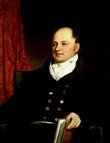
Portrait of John Quincy Adams
courtesy of Wikimedia Commons.
Adams' translation of Horace's ode is addressed "To Sally."
The man in righteousness arrayed,
A pure and blameless liver,
Needs not the keen Toledo blade,
Nor venom-freighted quiver.
What though he wind his toilsome way
O'er regions wild and weary —
Through Zara's burning desert stray,
Or Asia's jungles dreary:
What though he plough the billowy deep
By lunar light, or solar,
Meet the resistless Simoom's sweep,
Or iceberg circumpolar!
In bog or quagmire deep and dank
His foot shall never settle;
He mounts the summit of Mont Blanc,
Or Popocatapetl.
On Chimborazo's breathless height
He treads o'er burning lava;
Or snuffs the Bohan Upas blight,
The deathful plant of Java.
Through every peril he shall pass,
By virtue's shield protected;
And still by Truth's unerring glass
His path shall be directed.
Else wherefore was it, Thursday last,
While strolling down the valley,
Defenseless, musing as I passed
A canzonet to Sally,
A wolf, with mouth-protruding snout,
Forth from the thicket bounded —
I clapped my hands and raised a shout —
He heard — and fled — confounded.
Tangier nor tunis never bred
An animal more crabbéd;
Nor Fez, dry-nurse of lions, fed
A monster half so rabid;
Nor Ararat so fierce a beast
Has seen since days of Noah;
Nor stronger, eager for a feast,
The fell constrictor boa.
Oh! place me where the solar beam
Has scorch'd all verdure vernal;
Or on the polar verge extreme,
Block'd up with ice eternal —
Still shall my voice's tender lays
Of love remain unbroken;
And still my charming Sally praise,
Sweet smiling and sweet spoken.
Homer Praises Nissan's Murano Cross Cabriolet!

Thanks to former eLitterae editor LeaAnn Osburn for forwarding this brilliant piece from Car and Driver. LeaAnn had checked out the posting on LatinTeach and thought our readers would appreciate it.
John Pearley Huffman is a regular contributor to auto publications as well as the New York Times. This clever piece suggests his education surely included reading of the classics. He earned a BA in political science from the University of California at Santa Barbara. |
|
|
|
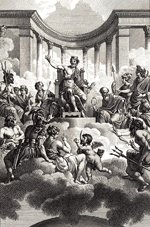
Wikimedia Commons image from a work
by Monsiau (1754–1837)
Bryan Baker, a recent convert to Latin for the New Millennium, Latin teacher at Colquitt County High School in Georgia, offered this terrific test on the LNM Teachers' Lounge.
Baker notes, "I am a stickler about multiple choice tests, having taught English Lit for so long. I have, as a consequence, gotten really good at writing test questions of the "know it or you don't" variety. Higher order thinking skills if you will."
Check out Baker's test on the Olympians. It contains eighteen well crafted multiple-choice questions as well as a matching section.
No matter what Latin text you're using, this is a great test for whenever you're teaching about the Olympians. Click to download your copy of this file, courtesy of Bryan Baker. |
|
|
The Aural/oral Components of the Latin for the New Millennium Series
Tuesday, October 25, 2011
6:00-7:30 ET
Latin for the New Millennium coauthor Terence Tunberg, celebrated neoLatinist and Conventicula Latina director, discusses the aural/oral components of the series. Dr. Tunberg will address such issues as how best to incorporate oral Latin in your LNM classroom. He will also demonstrate some of the oral activities delineated in the LNM Teacher's Manuals.
- All you need to participate in these webinars is high-speed Internet access, computer speakers/ headphones, and your access code, which we will provide to you once you register.
- Participation is free. All webinars provide an opportunity for participants to ask questions.
- Learn lots—attend each presentation. We’re happy to provide documentation of your participation for your supervisor(s)
Rave Review for Latin for the New Millennium Webinars
"The webinars are such a gift, and it's so kind of members of the LNM community (whether at the publishing level as you are, or enthusiastic teachers as Ms. Northrup is) to give time and energy to producing them, my only response is to say thank you! In both cases, the webinars offered very good, very useful information and embodied such a great spirit of collegiality that I would only ask you to do what you can to encourage such activity to continue."
–Rodney Larsen (Two-time Webinar Participant)
Academy of the Holy Cross
Kensington, MD
For more information about and to register for free webinars click here |
|
|
|
Bolchazy-Carducci textbooks are now available through Google and Xplana eBookstores, with more titles going digital every day! Each eBook offers a variety of tools to enhance the learning process, and eBook distributors are continually adding new features.
What do B-C eBooks currently offer?
eBooks have the same content as our traditional books in print, with these enhancements:

• Searchable
• Adjust text size, typeface, line space
• Free samples of books
• Worry-free archive
• Available on any computer with an internet connection
• Readable on:
- the web (via Windows or MAC computers)
- iPhone, iPad and iPod touch
- Android
- eBook Devices: Barnes & Noble Nook and Reader™ from Sony
Google ebook information: http://books.google.com/help/ebooks/overview.html
Google ebook store: http://books.google.com/ebooks
• Searchable
• Adjust text size, typeface, line space
•Add notes, customized highlights, and other annotations—all of which are added to the embedded annotation manager for convenient access
• Worry-free archive
• Available on any computer with an internet connection
• Readable on:
- the web (via Windows or MAC computers)
- tablet computers (any device that is Flash compatible)
Xplana ebook information: http://tinyurl.com/4qlyhye
Xplana ebook store: http://shop.xplana.com/
How do I purchase a B-C eBook?
Simple! When you are browsing through www.Bolchazy.com, any time you see Google or Xplana eBook logo, click on the logo, and you will automatically be directed to a webpage where you can purchase the eBook.
Can I purchase direct from the distributor?
Yes! If you prefer, you can link directly to our eBook providers’ websites and search by title, by author, or by Bolchazy-Carducci Publishers to locate the title you would like to purchase. The Google ebooks store offers a preview of the book, including the table of contents and select pages.
What hardware is required?
You can read eBooks on a Mac, PC, iPhone, iPad, Android, or a variety of eReaders. |
|
|
|
Bolchazy-Carducci
Links of Interest |
The Roman Calendar 2011–2012 should have arrived in your USPS mailbox. If you did not receive a Roman Calendar, please contact us at info@bolchazy.com, or download from our website: 2011-2012 Roman Calendar.
The calendar features important dates in Roman history as well as a daily snippet from the wisdom of the ancients.
Preview Bolchazy-Carducci Titles

Preview Bolchazy-Carducci titles before you buy using Google Preview.
Downloadable Products
iPodius - Bolchazy-Carducci Publishers online shop for: audio, software, video, and a treasure trove of teacher created materials in the Agora.
BCP Facebook Fan Page
Become a FAN of Bolchazy-Carducci Publishers, visit our Facebook Fan page for the latest news from BCP. |
|
|
|
|
An Interview with Katherine Bradley Coauthor of A Vergil Workbook,
2nd Edition |
DES: How did you become attracted to teaching Latin?
KB: I loved my Latin and Greek classes at the University of Michigan, and knew that teaching would be the only way to continue studying Classics. I spent an extra year at U-M to earn my teaching certificate before going on to graduate school. During my student teaching, my supervising teacher was inspiring and encouraging, and so I began teaching school after I finished my graduate program.
DES: What aspect of high school teaching brings you the most satisfaction?
KB: Watching students mature from gangly youngsters who think fairly literally into young adults who enjoy grappling with abstract ideas is the most satisfying. Being around teenagers, who are usually energetic, witty and optimistic, is a blast.
DES: Did you read Vergil as part of your high school Latin program? What do you recall of the experience?
KB: I began studying Latin and Greek in college, and did not read Vergil as an undergraduate.
DES: Why do you think studying Vergil is relevant for today's students?
KB: We read the Aeneid, so I will speak only to that work. In it, Vergil raises compelling questions: how do you choose the right course of action if the options also have negative consequences? What does loyalty mean? How do we weigh duty to family against duty to community? Why do we continue to be motivated by irrational forces? Are conflict and war inevitable? There are, obviously, many other questions raised, too, and it is in the discussion of these "big" ideas that we discover our humanity.
DES: What aspect/story of Vergil do you most like to teach?
KB: I enjoy teaching the Camilla episode and the Hercules and Cacus episode.
DES: If you were to give a novice teacher beginning her high school Latin teaching one nugget of advice based on your years of success as a Latin teacher, what would that be?
KB: Always bear in mind why you're teaching as much as whom and what you are teaching.
DES: With the new school year, you'll be taking on new responsibilities at Groton. How do you see your new role impacting your students' learning experience?
KB: As Assistant Head, my focus broadens from the care of students to the care of faculty, too. I will be teaching fewer classes, and I will be paying closer attention to the full range of curricular offerings rather than Classics only. In the classroom, though, I hope things don't change too much: I love my students, and I appreciate that I get to share with them the authors whom I myself enjoy so much.
DES: When not involved in teaching and learning more about the Classics, what do you most enjoy doing?
KB: I do in fact spend some of my "fun" time reading Latin and Greek, or preparing classes, or, occasionally, writing Latin. I live in a dormitory with 20 ninth-grade boys and five seniors, and this lifestyle keeps me hopping. Apart from that, my sons, who are six and eight, keep me busy. I enjoy reading, but find that these days I don't read as much as I used to.
Editor's Note: Katherine is pleased with the revised version of the popular A Vergil Workbook. The Second Edition includes all the new Aeneid passages required for the AP* 2012–2013 Latin syllabus. The workbook will also include several sight passages to help students develop their confidence in working through passages they're encountering for the first time. The Teacher's Manual has also been revised to accommodate the new syllabus. It will feature some essay suggestions that synthesize Caesar and Vergil. Like the current Teacher's Manual, it will feature four sight passages with accompanying multiple-choice questions.
The following biography is taken from the Groton School website. You'll note how revising A Vergil Workbook was “plork” for Katherine this past summer.
 Interim Assistant Head of School Katherine Bradley loves teaching Latin and Greek so much that she spends much of her summers exploring these interests or preparing her classes. She even employs the word “plork”—a conflation of play and work—to describe the satisfaction her work brings. Interim Assistant Head of School Katherine Bradley loves teaching Latin and Greek so much that she spends much of her summers exploring these interests or preparing her classes. She even employs the word “plork”—a conflation of play and work—to describe the satisfaction her work brings.
Katherine joined Groton in 2001 as a teacher of Latin and Greek. In 2004, she became head of the Classics Department, and in 2011 was named interim head of school. Before Groton, she was an instructor at the CANE Summer Institute; ninth grade principal and a teacher of Latin, Greek, and English at Greenhills School; and a Latin teacher at Gabriel Richard High School. Katherine has undergraduate and graduate degrees from the University of Michigan. Her published works include A Vergil Workbook: Teacher's Manual, A Vergil Workbook, “Self-guides to the Art Institute of Chicago” in Art of the Ancient Mediterranean World: Egypt, Greece, Italy, and "Women in the Ancient World," a slide show for the Kelsey Museum of Archaeology. Katherine’s awards include Groton’s Breck Award for Excellence in Teaching, the state of Michigan’s Glenn Knudsvig Award for the Teaching of Latin, and the Eunice Kraft Teaching Award.
Katherine heads a third form boys dorm, which she describes as “crazy, loud, and rambunctious,” but she says she finds herself “thankful to be working amidst such spirit, enthusiasm, and friendship.” She lives with Matt McCracken and their two sons, Degefe and Ajaje. Katherine enjoys spending time with family, exercising, and reading. Her current scholarly focus is Cicero. |
|
|
|
Report from Illinois Classical Conference 2011 |
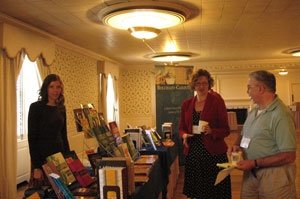
Laurel De Vries, Amanda Coles of Illinois Wesleyan University,
and Nick Young of University of Detroit High School
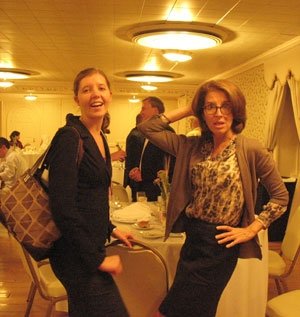
Intern Editor Laurel De Vries and ICC President Becki Wick
ham it up for the camera after the banquet
Editor Don Sprague and Intern Editor Laurel De Vries drove to the University of Illinois at Champaign-Urbana over Columbus Day weekend to join some 65 fellow classicists at ICC's annual meeting. B-C inventory and shipping specialist Michael Frazier packed Sprague's Honda Accord to the gills with goodies to be displayed at the ICC book exhibit. B-C believes strongly in meeting the desire of classicists, most of whom are also bibliophiles, to check out the books in real time . . . to page through them and relish doing so. B-C also donated a box full of classics texts to the ICC scholarship book sale.
University of Illinois classics professor Ariana Traill, her colleagues, and especially, the department's graduate students demonstrated meticulous care in ensuring that the conference met attendees' needs. The program arranged by Jim Chochola and Brian Tibbets offered a variety of talks—the practical, the pedagogical, and the scholarly.
Monmouth's Tom Sienkewicz presented a fantastic Florentine adventure exploring classical items and gave everyone a thick packet of references and materials for their next visit to Italy. Don Sprague's presentation, "Visions of Vitruvius in the New World" kicked off a thread of presentations on Augustan architecture and city planning. LNM 3 consultant, Nicholas Young of the University of Detroit-Mercy and the University of Detroit Jesuit High School talked about Augustus as "Builder and City Planner." The thread culminated in an overflow crowd for the University of Pennsylvania's Professor Lothar Haselberger who presented "Which Rome? Classics and Classical Architecture in the 21st Century." Haselberger's thesis that Alexandria provided a model for Augustan Rome proved very convincing.
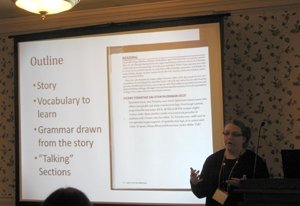
Lisa Walls presents on Latin for the New Millennium
Pedagogy presentations included using Google™ maps and Google™ docs in the Latin classroom, reading Latin, and Batavia High School's Lisa Walls, who spoke on "Latin for the New Millennium in the Classroom." Walls proved herself a very enthusiastic teacher as she discussed her experience transitioning to LNM and its benefits. Of particular note, her experience that students entering Latin 3 after two years of LNM were much better prepared than her students who had not used LNM.
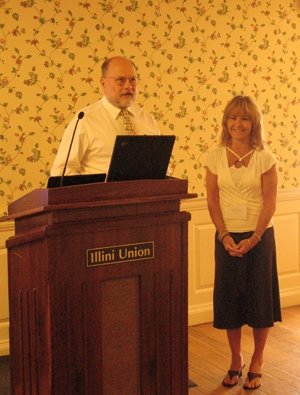
Tom Sienkewicz celebrates the career of Janene Mattingly
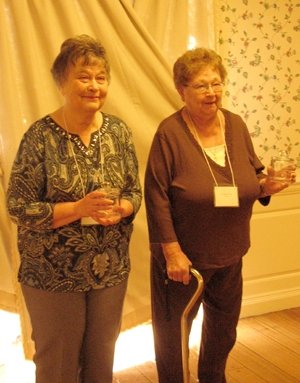
Dynamic Duo Lifetime Achievement Awardees
Judy Streid and Henri Davis
A highlight of conferences like ICC is the annual presentation of awards. The conference honored East Peoria High School's Janine Mattingly as she retires after thirty-seven years of high school teaching. It was fitting that she receive her award at her alma mater, the University of Illinois. The Lifetime Achievement Award was given to the dynamic Latin teacher duo Henrietta Davis and Judy Streid whose decades of inspiring the students of Pekin High and service as co-chairs of the Illinois Latin Tournament are legendary. Ad multos annos, Henri and Judy!
In 2012, the Illinois Classical Conference celebrates its 75th anniversary. The University of Chicago will host this milestone event. |
|
|
|
Specials for eLitterae Subscribers |
30% off Featured Horace Title
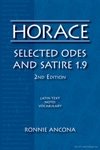
Horace Selected Odes and Satire 1.9, 2nd Edition
Ronnie Ancona
Student text: xxxii + 199. (2005) 9" x 6” Paperback
ISBN 978-0-86516-608-0 $38.00 $26.50
Teacher’s Guide: 82 pp. (2005) 8 1/2" x 11” Paperback
ISBN 978-0-86516-612-7 $29.00 $20.00
One copy of each, prepaid, no returns, not available to distributors.
Offer expires 11/15/11
Make sure to mention that you are an eLitterae subscriber if you place your order by phone or fax. If you place your order via www.BOLCHAZY.com the eLitterae. the special offer pricing will be charged at checkout. |
|
|
Insights on the Development of Latin for the New Millennium,
Level 3 |
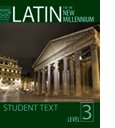 Work on Latin for the New Millennium, Level 3 continues apace. Helena Dettmer and LeaAnn Osburn are busy evaluating and incorporating the feedback from the consultants on the Cicero, Horace, Ovid, and Vergil units. The consultants offer suggestions for additions, deletions, clari-fications, and alternative interpretations. Helena and LeaAnn carefully weigh this feedback and make adjustments as they see fit. Sometimes this results in an additional Teaching Tip or Teacher By the Way for the teacher's edition and other times an additional item for the student text. The collation of consultant feedback includes a set of "author queries" from my perspective as editor for the volume. Currently, the consultants are working their way through the Caesar Unit. Karrie Singh and I are collaborating on the Renaissance Authors Unit. Latin for the New Millennium, Level 3 will include units on Caesar, Catullus, Cicero, Vergil, Horace, Ovid, and some Renaissance authors with an emphasis on Erasmus. The collaborative effort in the development of Latin for the New Millennium, Level 3 ensures a carefully vetted text. Work on Latin for the New Millennium, Level 3 continues apace. Helena Dettmer and LeaAnn Osburn are busy evaluating and incorporating the feedback from the consultants on the Cicero, Horace, Ovid, and Vergil units. The consultants offer suggestions for additions, deletions, clari-fications, and alternative interpretations. Helena and LeaAnn carefully weigh this feedback and make adjustments as they see fit. Sometimes this results in an additional Teaching Tip or Teacher By the Way for the teacher's edition and other times an additional item for the student text. The collation of consultant feedback includes a set of "author queries" from my perspective as editor for the volume. Currently, the consultants are working their way through the Caesar Unit. Karrie Singh and I are collaborating on the Renaissance Authors Unit. Latin for the New Millennium, Level 3 will include units on Caesar, Catullus, Cicero, Vergil, Horace, Ovid, and some Renaissance authors with an emphasis on Erasmus. The collaborative effort in the development of Latin for the New Millennium, Level 3 ensures a carefully vetted text.
|
|
|
|
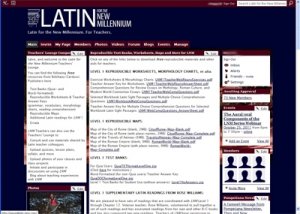
The Teachers' Lounge offers a treasure trove of teacher-generated materials. Teachers using Latin for the New Millennium are granted access to the Teachers' Lounge and to materials provided by Bolchazy-Carducci. Of equal value, however, is a panoply of materials posted by LNM teachers. If you have a particular topic for which you want to find some teaching tips or classroom materials, simply type your topic—say "indirect statement"—into the search box at the upper righthand corner. And, voila! a stream of entries with valuable suggestions from our Latin teacher colleagues pop up.
In addition, I direct you to Kelly Northrup's Forum posting, "All My Stuff Year 3." Kelly, an LNM enthusiast has posted her syllabi, lesson plans, etc. for you to mine. To access her most recent batch of materials stored in a drop box, contact her directly at knorthrup@webbschool.com and she'll give you access. She has 10 MB of files for Latin 1 alone! Kudos to Kelly! Many of you have learned from Kelly's insights presented in her popular Latin for the New Millennium webinars. Gratias tibi, Kelly, agimus! |
|
|
|
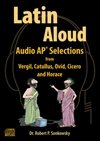
Enjoy the following selections from Catullus and Vergil read by master of the restored classical Latin pronunciation, Robert Sonkowsky. They are excerpted from Latin Aloud: Audio AP* Selections from Vergil, Catullus, Ovid, Cicero, and Horace which can be purchased as a full CD with over five hours of recordings or as single tracks through iPodius.
These selections are a great way to reinforce the aural-oral component of studying Latin poetry.
Download these selections.
Catullus 5
Catullus 7
Aeneid 12:887–952
You can also hear Sonkowsky's recitation of Horace's Ode 1.22 as noted in the feature on the Prairie Home Companion.
Robert Sonkowsky is a professor emeritus of Classical and Near Eastern Studies at the University of Minnesota. He is an authority on Latin rhetoric and the pronunciation of Golden Age Latin. His bachelor's degree is from Lawrence College, and his PhD is from the University of North Carolina. He is an Honorary Member of the Center for Chronobiology in the Mayo Building, Medical School.
Sonkowsky is a leading authority on and a performer of oral renditions of classical texts. He made the album Homer: The Death of Patroclus - Chapter XVI of the Iliad with Folkways Records as part of the Smithsonian Center for Folklife and Cultural Heritage. Numerous other recordings of his in classical Greek and Latin are available on the Internet.
Professor Sonkowsky is also a gifted actor who's been seen in on many Twin Cities stages, including the Guthrie Lab, the Lyric Theatre (at Minneapolis Theatre Garage), and Theatre de la Jeune Lune. He has appeared in numerous commercials (Northwest Airlines, Snyder Drug, Best Buy Stores, to name a few) and in industrial films for Blue Cross/Blue Shield, AT&T, 3M, Mayo Clinic, and other corporations.
With iPodius, one can purchase downloads of single works. |
|
|
|
Some Notes on B-C Titles and Series |
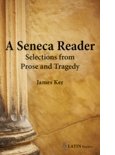 For those using or contemplating the use of the BC Latin Readers, Series Editor Ronnie Ancona encourages you to check out the webpage. In particular, she notes the abstracts from the 2011 CAMWS panel of BC Latin Reader authors: Latin in Small Packages: Expanding and Varying Advaned Latin Curricular Options. For those using or contemplating the use of the BC Latin Readers, Series Editor Ronnie Ancona encourages you to check out the webpage. In particular, she notes the abstracts from the 2011 CAMWS panel of BC Latin Reader authors: Latin in Small Packages: Expanding and Varying Advaned Latin Curricular Options.
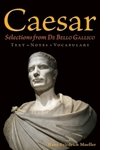 AP* Caesar Text for the AP* Caesar Text for the
New 2012–2013 Latin Syllabus
Hans-Friedrich Mueller's Caesar: Selections from De Bello Gallico speaks directly to today's Latin student making Caesar a relevant topic for an understanding of the contemporary world. In addition to providing notes and commentary for all the Latin selections required for the AP* exam, Professor Mueller, an accomplished high school and college Latin instructor, includes the required English readings from De Bello Gallico in this new text.
To learn more about our new and revised texts for the AP* 2012–2013 Latin Syllabus, and to order preview copies, check out this special page on the B-C website. |
|
|
|
|
|