Classical Conferences and Meetings in 2012 |
APA - The American Philological Association
143rd Annual Meeting
January 5–8, 2012
Philadelphia Downtown Marriott Hotel
Philadelphia, PA
Representatives: Drs. Lou and Marie Bolchazy, Allan Bolchazy, Dr. Bridget Buchholz, and Don Sprague
Round Table Discussion: Latin for the New Millennium in the College Classroom - Saturday, January 7, from 11:30am–1:00pm.
CANE - Classical Association of New England
2012 Annual Meeting
March 16–17, 2012
St. Sebastian's School
Needham, MA
Representative: Don Sprague
CAMWS - The Classical Association of the Middle West and South
108th Annual Meeting
March 28–31, 2012
Louisiana State University
Belle of Baton Rouge Hotel
Baton Rouge, LA
Representatives: Drs. Lou and Marie Bolchazy, Allan Bolchazy, and Dr. Bridget Buchholz
47th International Congress on Medieval Studies
May 10–13, 2012
Western Michigan University
Kalamazoo, MI
Representatives: Dr. Bridget Buchholz and Adam Velez
ACL - The American Classical League
65th Annual Institute
June 27–30, 2012
University of Nevada
Las Vegas, NV
Representatives: Drs. Lou and Marie Bolchazy, Allan Bolchazy, Dr. Bridget Buchholz, and Don Sprague
NJCL - The National Junior Classical League
59th Annual Convention
July 26–31, 2012
Wake Forest University
Winston-Salem, NC
Representatives: Allan Bolchazy and Laurel De Vries
Information taken from www.BOLCHAZY.com |
|
 |
|
Interesting Tidbits to Share |
Echoes of Caesar
Bonobos, an online apparel company, advertised its chino pants recently with this headline:
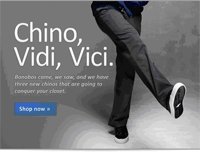
Bonobos came, we saw, and we have three new chinos that are going to conquer your closet.
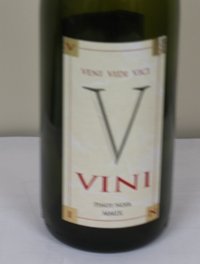
For those wine drinkers among you, may I recommend the Veni Vidi Vici Vini label. I regularly check out the wine offerings at a local grocery store that serves a variety of ethnic groups in the Rogers Park neighborhood of Chicago. As you can imagine, the Veni Vidi Vici readily caught my attention. I enjoyed the Pinot Noir 2009 (MMIX on the front label!). These wines are from vineyards along the Danube River plains in Bulgaria. As the label bids, "Indulge in this ancient grape growing region, historically a purveyor to Rome, it's a focal point of today's pioneering winemakers." Check out www.BulgarianWine.com.
Spartacus
The Chicago Tribune regularly presents a Sunday edition feature entitled "10 things you might know about . . . " The October 23, 2011 version featured "10 things you might know about Class Warfare." Item #8 on the list has a classics connection.
One of the most memorable class wars in history was the slave revolt led by Spartacus against the Roman Empire, circa 72 BC. The climactic scene in the 1960 film "Spartacus" depicts warriors shouting in solidarity, "I am Spartacus!" The filmmakers recorded audio for that scene and others by getting 76,000 football spectators to shout phrases before a 1959 Michigan State-Notre Dame football game in East Lansing. Then the Spartans defeated the Irish (and the Romans defeated the slaves).
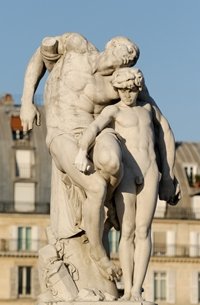
The Oath of Spartacus by Louis-Ernest Barrias (French, 1841–1905). Marble, 1871. In the Tuileries Gardens, Paris. Photo by Marie-Lan Nguyen / Wikimedia Commons (Public Domain) |
|
|
|
Editor Intern Laurel De Vries is doing some student teaching at Lake Forest Academy, Lake Forest, Illinois. She is working with David Wick's Latin 1 and Latin 2 students who have been learning Latin with the Latin for the New Millennium series. Inspired by a presentation at the Illinois Classical Conference by Joel Coakley, a student at Wheaton College, Laurel developed a similar Google™ Maps project to complement their study of Pompeii. Check out Laurel's project guidelines and her experience driven advice.
Download PDF of project details. |
|
|
Bolchazy-Carducci textbooks are now available through Google and Xplana eBookstores, with more titles going digital every day! Each eBook offers a variety of tools to enhance the learning process, and eBook distributors are continually adding new features.
What do B-C eBooks currently offer?
eBooks have the same content as our traditional books in print, with these enhancements:

• Searchable
• Adjust text size, typeface, line space
• Free samples of books
• Worry-free archive
• Available on any computer with an internet connection
• Readable on:
- the web (via Windows or MAC computers)
- iPhone, iPad and iPod touch
- Android
- eBook Devices: Barnes & Noble Nook and Reader™ from Sony
Google ebook information: http://books.google.com/help/ebooks/overview.html
Google ebook store: http://books.google.com/ebooks
• Searchable
• Adjust text size, typeface, line space
•Add notes, customized highlights, and other annotations—all of which are added to the embedded annotation manager for convenient access
• Worry-free archive
• Available on any computer with an internet connection
• Readable on:
- the web (via Windows or MAC computers)
- tablet computers (any device that is Flash compatible)
Xplana ebook information: http://tinyurl.com/4qlyhye
Xplana ebook store: http://shop.xplana.com/
How do I purchase a B-C eBook?
Simple! When you are browsing through www.Bolchazy.com, any time you see Google or Xplana eBook logo, click on the logo, and you will automatically be directed to a webpage where you can purchase the eBook.
Can I purchase direct from the distributor?
Yes! If you prefer, you can link directly to our eBook providers’ websites and search by title, by author, or by Bolchazy-Carducci Publishers to locate the title you would like to purchase. The Google ebooks store offers a preview of the book, including the table of contents and select pages.
What hardware is required?
You can read eBooks on a Mac, PC, iPhone, iPad, Android, or a variety of eReaders. |
|
|
|
Bolchazy-Carducci
Links of Interest |
The Roman Calendar 2011–2012 should have arrived in your USPS mailbox. If you did not receive a Roman Calendar, please contact us at info@bolchazy.com, or download from our website: 2011-2012 Roman Calendar.
The calendar features important dates in Roman history as well as a daily snippet from the wisdom of the ancients.
Preview Bolchazy-Carducci Titles

Preview Bolchazy-Carducci titles before you buy using Google Preview.
Downloadable Products
iPodius - Bolchazy-Carducci Publishers online shop for: audio, software, video, and a treasure trove of teacher created materials in the Agora.
BCP Facebook Fan Page
Become a FAN of Bolchazy-Carducci Publishers, visit our Facebook Fan page for the latest news from BCP.
*AP is a registered trademark of the College Entrance Examination Board, which was not involved in the production of, and does not endorse this product. |
|
|
|
|
eLitterae Interview with David Pellegrino
Author of B-C's forthcoming AP* Caesar Vocabulary Cards |
DES: How did you become attracted to teaching Latin?
DP: Teaching has been a profession that I have always wanted to pursue since elementary school. In ninth grade, I was a Spanish student who had homeroom in the Latin room. Underneath my desk there was a Using Latin 1 book, which I read from cover to cover. After that, I was hooked.
DES: What aspect of high school teaching brings you the most satisfaction?
DP: I love to use humor to bring Latin alive. There is nothing more satisfying than when students come back to tell me that they knew more about ancient Rome than their global studies teacher!
DES: Did you read Caesar as part of your high school Latin program? What do you recall of the experience?
DP: At the end of Latin 2, I remember reading the first few chapters of Book I of De Bello Gallico. I remember that it was difficult and that our Latin teacher had to help us a great deal.
DES: Why do you think studying Caesar is relevant for today's students?
DP: I think that Caesar is probably the most important general and politician of his time. Latin students have a great deal to learn from his leadership skills and ability to deal with setbacks that he encountered in lands far from Rome. Students learn the concept of bias and how Caesar uses it to sway the minds of the Romans.
DES: What aspect/story of Caesar do you most like to teach?
DP: I love to teach the sections in De Bello Gallico that deal with the culture of the Gauls and the Britons. I was thrilled to find out that the AP* was going to have some of those descriptions in the syllabus.
DES: If you were to give a novice teacher beginning her high school Latin teaching one nugget of advice based on your years of success as a Latin teacher, what would that be?
DP: Don’t be afraid to ask for help. I have learned a great deal from my colleagues who are a constant source of inspiration for me.
DES: Recently your school's Latin program was honored by the Classical Association of the Empire State. Could you tell our readers what that involved?
The five full-time Latin teachers met to list our collective accomplishments. As all five of us are involved in Junior Classical League, we work very hard to prepare our students for future competitions. We have created our own materials to supplement what we do in the classroom with our textbooks. We believe that all students can be successful with Latin and have systematic methods where students can learn from their mistakes and improve their Latin skills as well as their grades. We incorporate various forms of technology (smartboards, educational websites, e.g., Quia, Google Earth Rome 3D) into the Latin classroom. The use of modern technology in the study of an ancient language has given our students the opportunity to express their knowledge in new and different ways and also allows the subject matter to become more easily relatable. Students are able to use tools with which they are familiar to facilitate their language learning. Because of these factors and many more, our enrollment has more than doubled with the tremendous support of the administration, staff, and community.
DES: When not involved in teaching and learning more about the classics, what do you most enjoy doing?
DP: Even though I spend a great deal of time with the classics, I enjoy taking hikes in the beautiful parks in my area. Since I love to learn new languages, right now I am learning Mandarin.
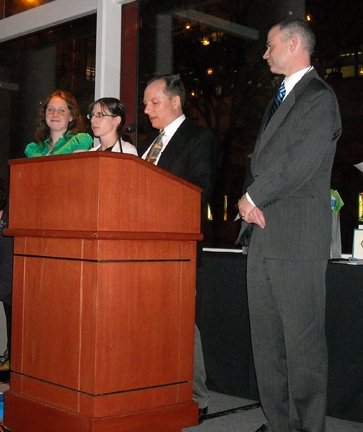
David Pellegrino accepts the CAES 2011 Award for Outstanding Latin Program on behalf of his colleagues at Pittsford Mendon High School.
David R. Pellegrino has been teaching Latin for twenty-four years. He has experience with both middle level and high school Latin. He majored in Latin at the State University of New York, Albany, where he subsequently gained an MA in Latin Education. He is past president of the Classical Association of the Empire State and Latin teacher at Pittsford Mendon High School. Pellegrino is the author of B-C's Catullus Vocabulary Cards for AP* Selections (2006) and Cicero and Horace Vocabulary Frequency Lists for AP* Selections (2008).
Pellegrino is hard at work developing word frequency lists and vocabulary cards based on the new AP* Caesar curriculum. Bolchazy-Carducci is pleased to collaborate with David Pellegrino and plans to have this product available in March, 2012. |
|
|
|
CAES and NYSAFLT Combined Conference Report |
This past October, the Classical Association of the Empire State (CAES) joined the New York State Association of Foreign Language Teachers (NYSAFLT) for a combined conference in Rochester New York from October 14–16. Lou and Marie Bolchazy staffed the B-C exhibit. While the registration and a number of the sessions were held at the Hyatt (the conference hotel), the refreshments and many of the sessions were held in the conference center next to the exhibit hall. In addition, the door prizes were given out there. Forty-five minute breaks gave sufficient time for conferees to visit the exhibitor booths. During the breaks, activity was brisk. Total attendance was approximately 375 with CAES members representing 55 of the participants. CAES usually draws about 50+ conferees, but, at this meeting, teachers of other foreign languages also visited the B-C booth. Some of them have just one section of Latin and wouldn’t normally attend a classics conference. 41 exhibitors ranging from the expected like Pearson Prentice Hall and Glencoe/McGraw-Hill to the unusual like a company dealing with fly fishing and another offering on-site massages joined B-C.
For each time slot, a session of interest to classicists was held:
- The New AP* Latin Course—Jill Crooker, who has served as an LNM consultant, was the presenter and was introduced by David Pellegrino, who has composed sets of vocabulary cards for B-C.
- Ecce Libri—Susan Scoppa discussed novels in English that elicit the interest of Latin students. She mentioned all of B-C's Jaro books and Cobbold’s translation of the Aeneid.
- Latin Checkpoint B Exam—Tom Hayes, CAES president, discussed how programs throughout New York produced and administered replacement exams for Checkpoint B.
- Aspects of Aeneas’ Character—Ray Perez examined several scenes from the Aeneid.
- Strategies for Saving Latin and Other Foreign Language Programs—discussed strategies and tactics for responding to budget cuts.
At the banquet—wow!—CAES gave out a lot of awards. Of special interest was one given to David Pellegrino and his colleagues at Pittsford Mendon High School, New York celebrating their outstanding Latin program.
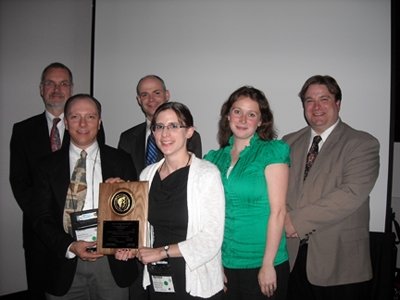
Pittsford Mendon High School Classics Faculty
Front: David Pellegrino, Julia Smith, Shelley Lindsay, Joshua Walker Back: John Weymann, Lynn Smith
John Anderson from Canisius High School in Buffalo made a point of sharing his experience with Latin for the New Millennium. Canisius adopted the program and is very pleased with LNM.
Not a conference goes by that we do not get praise for our customer service. Michele Cella of Irvington High School noted that it’s great to call B-C as the people who answer the phones are helpful and know what they are talking about. Said she, “It’s rare to find people who are knowledgeable, polite, and helpful.” We appreciate that feedback and immediately shared it with Linda, David, and Julie in customer service as well as Betty and Mike in shipping.
Marie Bolchazy |
|
|
|
Classical Association of the Atlantic States Report |
While the Bolchazys represented B-C in New York, I carried the standards to the Hunt Valley Marriott near Baltimore, Maryland where the Classical Association of the Atlantic States held its annual meeting, October 13–15. Prior to setting up the book display, I caught up with former student Tim Joseph, currently teaching classics at College of the Holy Cross, and his mom Sarah (with husband Bob, she now lives in DC), over dinner at the hotel. B-C, the only publisher who sent a representative to the meeting, provided four tables of titles of interest to both high school teachers and college professors. B-C authors Ronnie Ancona, Henry Bender, and David Murphy gave presentations at CAAS.
The conference afforded the opportunity to connect with CAAS friends and to spend some time with Ronnie Ancona, who serves as series editor for the BC Latin Readers and has been consulted on Latin for the New Millennium. Several of Ronnie's MAT graduates attended CAAS and I enjoyed chatting with them and savoring their enthusiasm for their high school Latin students. The Second Annual Jerry Clack Lecture featured Amy Richlin, UCLA, who delivered an entertaining and at the same time highly informative talk "Unexpurgated Classics: Profane Texts in a Christian Curriculum." It is always an inspiration to hear such a scholar firsthand!
The awards CAAS presents at the conference are always a highlight. I was especially pleased to share in the celebration as Barbara McManus, College of New Rochelle, received special recognition for her many years of service to CAAS and her passion for making the classics an inclusive discipline reaching out to minorities. Barbara and I shared a formative experience in 1979—a Vergilian Society study program of Campania under the direction of outstanding instructors Ann Koloski-Ostrow and Steve Ostrow. For over three decades, Barbara's commitment and enthusiasm for the classics has been a source of inspiration for me.
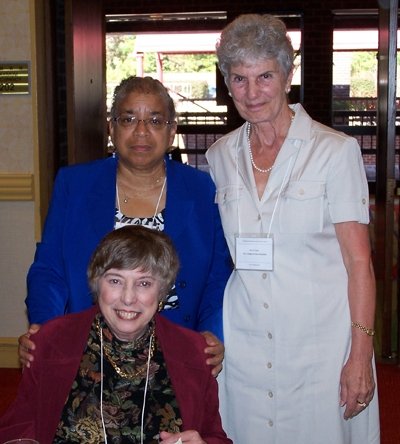
CAAS Honoree Barbara McManus flanked by CAAS First Vice President Shelley P. Haley of Hamilton College and College of New Rochelle colleague and collaborator Anne Raia.
It was also inspiring to witness Barbara Gold of Hamilton College and Matthew S. Santirocco of New York University, longtime editor for the Classical World, each being honored with a CAAS Ovatio. Kudos to Gold and Santirocco whose dedication to the classics profession is exemplary.
Many thanks to the students from Temple University's Eta Sigma Phi Chapter (college honors society for classics students) who volunteered to help me break down the book exhibit. Their sponsor, Martha Davis, and her colleagues at Temple deserve acclaim for the love of Latin and Greek that they instill in their students. It is an annual treat to chat with these young scholars about their classics studies. |
|
|
|
Specials for eLitterae Subscribers |
As we approach ordering season for 2012, teachers tell us that schools are struggling to provide books for their students. We wondered if we could help. We assessed stock, toughened negotiations, sharpened our pencils, and are pleased to announce that we are able to reduce the prices 6% to 40% on some of our most popular Latin texts for 2012. Some of our districts are ordering now for second semester so we are making these price reductions available immediately. Visit our Specials page for additional special pricing on textbooks.
Please note a very special offer for A Vergil Workbook, First Edition: $13.50 per copy.
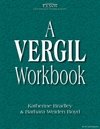
A Vergil Workbook
Katherine Bradley and Barbara Weiden Boyd
xiv + 226 pp. (2006) 8.5" x 11” Paperback
ISBN 978-0-86516-614-1 $27.00 $13.50
We have an overstock of the first edition, and are offering the first edition right now at half price, while supplies last. It is a perfect study aid for students who are studying Vergil in the spring semester of 2012. Normally $27, you can now have this book at $13.50. This offer is open to individuals, bookstores, and distributors. Sorry, no returns.
A Vergil Workbook, 2nd edition is being published in March of 2012, and is tailored to the new AP Syllabus.
Make sure to mention that you are an eLitterae subscriber if you place your order by phone or fax. If you place your order via www.BOLCHAZY.com the special eLitterae offer pricing will be charged at checkout. |
|
|
|
Updates on Texts in Development |
Latin for the New Millennium, Level 3
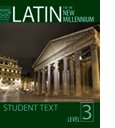 Editors Helena Dettmer and LeaAnn Osburn are putting the final touches on the manuscript for the six units on classical authors: Caesar, Catullus, Cicero, Vergil, Horace, and Ovid. Dr. Karen Singh and Don Sprague are working on the Renaissance Latin authors unit. It will feature letters from Erasmus, called the "Cicero" of his day for the quality of his classical Latin, for his prolific writing, and for the breadth of his works with respect to content and genre. While Sprague edits the body of the text, Dettmer and Osburn will work on the front and back matter including preface, appendices on meter and figures of speech, etc. Latin for the New Millennium, Level 3 is on schedule to debut at ACL 2012 in Las Vegas, Nevada. Editors Helena Dettmer and LeaAnn Osburn are putting the final touches on the manuscript for the six units on classical authors: Caesar, Catullus, Cicero, Vergil, Horace, and Ovid. Dr. Karen Singh and Don Sprague are working on the Renaissance Latin authors unit. It will feature letters from Erasmus, called the "Cicero" of his day for the quality of his classical Latin, for his prolific writing, and for the breadth of his works with respect to content and genre. While Sprague edits the body of the text, Dettmer and Osburn will work on the front and back matter including preface, appendices on meter and figures of speech, etc. Latin for the New Millennium, Level 3 is on schedule to debut at ACL 2012 in Las Vegas, Nevada.
Caesar: Selections from De Bello Gallico
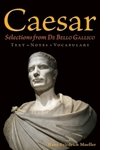 Hans-Friedrich Mueller's text written to meet the new curricular expectations of the AP* Latin syllabus is on target for publication in March, 2012. Mueller has used the popular Pharr Vergil’s AENEID as a model for this text. Thus, each page will contain the Latin text, vocabulary in alphabetical order, and notes. Caesar: Selections from De Bello Gallico will include a general vocabulary pull-out of the vocabulary that most frequently appears in these selections. In addition to the Latin text, Caesar: Selections from De Bello Gallico will include the English selections required for the AP* exam along with notes. Hans-Friedrich Mueller's text written to meet the new curricular expectations of the AP* Latin syllabus is on target for publication in March, 2012. Mueller has used the popular Pharr Vergil’s AENEID as a model for this text. Thus, each page will contain the Latin text, vocabulary in alphabetical order, and notes. Caesar: Selections from De Bello Gallico will include a general vocabulary pull-out of the vocabulary that most frequently appears in these selections. In addition to the Latin text, Caesar: Selections from De Bello Gallico will include the English selections required for the AP* exam along with notes.
Vergil’s Aeneid:
Selected Readings from Books 1, 2, 4, and 6
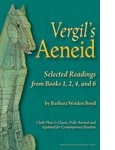
Barbara Weiden Boyd's latest Vergil text contains all the lines of the Aeneid required by the new AP* Latin syllabus. This version contains updated and revised notes and vocabulary for the required passages. In Pharr-fashion, vocabulary and notes follow the Latin passage on the same page. A complete Latin to English vocabulary is provided along with the general vocabulary pull-out. The text will include newly revised sections: “Vergil’s Meter” and “Rhetorical Terms, Figures of Speech, and Metrical Devices.” Recognizing that students prefer to carry around a lighter text, the grammatical index and grammatical appendix will be available online. This revised text will be available in March, 2012. |
|
|
|
Check out Laurel DeVries' Google™ Maps project and adapt it to complement your Latin for the New Millennium lessons. Consider the possibilities!
Level 1
Chapter 4: Trace Pyrrhus' Campaign from Epirus to Tarentum and southern Italy.
Chapter 8: Students can find the major battle sites of Xerxes' campaign against the Greeks.
Chapter 10: Students can check out the site of the excavations at Troy (Canakkale, Turkey).
Chapter 11: Students can follow Aeneas' travels by using the map provided on p. 187, Latin for the New Millennium, Level 1.
Chapter 13: Page 227 provides a schematic map of the city of Rome. Students can follow the path of the boor and Horace through the Forum Romanum. Caveat: students must distinguish which buildings are post-Horatian and which are from the Rome of his day.
Chapter 16: Laurel De Vries' project described in the Curriculum Corner and posted on the LNM website is a terrific activity for this chapter.
Chapter 17: Students can use Google™ Maps to determine which buildings were erected following the fire, which were erected over Nero's Golden House, and which in the forum area survived the fire.
The next issue will contain suggestions for using Google™ Maps to complement lessons from Latin for the New Millennium, Level 2. |
|
|
|
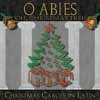
Check out this perennial favorite of Christmas and holiday songs in Latin from "Deck the Halls" to "Silent Night." A perfect way to add some aural/oral Latin learning to your classes.
CC Couch sings six of these favorites in the classical Latin pronunciation and six in the ecclesiastical Latin pronunciation. Teddy Irwin, who plays guitar for these songs, did the musical arrangements.
Get yourself in the holiday spirit!
For your listening pleasure . . .

Tinniunt, Tinniunt Tintinnabula
(Jingle Bells) 2:24 minutes
O Abies, O Abies
(Oh Christmass Tree) 3:21 minutes
With iPodius, one can purchase downloads of single works. |
|
|
|
|