Classical Conferences and Meetings in 2012 |
ACL - The American Classical League
65th Annual Institute
June 27–30, 2012
University of Nevada
Las Vegas, NV
Representatives: Drs. Lou and Marie Bolchazy, Dr. Bridget Buchholz, and Don Sprague
B-C Editor Presentations at ACL:
"A New Age; A New Textbook" Bridget Buchholz, presenter
"A New Comprehensive Text for Latin 3: Latin for the New Millennium, Level 3"
LeaAnn Osburn, Donald Sprague, Helena Dettmer, presenters
"Teaching Catullus at any Level" Ronnie Ancona
BC Latin Readers Editor, presenter
For a complete listing of ACL presentations given by B-C authors and/or consultants, click here.
NJCL - The National Junior Classical League
59th Annual Convention
July 26–31, 2012
Wake Forest University
Winston-Salem, NC
Representatives: Allan Bolchazy and Laurel De Vries
CAES - Classical Association of the Empire State
2012 Annual Institute in conjunction with
CAAS - The Classical Association of the Atlantic States
October 4–6, 2012
New York Marriott East Side
New York, NY
Representatives: Drs. Lou and Marie Bolchazy, and Donald Sprague
CAMWS-SS - Classical Association of the Middle West and South - Southern Section
November 1–3, 2012
Florida State University
The Double Tree by Hilton Hotel Tallahassee
Representatives: Dr. Bridget Buchholz and Donald Sprague
Information taken from www.BOLCHAZY.com |
|
 |
|
Interesting Classics Related Tidbits |
From ACIS Tours Map:
Fun Fact: According to legend, Julius Caesar wore a laurel wreath to cover the onset of baldness.
From the CBS Today Show:
Lou Manfredini on House Smarts when talking about choosing the right "paver" for your home landscaping, asserted that the paver is a great investment and noted that pavers can still be seen on some Roman roads that have survived the centuries.
The King James Bible Story
The King James Bible celebrates 400 years! The story of the creation of this venerable translation is a fascinating one. I highly recommend checking out King James Bible: The Book That Changes the World, a very informative and engaging DVD produced in 2011. Actor John Rhys-Davies narrates the documentary about this highly influential text and massive undertaking. The documentary includes live-action reenactments of key events leading up to the translation, on-location footage of important biblical and other landmarks, and interviews with scholars.
A scene that caught this Latin teacher's eye was an encounter between the young James VI of Scotland and his demanding tutor George Buchanan. Buchanan declares, "I'll not tolerate lazy Latin" as he does not spare the rod in conjugating a verb with his tutee. Pedagogy has certainly changed!
James VI proved himself an astute student and a scholar in his own right. His decision to create the translation that bears his name was a brilliant means for unifying England and its various religious factions of the time.
Latin for the New Millennium, Levels 2 & 3 folks should note that Erasmus's translation of the New Testament was a resource consulted by the King James Bible translators. Latin for the New Millennium, Level 2 contains two adapted readings from Erasmus while Chapter 7 of Latin for the New Millennium, Level 3 includes a set of unadapted letters from Erasmus and his correspondents. |
|
|
|
Congratulations
and Kudos |
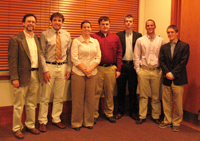
Bolchazy college editor, Dr. Bridget Buchholz poses with David Mathers of Loyola Academy and his Greek 4 (one not pictured) students. Dr. Buchholz served as an examiner at the students' Greek Defense. The seven fourth year Greek students had spent the year studying Homer—reading both epic poems in English and selections from the Iliad. Each year a visiting scholar or two, depending on the size of the group, ask the students questions on their year of study to a delighted and enthusiastic audience of the students' parents.
Laurel De Vries who spent the past year as an editor intern at Bolchazy-Carducci has been promoted to the position of editorial assistant. Her keen eye has been a valuable asset for our proofing processes and her knowledge of the Chicago Manual of Style, our bible at B-C, is equally impressive. Ad multos annos! |
|
|
Bolchazy-Carducci textbooks are now available through GooglePlay and Xplana eBookstores, with more titles going digital every day! Each eBook offers a variety of tools to enhance the learning process, and eBook distributors are continually adding new features.
What do B-C eBooks currently offer?
eBooks have the same content as our traditional books in print, with these enhancements:

• Searchable
• Adjust text size, typeface, line space
• Free samples of books
• Worry-free archive
• Available on any computer with an internet connection
• Readable on:
- the web (via Windows or MAC computers)
- iPhone, iPad and iPod touch
- Android
- eBook Devices: Barnes & Noble Nook and Reader™ from Sony
GooglePlay ebook information: http://books.google.com/help/ebooks/overview.html
GooglePlay ebook store: http://books.google.com/ebooks

• Searchable
• Adjust text size, typeface, line space
•Add notes, customized highlights, and other annotations—all of which are added to the embedded annotation manager for convenient access
• Worry-free archive
• Available on any computer with an internet connection
• Readable on:
- the web (via Windows or MAC computers)
- tablet computers
Xplana ebook information: http://tinyurl.com/4qlyhye
Xplana ebook store: http://shop.xplana.com/
How do I purchase a B-C eBook?
Simple! When you are browsing through www.Bolchazy.com, any time you see GooglePlay or Xplana eBook logo, click on the logo, and you will automatically be directed to a webpage where you can purchase the eBook.
Can I purchase direct from the distributor?
Yes! If you prefer, you can link directly to our eBook providers’ websites and search by title, by author, or by Bolchazy-Carducci Publishers to locate the title you would like to purchase. The GooglePlay ebooks store offers a preview of the book, including the table of contents and select pages.
What hardware is required?
You can read eBooks on a Mac, PC, iPhone, iPad, Android, or a variety of eReaders. |
|
|
|
Bolchazy-Carducci
Links of Interest |
Preview Bolchazy-Carducci Titles

Preview Bolchazy-Carducci titles before you buy using Google Preview.
Downloadable Products
iPodius - Bolchazy-Carducci Publishers online shop for: audio, software, video, and a treasure trove of teacher created materials in the Agora.

BCP Facebook Fan Page
Become a FAN of Bolchazy-Carducci Publishers, visit our Facebook Fan page for the latest news from BCP.
*AP is a registered trademark of the College Entrance Examination Board, which was not involved in the production of, and does not endorse this product |
|
|
|
|
Tempus fugit. It has been a while since we sent you an issue of eLitterae! Mea maxima culpa! While I regularly compiled notes for an issue, I beg your indulgence that some of those notes are only now being published. This has been an extraordinarily busy and exciting year for Bolchazy-Carducci Publishers as we developed, edited, and published new texts to meet the new curriculum for AP* Latin and, at the enthusiastic recommendation and request of teachers across the country, constructed Latin for the New Millennium, Level 3.
We look forward to sharing the fruits of these labors at our book display at the American Classical League Institute at the University of Nevada in Las Vegas, June 27–30, 2012.
LeaAnn Osburn and Helena Dettmer are very excited that you'll be able to check out Latin for the New Millennium, Level 3, a dream text for teaching all Latin 3 students.
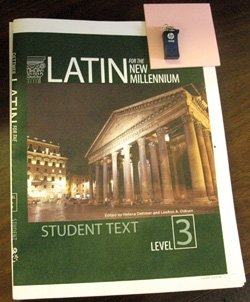
It's hard to imagine that the 600+ pages (including appendices and glossary) of Latin for the New Millennium, Level 3 could fit on such a small flashdrive! Even more taxing is to consider the many, many hours of planning, researching, reworking parts of B-C author texts, workbooks, and LEGAMUS texts, writing new exercises, notes, and vocabulary builders and revising, editing, and proofing can be reduced to a literally thumb-sized electronic storage device!
Come see copies of these new texts, especially those for AP* Latin:
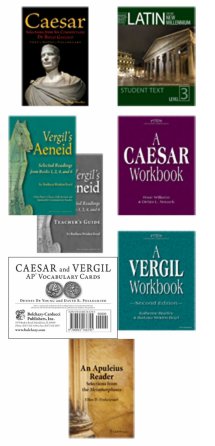 Hans-Friedrich Mueller's Caesar Selections from his Commentarii De Bello Gallico Hans-Friedrich Mueller's Caesar Selections from his Commentarii De Bello Gallico
Barbara Weiden Boyd's Vergil's Aeneid Selected Readings from Books 1, 2, 4, and 6 and Vergil's Aeneid Selected Readings from Books 1, 2, 4, and 6 Teacher's Guide
Dennis DeYoung and David R. Pellegrino's Caesar and Vergil AP* Vocabulary Cards
LeaAnn A. Osburn and Helena Dettmer's Latin for the New Millennium Level 3
A Caesar Workbook by Rose Williams and Debra L. Nousek
and galleys for:
A Vergil Workbook by Katherine Bradley and Barbara Weiden Boyd
An Apuleius Reader: Selections from Metamorphoses by Ellen Finkelpearl
So, be sure to reserve some quality time to peruse these new texts. Additonally, we invite you to attend one of the many ACL presentations being given by a B-C editor, author, or consultant.
I'm pleased to be communicating with you again through eLitterae. Join me in wishing Bolchazy-Carducci Publishers founder and president, Dr. Lou Bolchazy, a very happy 75th birthday. Check out Lou's reflections on old age.
Hope to see you at ACL. Best wishes for a restful and re-energizing summer.
Don Sprague |
|
|
|
eLitterae Interview with Dennis De Young Coauthor of Caesar and Vergil AP* Vocabulary Cards |
DES: How did you become attracted to teaching Latin?
DDY: I had studied seven foreign languages during my college and graduate school years, so my interest was already evident. I did some tutoring in grad school and then a high school job opened up. At that point I realized that I wanted to teach at the high school level. Subsequently I have taught Latin, but also Spanish and French.
DES: What aspect of high school teaching brings you the most satisfaction?
DDY: I am very satisfied when I have explained something very clearly and succinctly. But I gain the most satisfaction when my students do their work with academic rigor. When students demonstrate understanding and make a commitment to work diligently, I have succeeded. Their academic rigor will ensure their continued success through high school, college, and whatever they do afterward.
DES: Did you read Vergil as part of your high school Latin program? What do you recall of the experience?
DDY: I did not study Latin in high school. I taught myself Latin in college and only studied part of the Aeneid.
DES: Why do you think studying Vergil is relevant for today's students?
DDY: Relevance is not an important aspect or goal of my teaching. A student who achieves success in Latin will have a mind that is trained to recognize subtle clues that give a passage meaning. When such a student focuses her attention on an epic poem, her subsequent depth of understanding will bring its own reward. Furthermore, the Iliad, the Odyssey, and the Aeneid are the foundation stones for all Western literature.
DES: What aspect/story of Vergil do you most like to teach?
DDY: My two favorite sections of the poem are the “at regina” at the beginning of Book 4, and Turnus’s attempt to strike Aeneas with a stone near the end of the poem. The first because it dramatically switches the poem's focus from Aeneas’s sorrow to Dido’s inner malaise and the latter because the simile that describes Turnus’s attempt is the only simile in the first person plural. We comprehend his failure because all have had a nightmare in which we really must do something, but we fail.
DES: If you were to give a novice teacher beginning her high school Latin teaching one nugget of advice based on your years of success as a Latin teacher, what would that be?
DDY: Teach Latin because there is nothing else that you would rather do.
DES: When not involved in teaching and learning more about the classics, what do you most enjoy doing?
DP: My wife and I are independent sellers on Amazon. I most enjoy bargain book buying.
Dennis De Young holds a BA in Philosophy from Calvin College and an MA in Medieval Studies from University of Toronto. He has taught at a public school in Massachusetts, and private schools in Georgia and Tennessee. He retired from Montgomery Bell Academy in Nashville where he regular taught one of the largest AP* Latin classes in the country.
De Young completed a revised set of vocabulary cards for the Vergil portion of the new AP* curriculum. Previously, he had created vocabulary cards for the older AP* Vergil curriculum. David Pellegrino, whom we profiled in the last issue of eLitterae, prepared the Caesar vocabulary cards. The vocabulary card set will be available at ACL. |
|
|
|
A NEW Learning Tool for AP* Latin |
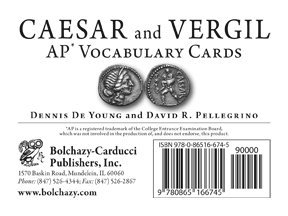
Caesar and Vergil AP* Vocabulary Cards
501 cards (2012) ISBN 978-0-86516-674-5
Dennis DeYoung and David R. Pellegrino
Learn frequent vocabulary, first! Students can prioritize their study of vocabulary (every language learner’s bane) with these helpful new cards. All vocabulary appearing five or more times in Vergil and Caesar AP* selections is included in these 501 cards!
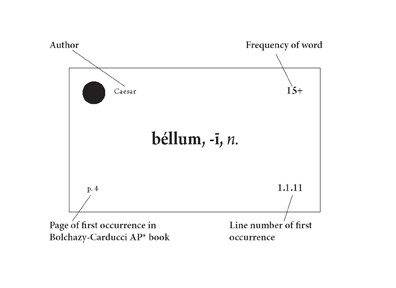
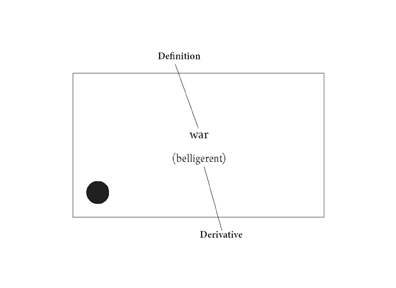
Each card provides a variety of information to help students. In addition to the dictionary form, the front of the card lists (clockwise) the author to which the card applies (Caesar, Vergil, or Caesar/Vergil for words that appear in both authors 15+ times); the number of occurrences in the author (15+, 9–14, 5–8); the line number of the first occurrence of the word; and the page number of the first occurrence of the word in the relevant Bolchazy-Carducci AP* book (Boyd/Mueller). The back of the card lists the definition and below it, in parentheses, some key derivatives.
|
|
|
Meet the Editor of the BC Latin Reader Series! |
Stop by our booth at ACL in Las Vegas this June to see our collection of BC Latin Readers. Check out the latest editions that have recently been published: Jeffrey Tatum’s, A Caesar Reader, and Ellen Finkelpearl’s, An Apuleius Reader. (We will have copies of the Caesar text and a galley of the Apuleius text at the conference.) The series editor, Dr. Ronnie Ancona, will be at the ACL Institute and available to meet with teachers and professors interested in learning more about the series or individual titles. These readers, whether used at the secondary or the college level, can expand and advance the curricula to meet the interests and needs of today’s Latin teachers and students. These readers also allow for diversifying curricula beyond traditional material. The books contain Latin selections chosen and annotated by noted scholars that can be used to introduce students to particular authors, genres, or topics. Please also consider attending Dr. Ancona's ACL presentation "Teaching Catullus at any Level" and/or her panel presentation on Latin in New York City schools. |
|
|
|
Bolchazy-Carducci Editors, Authors, and Consultants Present at ACL Institute 2012 |
Pre-Institute Workshops
Wednesday, June 27 and Thursday, June 28
"Neo-Latin: A Latin Teacher's Best Friend in a Multi-Cultural Society"
Milena Minkova, Terence Tunberg
Authors, Latin for the New Millennium, Levels 1 and 2
"Rome in Situ—Using Technology to Enrich the Classroom"
(also as a presentation on Saturday, June 30)
Marianthe Colakis, Panelist
Author, Excelability in Advanced Latin, and coauthor, Classical Mythology and More
Institute Program
Thursday, June 28
"A New Comprehensive Latin 3 Text"
LeaAnn Osburn, Donald Sprague, and Helena Dettmer
Editors for Latin for the New Millennium, Level 3
Osburn and Dettmer, coauthors, A Catullus Workbook
Osburn, coauthor, Vergil: A LEGAMUS Transitional Reader
"Latin on the Rise in New York City's Public & Charter Schools: Challenges & Opportunities"
Ronnie Ancona, Panelist
BC Latin Readers Editor
Author, Writing Passion: A Catullus Reader and Horace: Selected Odes and Satire 1.9, coauthor, A Horace Workbook and Horace: A LEGAMUS Transitional Reader
"Vitellia Rufina & the Flaminicae of the Imperial Cult"
Judith Sebesta
Author, Carmina Burana: Cantiones Profanae, coathor, Cicero: A LEGAMUS Transitional Reader
"A Black Odyssey: The Art of Romare Bearden"
Mary Pendergraft, Co-Presenter
Consultant, Latin for the New Millennium, Levels 1, 2, 3
Friday, June 29, 2012
"A New Age; A New Textbook"
Bridget Buchholz
B-C Editor
"The Latin Reading Proficiency Test & Webinar"
Sherwin Little, Co-Presenter
Consultant, Latin for the New Millennium, Levels 1, 2, 3
"Taming Caesar"
Rose Williams, Debra Nousek
Coauthors, A Caesar Workbook
"Eliza, Not Elissa"
Mary Pendergraft
Consultant, Latin for the New Millennium, Levels 1, 2, 3
Saturday, June 30, 2012
"Rome in Situ—Using Technology to Enrich the Classroom"
Marianthe Colakis, Panelist
Author, Excelability in Advanced Latin, and coauthor, Classical Mythology and More
"Roman Florentia: Florence for Latin Teachers & Students"
Tom Sienkewicz
Coauthor, Vergil: A LEGAMUS Transitional Reader, and editor, World Dictionary of Foreign Expressions
"Teaching Catullus at any Level"
Ronnie Ancona
BC Latin Readers Editor
Author, Writing Passion: A Catullus Reader and Horace: Selected Odes and Satire 1.9, coauthor, A Horace Workbook and Horace: A LEGAMUS Transitional Reader
"Fun with the Greek Alphabet!"
Wilfred Major
Coauthor, Plato: A Transitional Reader
"Veni, Vidi, Audivi: Technologies & Strategies to Advance Listening, Speaking & Learning in the Latin Classroom"
Sherry Jankowski, Co-Presenter
Consultant and Pilot Teacher, Latin for the New Millennium, Level 3
"Essential Subjunctive Mastery & the Revised AP Syllabus"
John Breuker, Jr.
Coauthor, A Little Book of Latin Love Poetry A Transitional Reader for Catullus, Horace, and Ovid
|
|
|
|
Apologies that we did not communicate this to you sooner! A recent email from LNM coauthor Terence Tunberg brought this connection to light. Terry had just returned from a conference in Rome dedicated to the 500th anniversary of the publication of "In Praise of Folly" by Erasmus.
Planned in 1509 and written in Latin that same year upon Erasmus’ return from Italy, dedicated in 1510 to Thomas More the English jurist and Erasmus' good friend, "In Praise of Folly" was first printed in Paris in 1511 under the title Moriae Encomium. It was then expanded in various editions published in Basel up until 1532, and was one of the great European successes of the Renaissance. Beyond the fact that the work is generally thought to have ushered in the Protestant Reformation, "In Praise of Folly" seeks the truth, combining religious considerations with philosophical principles. Erasmus’s work thus encourages philosophical thought and reflection.
"In Praise of Folly" is an essay written in 1509 by Desiderius Erasmus of Rotterdam and first printed in 1511. The essay was inspired by De Triumpho Stultitiae, written by Italian humanist Faustino Perisauli, born at Tredozio, near Forli in Italy. Erasmus revised and extended his own essay, which he originally wrote in the space of a week while sojourning with Sir Thomas More at More's estate in England. "In Praise of Folly" is considered one of the most notable works of the Renaissance and one of the catalysts of the Protestant Reformation.
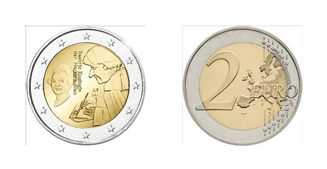
The Netherlands, home of Erasmus of Rotterdam, issued a special coin to commemorate this 500th anniversary. The inner part of the coin depicts Erasmus writing his book and the effigy of Beatrix of the Netherlands (the current queen of the Netherlands). Between these two images, the inscription Beatrix Koningin der Nederlanden (vertically written), the year mark, the mint master mark and the mintmark appear. The twelve stars of the European Union surround the design on the outer ring of the coin.
|
|
|
|
LeaAnn Osburn will be receiving a Merita Award at ACL 2012, we invite all those attending ACL to attend the award presentation.
LeaAnn is coeditor for Latin for the New Millennium, Levels 1, 2, and 3; coauthor of A Catullus Workbook and Vergil: A LEGAMUS Transitional Reader.
Congratulations LeaAnn and thank you for your contributions to the classics. |
|
|
Reflections from Lou Bolchazy on the Occasion of his 75th Birthday |
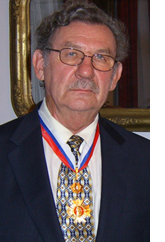 Dear Friends of a Comparable Age, Dear Friends of a Comparable Age,
You and I are close in chronological age. We’ve been promoting classics for the past 45 years, but now, we’re both getting older and more senile day by day. We feel inadequate, inferior in strength and handsomeness, and worried about our significance and contribution to society. And, of course, we are guilty of all the other complaints that Cicero mentions in his de Senectute.
As a result, we are blind to the harvest that life offers us to pluck and enjoy. I ask myself every day, “Must I feel miserable throughout the remaining days before my death? How can I feel young before my death?”
To celebrate my 75th birthday on June 7, 2012, I looked to two experts to help me with feeling old before my death. I commissioned a translation from our colleague in Classics G.B. Cobbold—the same person whom I commissioned to give Bolchazy-Carducci Publishers an English version of Vergil’s Aeneid in prose that reads like a novel. The other expert whom I consulted was Cicero and his de Senectute. Now I am happy to present a new translation by G.B. Cobbold of Cicero’s On Old Age.
The Red Flare: Cicero’s On Old Age is an antidote to old age. Cicero is the man for our season and his discourse On Old Age is our VADE MECUM, which we must carry next to our pills.
Vale,
Ladislaus (Lou) Bolchazy, PhD |
|
|
|
Specials for eLitterae Subscribers |
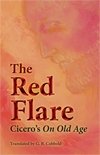
The Red Flare
G.B. Cobbold
xxvi + 92 pp. (2012) 5" x 7.75” Paperback
ISBN 978-0-86516-782-7 $15.00 $12.00 and Free media rate shipping
(1 copy, no returns, not available to distributors. This offer expires 06/30/12)
Make sure to mention that you are an eLitterae subscriber if you place your order by phone or fax. If you place your order via www.BOLCHAZY.com the special eLitterae offer pricing will be charged at checkout. |
|
|
|
|