Classical Conferences and Meetings in 2012 and 2013 |
NB: As best as possible, we also note presentations by B-C authors.
CAAS – Classical Association of the Atlantic States
in conjunction with
CAES – Classical Association of the Empire State
October 4–6, 2012
New York Marriott Eastside
New York, NY
Representative: Donald Sprague
Presentations:
“A New Option for Latin 3: Latin for the New Millennium, Level 3” – Donald Sprague (Kennedy-King College, City Colleges of Chicago & Bolchazy-Carducci Publishers)
“Revisiting the Latin Gerund and Gerundive: An Active Approach” – co-presenter Judith Hallett, coauthor of A Roman Women Reader
“Academic Activism in the Classics: The Public University as Springboard” – Judith Hallett, coeditor of Rome and Her Monuments
“Latin on the Rise in New York City's Public and Charter Schools: Challenges and Opportunities” – organizer and presider Ronnie Ancona, author of Writing Passion: A Catullus Reader and Horace: Selected Odes and Satire 1.9, BC Latin Readers Series editor
ICC – Illinois Classical Conference
75th Anniversary Meeting
October 5–7, 2012
University of Chicago
Chicago, IL
Representatives: Laurel De Vries and Bridget (Buchholz) Dean
Bolchazy-Carducci Publishers will celebrate ICC's 75th Anniversary with a special display of books edited, illustrated, or written by Illinois classicists.
Presentations:
‟Musical Interpretation of Homer's Odyssey” – Joe Goodkin, composer/lyricist/performer [B-C distributes his Odyssey Folk Opera, available via iPodius]
“Learning and Relearning in Latin 3” – LeaAnn Osburn, editor/contributor Latin for the New Millennium, Latin 3, coauthor of Vergil: A LEGAMUS Transitional Reader
“An On-Line Latin Course: Using My Latin Lab” – Thomas J. Sienkewicz, coauthor of Vergil: A LEGAMUS Transitional Reader
“Gaul Was Divided into a Lot More Than Three Parts: Caesar for His Time as well as Ours” – Nicholas Young, consultant/pilot teacher for Latin for the New Millennium, Latin 3
OCC - Ohio Classical Conference 2012 Meeting
October 26–27, 2012
Fawcett Center, The Ohio State University
Columbus, OH
Representative: Sherwin Little
CAMWS-SS – Classical Association of the Middle West and South – Southern Section
November 1–3, 2012
Florida State University
The Doubletree by Hilton Hotel
Tallahassee, FL
Representatives: Bridget (Buchholz) Dean and Donald Sprague
Presentations:
“A New Option for Latin 3: Latin for the New Millennium, Level 3” – Donald Sprague, Kennedy-King College, City Colleges of Chicago & Bolchazy-Carducci Publishers
“Custom Textbooks” – Bridget (Buchholz) Dean, Bolchazy-Carducci Publishers College Editor
“Caesar’s Language of War: Prose Style in De Bello Gallico” – Jane W. Crawford, coauthor of A Cicero Workbook
“Integrating Latin Teaching Standards into a Latin Course” – Thomas J. Sienkewicz, coauthor of Vergil: A LEGAMUS Transitional Reader
“Greece and Africa in Changó, el Gran Putas” – Madeleine M. Henry, author of Horace Satire 1.9: The Boor
TFLTA - Tennessee Foreign Language Teaching Association Fall Conference
November 2–3, 2012
Franklin Cool Springs Marriott
Greater Nashville, TN
Representative: Sherwin Little
AIA/APA – American Institute of Archeology/American Philological Association Joint Meeting
January 3–6, 2013
Washington State Convention Center and Sheraton Seattle Hotel
Seattle, WA
Representatives: Marie and Allan Bolchazy, Bridget (Buchholz) Dean, Donald Sprague
CANE – Classical Association of New England Annual Meeting
March 15–16, 2013
University of Connecticut
Storrs, CT
Representative: Donald Sprague
CAMWS – Classical Association of the Middle West and South
April 17–20, 2013
Sheraton Iowa City Hotel
Iowa City, IA
Representatives: Marie and Allan Bolchazy, Bridget (Buchholz) Dean, Donald Sprague
Information taken from www.BOLCHAZY.com |
|
 |
|
Interesting Classics Related Tidbits |
A recent installment of TNT's Franklin and Bash included an extended allusion to the Odyssey as well as the wisecrack, "you have sex in Latin?" to a lawyer's quoting "res ipsa loquitur" as he introduced his beautiful lady friend.
During the Olympics, AT&T regularly ran a commercial featuring the mobile phone feature that allows one to listen to recorded works of literature. A long distance cyclist listens first to excerpts from the Odyssey—Books 1, 3, 17, 20 and 24—and then shifts to Moby Dick!
A Caesar Connection
The Parisii tribe's motto remains in use as the motto for the city of Paris. ‟Fluctuat nec mergitur” translates to ‟She is tossed by the waves but is not sunk.” The motto translated into the image of a ship representing the Ile de France, the site of a Parisii settlement and later the Roman Lutetia Parisiorum. The Ile de France is an island in the Seine that some would say is in the shape of a ship. The following image provides the version on the facade of the Petit Palais in Paris sculpted by Émile Peynot (French, 1850–1932).
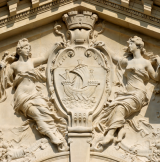
(Wikimedia Commons) |
|
|
|
Many of your students spent some time watching the 2012 Olympics this summer. That's a pretty significant teachable moment. Here follow a couple suggestions.

The Olympic rings on the River Thames as part of the Olympics 2012 celebration in London. (Wikimedia Commons)
The Olympic Motto
A friend of Baron Pierre de Coubertin, Father Henri Martin Didon, of the Dominican order, was principal of the Arcueil College, near Paris. An energetic teacher, he used the discipline of sport as a powerful educational tool. One day, following an interscholastic athletics meeting, he ended his speech with oratorical flourish, proclaiming "Citius, Altius, Fortius" (faster, higher, stronger). Struck by the succinctness of this phrase, Baron Pierre de Coubertin made it the Olympic motto, pointing out that "Athletes need 'freedom of excess.' That is why we gave them this motto . . . a motto for people who dare to try to break records." (adapted from http://www.mapsofworld.com/olympic-trivia/olympic-motto.html.)
Latin students, of course, should be able to parse those adverbs. For discussion, you might ask, "Why the comparative degree and not the superlative?"
For images of the London Olympic medals, check out http://www.london2012.com/medals/about/.
The medals provide a great opportunity to introduce students to the Greek goddess, Nike.
Of course, teachers may also have students research the original Olympics and their significance in the ancient world. |
|
|
|
B-C author Judith Lynn Sebesta (Author, Carmina Burana: Cantiones Profanae and Coauthor, Cicero: A LEGAMUS Transitional Reader) was honored for her outstanding teaching with the University of South Dakota's prestigious James M. Doyle Humanities Teaching Award.
The award named for longtime religious studies scholar and department chair, Monsignor James M. Doyle, is awarded annually to an outstanding humanities professor. Congratulations, Professor Sebesta!
Check out YouTube: http://www.youtube.com/watch?v=cN0OW4_4v9E
We also salute Anna Andresian, author of Looking at Latin and its companion website with 5,700 self-correcting Latin grammar and syntax questions, who was honored with an American Philological Association Pre-collegiate Teaching Award 2011. Read the citation for Andresian. Andresian will be giving a B-C webinar on classics, technology, and website resources. Once we've nailed down the date, it will be posted on our webinar schedule.
Sean Smith, coauthor of Catullus: A LEGAMUS Transitional Reader and author of the Teacher's Guide for this text, was honored by the Classical Association of New England with its Matthew I. Wiencke Award. The award recognizes excellence in teaching at the primary, middle, and secondary school levels. Smith, who has previously been awarded an American Philological Assocation Pre-collegiate Teaching Award, is a celebrated Latin teacher who has taught at both the middle and the secondary level at Amherst Regional Middle and High School in Massachusetts. Smith is much esteemed as a mentor teacher who has significantly impacted the teaching of students earning their MAT degrees at the University of Massachusetts at Amherst.

Helena Dettmer, Associate Dean for Undergraduate Programs and Curriculum in the University of Iowa College of Liberal Arts and Sciences.
The Lola Lopes Award for Undergraduate Student Advocacy, given annually by the Office of the Provost, honors University of Iowa administrators and staff who support undergraduate education and serve as strong, effective advocates for undergraduate students and the undergraduate experience.
B-C author Helena Dettmer (Latin for the New Millennium, Level 3, A Catullus Workbook, A Catullus Workbook Teacher's Manual) was recognized as a 2012 recipient of the Lola Lopes Award for her dedication. "A champion of students, Dean Dettmer demonstrates a knack for identifying problems and creating solutions."
The recipient receives a $1,000 honorarium and a certificate, and his or her name is added to a plaque displayed prominently in the Admissions Visitors Center where prospective students and parents can see the importance The University of Iowa places on undergraduate students and their educational experience.
To read more about Dettmer's award, see http://now.uiowa.edu/2012/05/champion-students.
Nicholas Young, a consultant and pilot teacher for Latin for the New Millennium, Level 3 was presented an American Classical League Emeritus Award at the 2012 Institute banquet held at the University of Nevada at Las Vegas. Young oversees a burgeoning Latin program at the University of Detroit Jesuit High School and is rebuilding the program at the University of Detroit Mercy. He has given yeoman service to colleagues in Michigan and is president of the Detroit Classical Club.
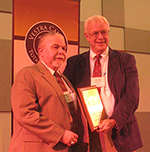
Nick Young, having received his Emeritus Award, poses with American Classical League president Peter Howard. |
|
|
|
Make September a month to remember with Latin sing-alongs! Students will readily recognize the melodies and they'll love the songs in Latin. A perfect way to add some aural/oral Latin learning to your classes.
CC Couch lends her beautiful, clear vocals while Teddy Irwin developed a terrific set of musical arrangements for these all-time favorites.
Liven up the Latin class with these popular songs from "O, Susannah!" to "Polly Wolly Doodle".
For your listening pleasure, check these two favorites out.
"Gaudeamus Igitur" 3.22 minutes
"Old MacDonald" 2.55 minutes |
|
|
Bolchazy-Carducci
Links of Interest |
Preview Bolchazy-Carducci Titles

Preview Bolchazy-Carducci titles before you buy using Google Preview.
Downloadable Products
iPodius - Bolchazy-Carducci Publishers online shop for: audio, software, video, and a treasure trove of teacher created materials in the Agora.

BCP Facebook Fan Page
Become a FAN of Bolchazy-Carducci Publishers, visit our Facebook Fan page for the latest news from BCP.
*AP is a registered trademark of the College Entrance Examination Board, which was not involved in the production of, and does not endorse this product |
|
|
Bolchazy-Carducci textbooks are now available through GooglePlay and Xplana eBookstores, with more titles going digital every day! Each eBook offers a variety of tools to enhance the learning process, and eBook distributors are continually adding new features.
What do B-C eBooks currently offer?
eBooks have the same content as our traditional books in print, with these enhancements:

• Searchable
• Adjust text size, typeface, line space
• Free samples of books
• Worry-free archive
• Available on any computer with an internet connection
• Readable on:
- the web (via Windows or MAC computers)
- iPhone, iPad and iPod touch
- Android
- eBook Devices: Barnes & Noble Nook and Reader™ from Sony
GooglePlay ebook information: http://books.google.com/help/ebooks/overview.html
GooglePlay ebook store: http://books.google.com/ebooks
• Searchable
• Adjust text size, typeface, line space
•Add notes, customized highlights, and other annotations—all of which are added to the embedded annotation manager for convenient access
• Worry-free archive
• Available on any computer with an internet connection
• Readable on:
- the web (via Windows or MAC computers)
- tablet computers
Xplana ebook information: http://tinyurl.com/4qlyhye
Xplana ebook store: http://shop.xplana.com/
How do I purchase a B-C eBook?
Simple! When you are browsing through www.Bolchazy.com, any time you see GooglePlay or Xplana eBook logo, click on the logo, and you will automatically be directed to a webpage where you can purchase the eBook.
Can I purchase direct from the distributor?
Yes! If you prefer, you can link directly to our eBook providers’ websites and search by title, by author, or by Bolchazy-Carducci Publishers to locate the title you would like to purchase. The GooglePlay ebooks store offers a preview of the book, including the table of contents and select pages.
What hardware is required?
You can read eBooks on a Mac, PC, iPhone, iPad, Android, or a variety of eReaders. |
|
|
|
|
|
With this issue of eLitterae, we are committed to its monthly appearance at the very beginning of the month! As mentioned in the August issue, we welcome the inaugural appearance of Sherwin Little and his monthly column “Little’s Bits.” Don’t let that clever title lead you to believe that Little’s topics are less than weighty. This month he explores the need for intentional curriculum and uses the new Caesar AP* curriculum to demonstrate his points—certainly a topic of significance! For this launch, we place Little’s column as the feature piece in the issue.
Most of you recognize the name Sherwin Little and many of you, especially CAMWS and ACL attendees, have probably met this accomplished individual. He was profiled previously in eLitterae as one of the consultants for Latin for the New Millennium, Level 3. In fact, he served as a valued consultant for all three levels of Latin for the New Millennium, student versions and teacher manuals.
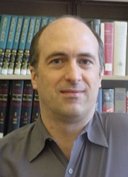
Sherwin Little
BA University of Cincinnati, Ohio; MA University of Colorado
The following information is culled from the citation for the
American Philological Association Pre-Collegiate
Teaching Award 2011
Mr. Little has been teaching Latin and Greek in the Indian Hill Exempted Village School District in Cincinnati, Ohio since 1983. He has taught at the middle school and high school levels. His courses have included sixth grade, seventh grade, and eighth grade Latin, Latin I-V, AP Vergil, AP Latin Literature (Catullus-Horace), Latin Ia and IIa (courses he developed for special needs students), and Independent Study Greek. He started with only four classes. The Latin program now has four teachers and 25% of the students in grades 6-12 are enrolled in Latin. Sherwin, who holds National Board Certification, retired from fulltime teaching this past June.
Recognized for his accomplishments by both the Ohio Classical Conference (his program twice earned the Hildesheim Vase Award) and CAMWS (recipient of both a Good Teaching Award and an Ovatio), it is at the national level that Mr. Little’s service has impacted members of the classics profession in countless ways. Serving first as ACL Vice President, and then as ACL President (the first pre-collegiate level teacher ever to do so), co-chairing the Joint APA-ACL Task Force that developed and wrote the recent Standards for Latin Teacher Preparation, serving on the AP Latin Curriculum Review Committee and the Latin Reading Proficiency Test Development Committee, in the words of his nominator, “he has helped shape the national discussion on Latin pedagogy.” Sherwin currently serves as the ACL Placement Director. [Editor’s note: the italicized comments are my additions to the citation. Read the full citation.] |
|
|
|
Welcome to the inaugural edition of this eLitterae feature. My hope in each column is to address different aspects of teaching the classics in all forms. Sometimes I will also highlight some materials from Bolchazy-Carducci that can help you with the featured topics. I hope you will find the discussions interesting, and as always I like to carry on discussion. Feel free to email me with suggestions or ideas, or for follow-up discussion.
Recent conversations with teachers have brought my interest to the idea of articulation in the curriculum. The learning strategies to achieve success in Latin III or IV begin in the first two years of study. In a Latin program with more than one teacher, it is important to balance each individual teacher’s style, preferences, and biases with the need to keep the outcomes in mind. It shouldn’t matter how you reach those goals, as long as you get there. Solo Latin teachers carry the entire burden for developing curriculum, and, without feedback from colleagues, it is easy to create a series of activities that are not logically connected to the curriculum goals.
I will make a few suggestions about how to make the intentional choices to help your students make the transitions between levels. I will use Caesar as the vehicle, since this topic has become of great interest. It doesn’t matter if you teach AP, IB, or neither. You can adapt these strategies to meet the needs of your program.
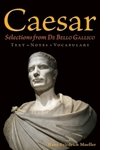 First let’s look at the new Bolchazy-Carducci materials geared towards Caesar. The new reader or primary text is Caesar: Selections from his Commentarii De Bello Gallico by Hans-Friedrich Mueller. The philosophy of this book is to give students everything they need, namely the vocabulary and notes, on the same page in order to read the Latin text. If students need additional resources, they can consult a full glossary, a pull-out vocabulary of common words, and contextual essays which give useful background information about the army and Caesar. I was very happy to see the inclusion of the full Latin text in an un-annotated format. I hope teachers will use this to get their students to read the Latin and not rely on notes too heavily. The reader also includes the text of all the English readings required on the AP* syllabus. In the Teacher’s Guide you will find two literal translations, but more importantly there are discussion questions that will encourage students to think beyond the text. These will give you ideas about how to address the Themes and Essential Questions from the AP* Course Description that can enrich your students’ understanding and appreciation of the readings. Where appropriate, Mueller has included discussion questions connecting Caesar and Vergil. These can be valuable whether you have your students read Caesar or Vergil first. First let’s look at the new Bolchazy-Carducci materials geared towards Caesar. The new reader or primary text is Caesar: Selections from his Commentarii De Bello Gallico by Hans-Friedrich Mueller. The philosophy of this book is to give students everything they need, namely the vocabulary and notes, on the same page in order to read the Latin text. If students need additional resources, they can consult a full glossary, a pull-out vocabulary of common words, and contextual essays which give useful background information about the army and Caesar. I was very happy to see the inclusion of the full Latin text in an un-annotated format. I hope teachers will use this to get their students to read the Latin and not rely on notes too heavily. The reader also includes the text of all the English readings required on the AP* syllabus. In the Teacher’s Guide you will find two literal translations, but more importantly there are discussion questions that will encourage students to think beyond the text. These will give you ideas about how to address the Themes and Essential Questions from the AP* Course Description that can enrich your students’ understanding and appreciation of the readings. Where appropriate, Mueller has included discussion questions connecting Caesar and Vergil. These can be valuable whether you have your students read Caesar or Vergil first.
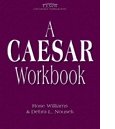 The student workbook, A Caesar Workbook by Rose Williams and Debra Nousek provides practice sets which help the student understand not only how the Latin fits together, but also what the author is communicating. Both the preparatory and multiple choice questions offer practice in identifying syntax and grammatical elements, as well as answering comprehension questions. Students will find the introduction useful as it explains how to interpret prompts and shows what type of information is expected for each question type. AP* teachers are reminded to check the AP* course description for the specific grammatical terms that will be tested. Selections for translation give the students practice in showing that they understand how the Latin text fits together. Short answer questions and longer essay questions provide practice in analysis of key ideas and larger themes found in the text and regularly require students to cite the Latin to document their answers. This is a skill that students need to practice continually. In addition to answers for the preparatory and short answer questions, the Teacher’s Manual for the workbook includes scoring guides for essays, which will help teachers evaluate student writing and can help the students see how to improve their writing. The translations are divided into chunks, which is the method used in scoring translations on the AP* exam. The answers to the short answer questions and the longer essay questions give sample responses as well as Latin line references. The student workbook, A Caesar Workbook by Rose Williams and Debra Nousek provides practice sets which help the student understand not only how the Latin fits together, but also what the author is communicating. Both the preparatory and multiple choice questions offer practice in identifying syntax and grammatical elements, as well as answering comprehension questions. Students will find the introduction useful as it explains how to interpret prompts and shows what type of information is expected for each question type. AP* teachers are reminded to check the AP* course description for the specific grammatical terms that will be tested. Selections for translation give the students practice in showing that they understand how the Latin text fits together. Short answer questions and longer essay questions provide practice in analysis of key ideas and larger themes found in the text and regularly require students to cite the Latin to document their answers. This is a skill that students need to practice continually. In addition to answers for the preparatory and short answer questions, the Teacher’s Manual for the workbook includes scoring guides for essays, which will help teachers evaluate student writing and can help the students see how to improve their writing. The translations are divided into chunks, which is the method used in scoring translations on the AP* exam. The answers to the short answer questions and the longer essay questions give sample responses as well as Latin line references.
Now some suggestions! If you are finding that your students in upper-level classes are having trouble answering the grammatical or referential questions that are in the Caesar workbook, use these question types as a model and begin embedding them into your in-class work, homework, and testing from the earliest lessons. Once students have read a passage, give them a five-question reading check using five different question types. Hint: don’t give them the questions before they read; otherwise they are likely to read only to answer those specific questions.
If on the other hand your upper-level students are struggling with producing the analytical writing that you want, build that skill earlier. Create short-answer type questions similar to what you see in the Caesar workbook, and ask them as a class discussion activity. You can certainly use these for individual work, but your youngest students may not be entirely sure what you want as an answer until you have practiced this kind of question. You can start with an easy question like “How is this character feeling in this story?” and have everyone write down an answer. Then follow up with “write a few Latin words or phrases that told you that,” and you are on your way! In a few weeks, ask a question that is a little more complex, such as “What action caused the character to react so strongly?”
I’m also a big fan of getting authentic Latin in front of the kids as early as possible. Caesar was a staple of Latin II courses for a long time. Find some high-interest passages from the Caesar textbook. For the youngest students you may want to look at Caesar’s Invasion of Britain with its adapted text. Present these as something to read together, not as something for a grade. Project the text and read through it with the kids. Supply some vocabulary but don’t overdo it. This is a great opportunity to model reading strategies. You can help them through grammatical hurdles but don’t worry about explaining everything. Then ask them one of the Discussion Questions you can find in the Teacher’s Guide for the Caesar text mentioned above, or create a similar one yourself, even if it is as simple as “Can you think of anything happening like this today?” Kids love to know that they have read something that the seniors are reading. What a great feeling for your students when you say “Look—you understood that with only a little help from me. By the time you are seniors and you have seen these forms and learned some vocabulary you will be reading this on your own!”
By keeping articulation in mind, the activities you choose will help your students progress towards the goals you have identified. When you gear your class towards success, your students have a clear path on the way to reading and enjoying Latin even more. Now if we can just find a way to get them all to follow that path . . .
I hope you have a great start to the school year. Please email me with your comments and experiences. I would love to hear what topics you would like me to explore in future columns.
As always, bene doceatis!
Sherwin Little
Slittle6@cinci.rr.com |
|
|
|
International Congress on Medieval Studies 2012 |
Medieval Congress saw a B-C crew head to Kalamazoo for this annual gathering of medieval scholars sponsored by the Medieval Institute at Western Michigan University each May. College editor Bridget (Buchholz) Dean and Adam Velez, senior graphic designer and medieval enthusiast, accompanied by their spouses drove to Michigan, and staffed the B-C booth. Dr. Lou Bolchazy attended the first part of the conference.
While traffic in the exhibitors’ room was slower than in years past due to a packed program and some distance between presentations and the book displays, those who stopped by the B-C booth enjoyed the opportunity to look through the books and to make purchases at the conference discount. Attendees showed interest in Latin for the New Millennium as a possible text for the classroom and others felt its visual and cultural richness made it an attractive option for review and from which to self-teach.
The conference generated a number of ideas about how Bolchazy-Carducci can better serve the medievalists. Bridget and Adam discussed adding a few new buttons to our offerings. Many visits to the booth were initiated by those searching for new or later century buttons. One conferee suggested St. Augustine’s “da mihi castitatem et continentiam, sed noli modo” (Give me chastity and continence, but not yet). Stay tuned. |
|
|
|
American Classical League
Institute 2012 |
The annual meeting of the American Classical League is always a highlight of the Bolchazy-Carducci calendar as the gathering allows us to catch up with classicist friends from across the country, to get a pulse on what's happening in the Latin classroom—especially at the high school level, to display our titles, and to glean teachers' current needs. Lou (the Las Vegas institute will always burn brightly for us at B-C as Lou's last conference and book exhibit) and Marie Bolchazy, Bridget (Buchholz) Dean and her husband, Adam, and Don Sprague enjoyed the bustle and excitement of the ACL Institute held at the University of Nevada at Las Vegas.
It was a busy time for the B-C folks—Bridget gave a presentation on AcademicPub, A Caesar Workbook coauthors Rose Williams and Debra Nousek gave a talk Taming Caesar, LeaAnn Osburn and Helena Dettmer, the editor/contributors to Latin for the New Millennium, Level 3, joined editor Don Sprague for a panel presentation on the new text and its features, and all the while five tables of B-C titles attracted a steady flow of folks new to our work as well as longtime fans.
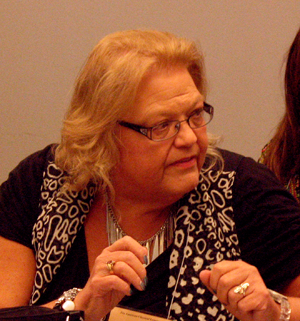
LNM 3 contributor/editor LeaAnn Osburn gives an animated response to a question posed during the LNM 3 session.
The ACL meeting saw the launch of the much-anticipated A Caesar Workbook and Latin for the New Millennium, Level 3. For some it was also their first opportunity to see the new Caesar text for AP*, Hans-Friedrich Mueller's Caesar: Selections from his Commentaries De Bello Gallico, and the revised Vergil text, Vergil's Aeneid: Selected Readings from Books 1, 2, 4, and 6 by Barbara Weiden Boyd. We ran out of copies of A Caesar Workbook while teachers praised the new Caesar and Vergil AP* Vocabulary Cards. David Pellegrino, author for the Caesar vocabulary cards, stopped by and was pleased with the quality of the card sets: prepunched, of durable paper stock, packaged in a box for storing, and containing a steel ring on which to place the words needing the most attention.
Bolchazy-Carducci co-hosted the reception on Friday evening and we enjoyed chatting with our classics colleagues. Saturday evening's banquet was a very special event for B-C as former editor, beloved teacher-colleague, author, and longtime friend LeaAnn Osburn was honored with an American Classical League Emerita Award. The citation and celebration of this national award, much-deserved, brought forth tears of joy and admiration. Read the citation that accompanied LeaAnn's award.
ACL 2012 Photo Gallery
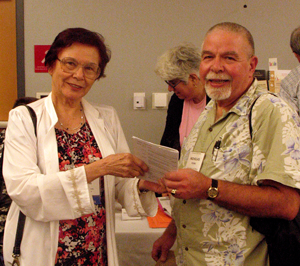
LNM 3 consultants Rose Williams and Nick Young ham it up
at the book display for the B-C photographer.
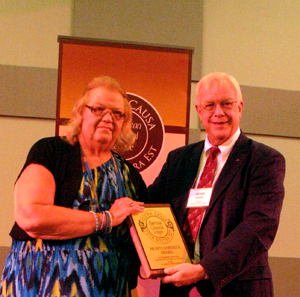
LeaAnn Osburn, having received her ACL Emerita certificate,
faces her many admiring colleagues, accompanied
by ACL President Peter Howard.
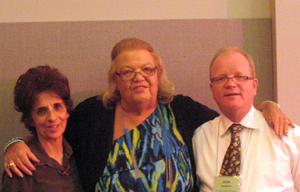
Latin teacher trio Elisa Denja, LeaAnn Osburn, and Don Sprague, first met while teaching Latin and collaborating on Illinois Classical Conference and Illinois Latin Tournament activities and later became editor colleagues for the Latin for the New Millennium series. Denja and Sprague were especially honored to be present as their friend and colleague, LeaAnn Osburn, was recognized by the American Classical League.
For those unable to attend ACL, Williams and Nousek will present their talk as a webinar on September 25. |
|
|
|

Taming Caesar: Analysis and Strategies for Teaching Caesar’s Grammar - September 25, 6:00–7:15 p.m. (Eastern Time)
Presented by Rose Williams and Debra Nousek, coauthors of A Caesar Workbook
The authors have immersed themselves in the Caesar selections for the new AP* exam as they developed A Caesar Workbook. Williams has done additional work with Caesar as coauthor of the forthcoming Caesar: A LEGAMUS Transitional Reader. Nousek is a Caesar specialist who has contributed to the forthcoming Cambridge Companion to Caesar and the Landmark Caesar. In the webinar, these master teachers will focus on those constructions that appear frequently in the AP* selections and Caesar’s unique take on some of them.
Google Earth for the Latin Classroom - October 16, 6:00–7:00 p.m. (Eastern Time)
Presented by Laurel De Vries
Learn how to enhance lectures, class discussions, and student projects using Google Earth, a program that allows users to view satellite imagery, maps, and terrain. This presentation focuses on ideas for student projects to accompany Latin for the New Millennium and the AP* Latin syllabus that debuts in 2012–2013. The presentation concludes with an overview of how to use the tools and features of the Google Earth program.
Quia: A Quiz Resource—How to Use the LNM Question Bank, to Use the Umiker Question Bank, to Use One You Make Yourself - November 6, 6:00–7:00 p.m. (Eastern Time)
Presented by Charles Umiker
Charles Umiker, Latin teacher at the Tatnall School in Wilmington, Delaware has been a Latin for the New Millennium devotee and frequent contributor to the LNM Teachers' Lounge. He will show you how to navigate Quia using the LNM test bank and his own questions for a couple of the LNM enrichment texts. And, better yet, he’ll show you how you can make your own set of questions.
Click here to register for these FREE Webinars
To participate in Bolchazy-Carducci Publisher sponsored webinars you will need high-speed internet access, computer speakers/headphones, current web browser with updated “Flash Player”*, and the link to the webinar virtual meeting space, which is provided in your webinar invitation.
*Current web browsers: Internet Explorer 8, FireFox 3, Google Chrome, Safari 4 or 5. Flash Player available from Adobe.com: http://get.adobe.com/flashplayer/. Consult your school IT dept.
Webinars for Professional Development
Participation is free. All webinars provide opportunity for participants to ask questions. Learn lots – attend each presentation. Sign up for this professional development webinar. Bolchazy-Carducci Publishers will provide documentation for your participation. |
|
|
|
Latin for the New Millennium,
Level 3 Development Notes |
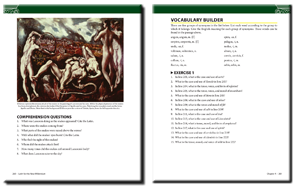
Spread with El Greco’s Laocoon is taken from LNM 3’s Vergil chapter.
In the course of the past couple years, a regular feature of eLitterae has been an ongoing series of notes on the development of Latin for the New Millennium, Level 3. In those notes, we've introduced the various collaborators in this massive undertaking. We highlight two more contributors.
Peter Sipes helped us manage the various vocabulary lists, macrons, and the Latin to English glossary. He is currently finalizing vocabulary lists for each of the seven authors in LNM 3 as well as a list of those words from LNM 1 & 2 "vocabulary to be learned" that also appear in LNM 3. Sipes has been teaching Latin to home-schooled students for the last seven years. He has also worked for Bolchazy-Carducci Publishers and currently does freelance projects for the company. He has also braved the waters of stay-at-home parenting for his two children: Ada and Charlie. He is a student of linguistics at Northeastern Illinois University and occasionally blogs about linguistics and classics at deadlinguist.blogspot.com and blogs in Latin at pluteopleno.blogspot.com. In his spare time he likes to go to Conventiculum. This past summer, dad and his five-year old daughter Ada traveled to Kentucky for this annual immersion in lingua Latina.
For the index to Latin for the New Millennium, Level 3, we turned to Michael Hendry who diligently indexed Levels 1 and 2. Hendry earned his BA from St. John's College in Annapolis and his PhD from the University of Virginia. He teaches high school in Virginia. Hendry has published widely on classical literature, mostly textual criticism of Latin poets. He is working on putting texts with apparatus criticus on the web at www.curculio.org. |
|
|
|
Reviewers, students, teachers, and "layfolk" have consistently praised the visual appeal of the Latin for the New Millennium series. We are gratified by that praise as we believe that Latin students should be immersed in the visual legacy of the ancient world. To that end, we chose images that would illustrate the influence of classical art and architecture to the present day.
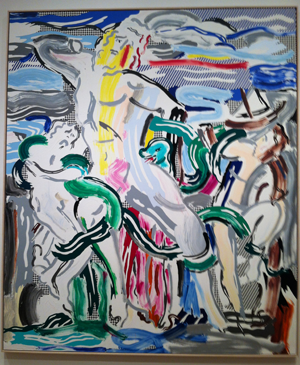
In compiling a set of images for each level of LNM, we had to deal with a number of constraints and limitations. Thus, we were not able to publish every image we would have liked. And, how does that affect you as an LNM teacher? It affords you and your students with a marvelous opportunity to explore and gather additional images that students can present in class. For example, students can search for variations on an image published in LNM or on a given topic such as the she-wolf story. Students can explore the Internet and share their discoveries by showing the images for one time (not for publication!) projection in class. Such assignments should regularly include a search for contemporary images. A recent retrospective of Roy Lichtenstein's work at the Art Institute of Chicago revealed a number of examples of classical influence in his work including his take on the famous Laocoon story. The photo below was taken by Xiaohong Peng.
|
|
|
|
Specials for eLitterae Subscribers |
Start off the school by treating yourself to a book that will enrich your life and serve as a perfect remedy to one of those "Why am I teaching?" days. Our president, Marie Bolchazy shares her reflections on a special text . . .
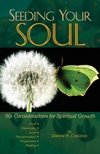
Seeding Your Soul
Dianne Constanza
xxvi + 78 pp. (2005) Hardbound
ISBN 978-0-86516-592-2 $9.00 $7.00 and free media rate shipping
(1 copy, no returns, not available to distributors. This offer expires 09/30/12)
Seeding Your Soul provides an invitation to spiritual growth with a focus on six considerations: trust, generosity, love, transformation, forgiveness, and healing. Author Dianne Constanza discusses carrying the seed of God and makes analogies between growing plants and biblical passages to illustrate her message. She begins her first chapter with the question, “How does your garden grow?” Comparing the “consider the lilies” passage (Luke 12:22–31) to planting trust, the “widow’s mite” passage (Mark 12:41–44) to planting generosity, and the “prodigal son” passage (Luke 15:11–31) to planting forgiveness, she gives the reader pause. She also offers resources, such as books and movies, for cultivating trust. For example, she recommends the movie Moonstruck in which the character Loretta learns to trust God’s plan for her, one very different from her own plan. Costanza's exercises for nurturing spiritual growth are meaningful and reflective.
Make sure to mention that you are an eLitterae subscriber if you place your order by phone or fax. If you place your order via www.BOLCHAZY.com the special eLitterae offer pricing will be charged at checkout. |
|
|
|
|
|