Classical Conferences and Meetings in 2012 and 2013 |
NB: As best as possible, we also note presentations by B-C authors.
AIA/APA – American Institute of Archeology/American Philological Association Joint Meeting
January 3–6, 2013
Washington State Convention Center and Sheraton Seattle Hotel
Seattle, WA
Representatives: Marie and Allan Bolchazy, Bridget (Buchholz) Dean, Donald Sprague
New York Classical Club
Annual Winter Conference: "Julius Caesar in History and in the Classroom."
Saturday, January 26, 2013, 11 a.m.-6 p.m
Representative: Donald Sprague
Presentation: “Caesar and the State Religion” – Hans-Friedrich Mueller, author, Caesar: Selections from His Commentarii De Bello Gallico; coauthor, Caesar: A LEGAMUS Transitional Reader
CANE – Classical Association of New England Annual Meeting
March 15–16, 2013
University of Connecticut
Storrs, CT
Representative: Donald Sprague
CAMWS – Classical Association of the Middle West and South
April 17–20, 2013
Sheraton Iowa City Hotel
Iowa City, IA
Representatives: Marie and Allan Bolchazy, Bridget (Buchholz) Dean, Donald Sprague
Presentation: "Creating Custom Textbooks" - Bridget (Buchholz) Dean
Information taken from www.BOLCHAZY.com |
|
 |
|
Interesting Tidbits to Share |
Marie Bolchazy reports that classicists will especially appreciate the October 24, 2012 edition of the Colbert Report. Colbert recites the beginning of Caesar’s De bello Gallico as he seeks to impress guest historian Anthony Everitt who talks about Rome's initial lack of culture, brutal empire conquests, and his favorite ruler, Julius Caesar. Consider sharing this six-minute clip with the appropriate classes. Caveat: you should avoid showing the full show as it contains some adult humor. This clip is of the exchange with historian Everitt.
http://www.colbertnation.com/the-colbert-report-videos/420542/october-24-2012/anthony-everitt
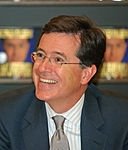
Wikimedia Commons Photo
by David Shankbone. |
|
|
Important Classics Deadlines |
Nov. 9, 2012: Deadline to register for CAMWS Latin Translation Contest
Dec. 1, 2012: Deadline to register for SCRIBO writing contest
Jan. 21, 2013: Deadline to register for Classical Literacy Exam
Jan. 15, 2013: Deadline to register for National Mythology Exam
Jan. 15, 2013: Deadline to register for National Greek Exam
Jan. 18, 2013: Deadline to register for National Latin Exam
Feb. 1, 2013: Deadline to register for National Roman Civilization Exam
Feb. 9, 2013: Deadline to register for Medusa Mythology Exam
Mar 1, 2013: deadline to register for Exploratory Latin Exam to be administered between October 1, 2012 and April 1, 2013. |
|
|
Bolchazy-Carducci
Links of Interest |
Preview Bolchazy-Carducci Titles

Preview Bolchazy-Carducci titles before you buy using Google Preview.
Downloadable Products
iPodius - Bolchazy-Carducci Publishers online shop for: audio, software, video, and a treasure trove of teacher created materials in the Agora.

BCP Facebook Fan Page
Become a FAN of Bolchazy-Carducci Publishers, visit our Facebook Fan page for the latest news from BCP.
*AP is a registered trademark of the College Entrance Examination Board, which was not involved in the production of, and does not endorse this product |
|
|
Bolchazy-Carducci textbooks are now available through GooglePlay and DirectDigital (Xplana) eBookstores, with more titles going digital every day! Each eBook offers a variety of tools to enhance the learning process, and eBook distributors are continually adding new features.
What do B-C eBooks currently offer?
eBooks have the same content as our traditional books in print, with these enhancements:

• Searchable
• Adjust text size, typeface, line space
• Free samples of books
• Worry-free archive
• Available on any computer with an internet connection
• Readable on:
- the web (via Windows or MAC computers)
- iPhone, iPad and iPod touch
- Android
- eBook Devices: Barnes & Noble Nook and Reader™ from Sony
GooglePlay ebook information: http://books.google.com/help/ebooks/overview.html
GooglePlay ebook store: http://books.google.com/ebooks

(Formerly Xplana)
• Searchable
• Adjust text size, typeface, line space
•Add notes, customized highlights, and other annotations—all of which are added to the embedded annotation manager for convenient access
• Worry-free archive
• Available on any computer with an internet connection
• Readable on:
- the web (via Windows or MAC computers)
- tablet computers
DirectDigital ebook information
DirectDigital ebook store
How do I purchase a B-C eBook?
Simple! When you are browsing through www.Bolchazy.com, any time you see GooglePlay or DirectDigital eBook logo, click on the logo, and you will automatically be directed to a webpage where you can purchase the eBook.
Can I purchase direct from the distributor?
Yes! If you prefer, you can link directly to our eBook providers’ websites and search by title, by author, or by Bolchazy-Carducci Publishers to locate the title you would like to purchase. The GooglePlay ebooks store offers a preview of the book, including the table of contents and select pages.
What hardware is required?
You can read eBooks on a Mac, PC, iPhone, iPad, Android, or a variety of eReaders. |
|
|
|
Annually Bolchazy-Carducci publishes a Roman Calendar that includes key dates in Roman history and literature as well as a significant Latin quote for each day of the month. If you didn't receive one, email info@bolchazy.com to request one. We'll send you the 2012–2013 calendar and put you on our mailing list. Or better yet, download it. |
|
|
|
|
The Classical Association of the Atlantic States and the Classical Association of the Empire State met October 4–6 at the Eastside Marriott New York. The Marriott is well-located, at 48th and Lexington right by the Waldorf Astoria. CAAS executive director Mary Brown assured attendees that they would find the meals of high quality and the meals proved to be far superior to the usual hotel conference fare.
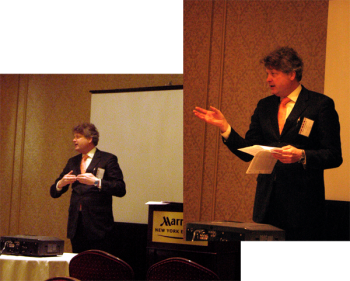
Professor Mueller exhibits enthusiasm as he discusses Julius Caesar and the state religion.
About 18 teachers and I attended the Friday morning CAES presentations: Hans-Friedrich Mueller on “Pius Julius: Julius Caesar and Roman Religion”; one of his students, Chris Choquette presented on “Caesar Conjuratus (as conspirator”); I gave an illustrated overview of LNM 3 and insights into its development; David Pellegrino, a replacement speaker (and author of the B-C AP* Caesar vocabulary cards), did a terrific job showing how his school’s Latin students are meeting across-the-curriculum writing and critical thinking expectations and helped me set up my laptop. David’s presentation generated some great pedagogical contributions from the assembled teachers. Chris Coquette agreed to submit his paper so that we can hang it on the B-C AP Caesar/Vergil website.
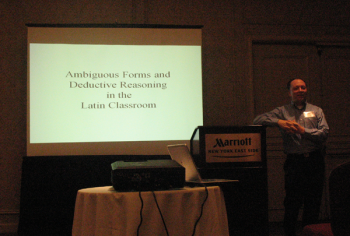
David Pellegrino, CAES treasurer, presents an interactive session on using Latin to teach critical thinking skills.
Friday’s lunch and dinner were both excellent—just as Mary Brown had promised. The lunch honored longtime CAAS secretary Barbara Pavlock of Lehigh University with a well-deserved Ovatio. The Jerry Clack Lecture was just spectacular. Jeffrey Tatum from Dartmouth College spoke on “Plautus and the Making of Shakespeare’s Othello.” He gave background and context, provided commentary, and directed a group of six professional actors (Ad Istud) who performed scenes first from the Plautus and then Shakespeare’s adaptation. Just stunning! And, three of the actors, Hans, and I ended up at the same table for dinner. The actors were an interesting group—their leader first met Tatum as his editor! The actors loved the audience because all those learned souls got all the references.
Donald Sprague
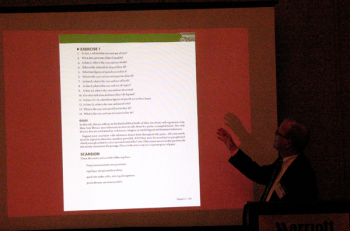
LNM 3 editor Don Sprague provides insights on the text’s development. |
|
|
|
Illinois Classical Conference 75th Anniversary Report |
The Illinois Classical Conference celebrated its 75th anniversary as guests of the The University of Chicago was one of the original three university-level sponsors of the ICC. Both the Chicago Classical Club and the Chicago Chapter of the Archaeological Institute of America cosponsored speakers for the anniversary program. Alice Mulberry, a retired Chicago public school Latin teacher, served as the chair of the local committee. She and her committee colleagues put forth herculean effort to make the conference a success. The anniversary program proved a great draw including many retirees and ICC members of legendary status!
Bolchazy-Carducci editors Bridget (Buchholz) Dean and Laurel (De Vries) Draper attended the conference with a larger than usual five table display of texts. One table paid tribute to books authored by Illinoisans. Special posters featured B-C authors, editors, and consultants from Illinois and celebrated the special relationship between Bolchazy-Carducci and the Illinois Classical Conference. Former editor LeaAnn Osburn and current editor Donald Sprague were both honored by ICC as Illinois Latin Teacher of the Year (1989 and 1990 respectively) and both served as ICC officers, LeaAnn as vice-president and president, and Don fourteen years as treasurer. ICC honored Lou and Marie Bolchazy for their commitment to the classics profession as the inaugural recipients of the ICC Lifetime Achievement Award. LeaAnn Osburn was so honored in 2008. ICC recognized LNM 1 coeditor Elisa Denja as Illinois Latin Teacher of the Year in 1992 and with the Lifetime Achievement Award in 2007. ICC president emerita Vicki Wine has served as an adjunct editor for B-C. And, the connections go on and on!
Over the course of its thirty-six years, Bolchazy-Carducci has collaborated with some twenty-six Illinois classicists: 15 as authors or coauthors, 9 as editors, and 6 as consultants or pilot teachers. Rev. James A. Mertz, S.J. of Loyola University Chicago, one of the founding fathers of the Illinois Classical Conference, was also the author of Jesuit Latin Poets.
The 75th anniversary banquet took place at the Quadrangle Club. During the banquet, Joe Goodkin performed his folk opera, The Odyssey. The October edition of eLitterae featured Joe’s original work. The ICC audience seemed quite pleased with the performance.
The ICC presented two awards at the banquet. The first was for recent retiree Dr. William (Bill) Napiwocki, who served many years as editor for the ICC newsletter The Augur, as necrologist, and currently as invocator. Napiwocki inspired students at Weber High School, Quigley Preparatory School, and most recently at St. Joseph’s Seminary. ICC also honored Lois Dion, retired from A. A. Stagg and Carl Sandburg High Schools, 1991 Illinois Latin Teacher of the Year, with the ICC Lifetime Achievement Award.
The conference proved a successful celebration of the 75th anniversary. B-C is edified by the many attendees who took the time to express their thanks to B-C for our participation. |
|
|
|
In last month’s column, we examined reading assessments, so it makes sense this month to look at some ideas for teaching reading. We often have our students read some Latin because it is in the chapter of the textbook, or because it is on the syllabus. The purpose of this is to help students learn some new vocabulary or get some practice with a new grammatical form, both of which are necessary for learning Latin. In this column I am suggesting, however, that we can also have our students use their Latin reading skills to learn something new. Indeed, we can help them become superior readers of Latin.
No matter what else we do in the Latin classroom, we all have our students read various texts. Whatever methodology we use to get them there, our students will end up reading something. Therefore any time spent on familiarizing yourself with the characteristics of text levels described below yields rewards when you are selecting readings for different activities and assessments.
As a reminder, you have different purposes when you are having your students practice and when you are assessing them. In order for your students to read more complex texts and progress along the continuum, you need to expose them to texts that are more complex but provide them with a good deal of support and review. This is good practice-reading. By contrast when you are assessing their skills, the texts need to be at their reading level so you can evaluate how well they can handle that level of text. Let’s look at the characteristics of the different levels of readers and the texts they can handle.
Different Levels of Readers
▪ Think about your youngest students—very often they read relying on isolated, familiar words or phrases. These are the Novice readers.
▪ Intermediate readers are comfortable working on the level of sentences, and can identify main themes or topics.
▪ An Advanced level reader is able to comprehend texts intended to instruct the reader, texts that require the reader to understand the sequence of events or cause and effect.
▪ At the Superior level, the reader is able to understand an author’s intent, including inference, hypothesis, tone or theory.
 To illustrate this idea, I will use Asconius: Commentaries on Five Speeches of Cicero. In case you aren’t familiar with the text, Asconius was a scholar in the early Empire who took some of Cicero’s speeches and wrote commentaries including an exposition of the case as well as of what happened after the case. Asconius comments on his sources, and tells us if there were things he could not find out. For some of the speeches, the text that Asconius quotes for commentary is the only remaining part of that speech. To illustrate this idea, I will use Asconius: Commentaries on Five Speeches of Cicero. In case you aren’t familiar with the text, Asconius was a scholar in the early Empire who took some of Cicero’s speeches and wrote commentaries including an exposition of the case as well as of what happened after the case. Asconius comments on his sources, and tells us if there were things he could not find out. For some of the speeches, the text that Asconius quotes for commentary is the only remaining part of that speech.
This edition is most useful for you to use as a resource or for your upper level students. The text has a parallel translation but no grammatical notes or vocabulary. The glossary of Latin terms in the back describing legal and technical terms is extremely useful. I learned a lot, and I often referred back to the glossary to make sure that I was fully understanding something like the differences among a civitas, municipium, colonia, and vicus.
One of the speeches for which we only have Asconius’s account is pro Cornelio. This speech deals with C. Cornelius’s actions as tribunus plebis and the subsequent charge against him of treason (maiestas). Asconius’s exposition of the case and his comments on Cicero’s argument give a great account of political moves and countermoves that sound very much like contemporary politics.
Asconius’s work has a good deal of text appropriate for an Advanced level reader, with many instances where Asconius is identifying the players or explaining historical context. The text is especially appropriate for a Superior reader when Asconius offers his opinion about a point of law, about the strategy Cicero or his opponent employed, or when he mentions a court case or law that illuminates a point by precedent. Another book that presents text in this same way is Servius' Commentary on Book Four of Virgil's Aeneid. In this book, Vergil teachers can find Latin text and commentary that will achieve a similar function.
To illustrate the difference between texts for Advanced and Superior readers, Cicero makes a point in this speech about four ways that that Senate can deal with a law which it considers harmful (pp. 104-105). Asconius only recounts three of those points, but that doesn’t affect our discussion here. First, give the students only Cicero’s three examples. An Advanced level reader should understand but would more than likely require some explanation of the technical terms. I know that I had to do a little reading myself to get a handle on some of these. After the students have read this text, I can see a great discussion about the battle between the Senate and the people.
The purpose of this exercise is to help Advanced readers over that bridge to become Superior readers, which doesn’t magically happen. As a pre-reading exercise before the students read Asconius’s commentary, ask the students what information they feel they would need in order to fully understand Cicero’s argument. The students will likely say that they don’t know the details of the laws Cicero quotes—laws that would have been familiar to a Roman in Cicero’s day.
Next, share Asconius’s commentaries on the three points. Your students should be able to read these with some support, especially for the technical terms. The task for the students is to write in English a short paragraph for each point, discussing whether Asconius helped them understand Cicero’s point or not. If so, they should note what information helped and how; if not, what information was still missing.
Let’s review how this activity helps students progress from an Advanced reader to a Superior reader. An Advanced reader could read the text, both Cicero’s and Asconius’s, with some support on the technical terms of Roman law. The Superior reader asks the question “so what.” Why does Cicero include these laws as examples? Even more important is that the students are getting the answers from the Latin. They didn’t look up information about these laws on the Internet. Instead, they unlocked the answers from the Latin text.
Reading is a complex task, and our students are still developing their reading skills in their native language. Intentionally teaching reading strategies will yield great rewards in helping your students become strategic readers, both in Latin and in their native language.
Next month I will look at the daunting task of developing a semester exam that gives you some real information about your students’ skills and helps your students understand their strengths.
In the meantime, I would love to hear from you. Suggest some topics you would like me to explore.
Sherwin Little
slittle6@cinci.rr.com |
|
|
|
We will announce upcoming webinar dates and specifics in the next issue of eLitterae. We are still working on the lineup but are pleased to let you know in advance about two AP* related webinars. Hans-Friedrich Mueller, author of B-C's new Caesar: Selections from his COMMENTARII DE BELLO GALLICO, and popular classics professor and department chair at Union College will present “Pius Julius: Julius Caesar and the State Religion.” Mary Pendergraft of Wake Forest University, who is much beloved by students and high school colleagues alike, is working on a presentation about connections and themes between Caesar and Vergil. Dr. Pendergraft has served as a state and national consultant on Latin curriculum and standards, including service on the AP* Latin development committee.
Click here to register for FREE Webinars
To participate in Bolchazy-Carducci Publisher sponsored webinars you will need high-speed internet access, computer speakers/headphones, current web browser with updated “Flash Player”*, and the link to the webinar virtual meeting space, which is provided in your webinar invitation.
*Current web browsers: Internet Explorer 8, FireFox 3, Google Chrome, Safari 4 or 5. Flash Player available from Adobe.com: http://get.adobe.com/flashplayer/. Consult your school IT dept.
Webinars for Professional Development
Participation is free. All webinars provide opportunity for participants to ask questions. Learn lots – attend each presentation. Sign up for this professional development webinar. Bolchazy-Carducci Publishers will provide documentation for your participation. |
|
|
|
A Focus on Audio and Teaching Tip for Vergil |
Standard 2.1 of the National Standards states that students use orally, listen to, and write Latin or Greek as part of the language learning process. The sample Advanced Progress Indicators for 2.1 states: students read Latin or Greek prose and poetry aloud with attention to such features as metrical structure, meaningful phrase grouping, and appropriate voice inflection. For those of you working with students and the new AP* Vergil curriculum, we suggest you consider purchasing some MP3 tracks from Latin Aloud AP* Selections from Vergil, Catullus, Ovid, Cicero, and Horace by Robert P. Sonkowsky. Indeed, you could recommend that students purchase their own copies for polishing their recitation skills. Nine of the tracks available coordinate with the current Vergil selections.
Check out the following:

Aeneid 1.1-49
Aeneid 2.40-56 |
|
|
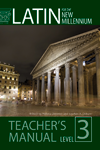
Many students take Latin with the intention of enhancing their English vocabulary. The teacher manuals for LNM 1 and 2 provide English derivative information for each chapter of the student text. This information supplements the derivative work provided in Exercise 2 of each chapter. The LNM 3 Teacher’s Manual—now in the proofs stage!—also provides English derivatives their meanings and histories as “Teacher Lecture Notes.” Downloadable lists for the students will be available in the LNM Teachers’ Lounge as will quiz questions on the derivatives. This material should be a great resource to teachers seeking to enrich their Latin students’ English vocabularies.
Kudos to Dr. Karen Lee Singh (retired) of Florida State University and the Florida State University School who researched and developed these lists, notes, and quiz questions. |
|
|
Specials for eLitterae Subscribers |
Find yourself disappointed that your students don’t know the Greek myths or haven’t read the great Greek plays? Looking for an enrichment activity for those go-getters? Want to provide them with an accessible resource? Looking to enrich the whole class with oral reports from the go-getters? B-C has a solution!
A classroom set of Jolliffe’s Tales from the Greek Drama, which presents 10 classic plays in a dramatic, comprehensible prose format, will prove a terrific resource.
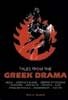
Tales from the Greek Drama
H. R. Jolliffe
xi + 311 pp. (1962, reprint 1984) Paperback
ISBN 978-0-86516-013-2 $12.00 $9.00 and free media rate shipping
(no returns, not available to distributors.
Classroom sets of 10+ at $8.00 each, plus shipping.
This offer expires 11/30/12)
Make sure to mention that you are an eLitterae subscriber if you place your order by phone or fax. If you place your order via www.BOLCHAZY.com the special eLitterae offer pricing will be charged at checkout. |
|
|
|
|