Classical Conferences and Meetings 2013 |
NB: As best as possible, we also note presentations by B-C authors.
New York Classical Club
Annual Winter Conference: "Julius Caesar in History and in the Classroom."
Saturday, January 26, 2013,
11 a.m.–6 p.m
Representative: Donald Sprague
Presentation: “Caesar and the State Religion” – Hans-Friedrich Mueller, author, Caesar: Selections from His Commentarii De Bello Gallico; coauthor, Caesar: A LEGAMUS Transitional Reader
CANE – Classical Association of New England Annual Meeting
March 15–16, 2013
University of Connecticut
Storrs, CT
Representative: Donald Sprague
Presentation: "AcademicPub Creating Your Own Textbooks" – Donald Sprague
CAMWS – Classical Association of the Middle West and South
April 17–20, 2013
Sheraton Iowa City Hotel
Iowa City, IA
Representatives: Allan Bolchazy, Bridget (Buchholz) Dean, Donald Sprague
Presentation: "Creating Custom Textbooks" – Bridget (Buchholz) Dean
ACL - American Classical League
66th Annual ACL Institute
June 27–29, 2013
University of Memphis
Memphis, Tennessee
Representatives: Marie and Allan Bolchazy, Laurel Draper, Donald Sprague
Information taken from www.BOLCHAZY.com |
|
 |
|
Latin No Longer
The winter issue of the Williams College Alumni Review included a sad notice for promoters of Latin. January 1 marked the one-year anniversary of a milestone decision by the International Code of Botanical Nomenclature to allow English in publications describing new plant species. Since 1935, Latin was the language for such descriptions.
To learn more about this and the reasons for the change, see Williams Fall Magazine 2012.
Be sure to enlarge the page so that you can more easily read the piece “(One of) The Last of the Latin-Named Plants.”
Maya Culpa
The Chicago Tribune’s December 27, 2012 edition featured an Op-Art by Joe Fournier entitled Maya Culpa. Teachers might point out to their students that the political cartoonist expected readers to understand the wordplay: maya culpa vs. mea culpa. The latter provides a teachable moment for reviewing the ablative of cause.

Mayan Zodiac Circle.
Photo Courtesy of Wikimedia Commons.
Pontifex Maximus
The current pope, Benedict XVI launched his twitter account. You can check it out: Follow @pontifex .
The Vatican greatly delighted in the success of the launch, boasting that the Pontiff’s retweets beat out Justin Bieber's record. Read this Reuters blog article.

Benedict XVI performing a blessing
in St. Peter’s Square in Rome, Italy on
Sunday October 12, 2008.
Photo courtesy of Wikimedia Commons.
NCIS LA Vergil Connection
The NCIS LA December 11, 2012 episode entitled “The Gold Standard” saw headquarters and team manager Hetty Lane, played by Linda Hunt, again quoting Vergil, “O accursed hunger of gold, to what do you not compel human hearts!” The quote from Aeneid 3.56–57 alludes to Polydorus whom the King of Thrace killed in pursuit of gold. Hetty followed the quote with the wry observation “Too bad, they're (referring to the bad guys) not as well-versed in the classics . . . ”
Watch the episode: NCIS Los Angeles video - Vergil Connection
(This quote comes at the end of the episode.) |
|
|
|
Latin Music Through the Ages, available as a CD or via MP3 tracks, takes you on a musical Latin journey from the 4th century CE to the 20th. Beautiful Latin verses are set in equally beautiful arrangements and magnificently sung by the Lafayette Chamber Singers of Purdue University.
Check out two favorites—a poem composed in praise of Mary by Hildegard of Bingen, the 12th century nun, mystic, abbess, recently proclaimed a Doctor of the Church by Pope Benedict XVI—and the humorous British folksong Amo Amas I Love a Lass.
If these two pique your interest, check out this month’s special discount.
For your listening pleasure . . .

Ave, Generosa 4:28 minutes
Amo Amas I Love a Lass 1:52 minutes |
|
|
Latin for the New Millennium, Level 3 Teacher’s Manual Update |
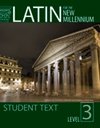
With great pleasure, we announce that the Teacher's Manual for LNM 3 is on its way to the printer.
It’s a terrific resource chock-full of teaching tips, suggestions, and information for teachers similar to the much-appreciated manuals for LNM 1 and 2. However, please note one MAJOR difference—the LNM 3 TM does NOT reprint the student text. This makes for a smaller, more manageable book. The TM has all the translations and answers including scansion and sample essays.
Recognizing that many students choose Latin with the hope of building their English vocabulary, the LNM 3 Teacher’s Manual provides a rich set of teacher lectures on the English derivatives based on each reading’s Latin vocabulary. The Teachers’ Lounge will host a set of multiple choice quizzes for these derivative lessons.
For teachers who used LNM 1 and 2, the manual includes cross-references with those volumes. However, the student version of LNM 3 makes only a handful of such references as LNM 3 was expressly designed as a Latin 3 text for students coming from any Latin 1 and 2 program. Indeed, LNM 3 provides students a comprehensive introduction to the unadapted Latin of Caesar, Catullus, Cicero, Vergil, Horace, Ovid, and Erasmus and to the components of literary analysis. |
|
|
|
Important Classics Deadlines |
|
|
Bolchazy-Carducci
Links of Interest |
Preview Bolchazy-Carducci Titles

Preview Bolchazy-Carducci titles before you buy using Google Preview.
Downloadable Products
iPodius - Bolchazy-Carducci Publishers online shop for: audio, software, video, and a treasure trove of teacher-created materials in the Agora.

BCP Facebook Fan Page
Become a FAN of Bolchazy-Carducci Publishers, visit our Facebook Fan page for the latest news from BCP.
*AP is a registered trademark of the College Entrance Examination Board, which was not involved in the production of, and does not endorse this product. |
|
|
Bolchazy-Carducci textbooks are now available through GooglePlay and DirectDigital (Xplana) eBookstores, with more titles going digital every day! Each eBook offers a variety of tools to enhance the learning process, and eBook distributors are continually adding new features.
What do B-C eBooks currently offer?
eBooks have the same content as our traditional books in print, with these enhancements:

• Searchable
• Adjust text size, typeface, line space
• Free samples of books
• Worry-free archive
• Available on any computer with an internet connection
• Readable on:
- the web (via Windows or MAC computers)
- iPhone, iPad and iPod touch
- Android
- eBook Devices: Barnes & Noble Nook and Reader™ from Sony
GooglePlay ebook information
GooglePlay ebook store: http://books.google.com/ebooks

(Formerly Xplana)
• Searchable
• Adjust text size, typeface, line space
•Add notes, customized highlights, and other annotations—all of which are added to the embedded annotation manager for convenient access
• Worry-free archive
• Available on any computer with an internet connection
• Readable on:
- the web (via Windows or MAC computers)
- tablet computers
DirectDigital ebook information
DirectDigital ebook store
How do I purchase a B-C eBook?
Simple! When you are browsing through www.Bolchazy.com, any time you see GooglePlay or DirectDigital eBook logo, click on the logo, and you will automatically be directed to a webpage where you can purchase the eBook.
Can I purchase direct from the distributor?
Yes! If you prefer, you can link directly to our eBook providers’ websites and search by title, by author, or by Bolchazy-Carducci Publishers to locate the title you would like to purchase. The GooglePlay ebooks store offers a preview of the book, including the table of contents and select pages.
What hardware is required?
You can read eBooks on a Mac, PC, iPhone, iPad, Android, or a variety of eReaders. |
|
|
|
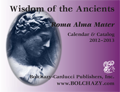
Annually Bolchazy-Carducci publishes a Roman Calendar that includes key dates in Roman history and literature as well as a significant Latin quote for each day of the month. If you didn't receive one, email info@bolchazy.com to request one. We'll send you the 2012–2013 calendar and put you on our mailing list. Or better yet, download it. |
|
|
American Classical League’s 66th Annual Institute is scheduled for June 27–29, 2013 in Memphis, TN at the invitation of the University of Memphis. The December 2012/January 2013 issue of National Geographic Traveler includes Memphis as one of its “20 Must-See Places for 2013.” The article highlights the Stax Museum of American Soul Music as one of the key players in the city’s arts revival and the vibrant local food community—Project Green Fork has certified dozens of Memphis restaurants as sustainable, linking chefs with farmers. So, mark your calendar, make your plans to combine some terrific professional development activities with some great local culture and culinary experiences.

Photo courtesy of Wikimedia Commons. |
|
|
|
|
As we celebrate Janus, we look back to a year of great success with the publication of a dozen new titles and of great sadness with the death of our founder and president Dr. Lou Bolchazy, a larger than life, passionate promoter of the classics. We also look forward to another great year confident that Bolchazy-Carducci Publishers will pursue Lou's vision with great vigor and enthusiasm. Watch for additional titles in the celebrated B-C Latin Reader Series, revised editions of our popular Latin literature titles, and a number of other new titles.
As is our longstanding tradition, Bolchazy-Carducci welcomes your suggestions, your ideas, and your recommendations. How can we better serve you? What are your latest needs?
Please help us assess the current state of your eBook and eLearning use and needs. This survey will take you two to three minutes.
(click here to complete the survey)
https://secure.blueoctane.net/forms/WWECVFTSOHSR
Don Sprague
don@bolchazy.com |
|
|
I hope that you have enjoyed some time relaxing with family and friends and recharging your batteries for the next part of the school year. This is a natural time to reflect on how your year has progressed with your students and on what you still want to accomplish with them. Let me know what questions come from your reflection and I will address them in future columns. Contact me at slittle6@cinci.rr.com.
When January comes around we begin to think about retaining students for the upcoming year and attracting new students to begin their study of Latin. Take a moment and think about how well you make your Latin program open to all students—not just the best and the brightest—but all students. If we believe that Latin has something to offer everyone, we need to make sure that we are walking that walk. I have always believed that our neediest students need our best teachers. It’s easy to teach to the students at the top—as we teachers feel personally rewarded because these students “get” what we want them to learn. Perhaps we see a little bit of ourselves in these students. However, our goal is to reach all students.
This discussion could touch on all sorts of topics, but I would like to focus on ways to make sure our classes meet the needs of today’s students. The biggest difference I see in today’s students from those I taught at the start of my career is how students view information. Today’s students want to use information for their own purpose. They want to master it and make it their own. The relatively passive action of contemplating an ancient text is not enough. How can we tweak our classroom activities to include more active use of Latin?
Referring to the Standards for Classical Language Learning gives us a great starting point. Their overarching goal is Communication. Let’s look at the Standards under the Communications goal:
Communicate in a Classical Language
• Standard 1.1: Students read, understand, and interpret Latin or Greek.
• Standard 1.2: Students use orally, listen to, and write Latin or Greek as part of the language learning process.
Standard 1.1 is very familiar. We communicate with the ancient world through text. Standard 1.2 causes more concern. Teachers are often unsure what this looks like, how to measure it, or how much time to give these activities. I have a few suggestions how you can adapt what you already do to meet this standard. If you employ conversational Latin in your classroom, you are well on your way to meeting this standard.
EXAMPLES:
IDEAS FOR YOUNGER STUDENTS
We all have our students read texts, whether our textbook uses a narrative storyline, presents a different topic or text in each chapter, or even if you use no textbook at all. They could record it or read it in front of the class. Just a reminder—all of these activities are conducted in Latin!
Have them:
(1) Re-tell the text from the point of view of one of the characters.
(2) Take a narrative text and turn it into a dialogue, or vice-versa (this is especially on target when students are learning the different personal endings).
(3) After they create a dialogue, read it out loud to each other. They could record it or read it in front of the class.
Some students might enjoy acting it out as they present it to the class while others, often the more introverted, would prefer the opportunity to record a short video as they act it out and present the video to the class.
February includes Valentine’s Day, and I enjoyed (and I think my students enjoyed) making valentines –with a twist! Students pick a pair to write about, such as Jupiter/Juno, Penelope/Odysseus, Cleopatra/Caesar, even Catullus/Lesbia. The format of the poem is:
| Character A |
| Adjective A |
Adjective A |
| Verb A |
Verb A & B |
Verb B |
| Adjective B |
Adjective B |
| Character B |
| Here is an example: |
| Penelope |
| pulchra |
fidelis |
| exspectat |
amant petit |
| sapiens |
fortis |
| Odysseus |
The challenge in this activity is for you as the teacher to avoid becoming the human dictionary answering “how do you say. . . ?” My responses were usually “Where could you find that out?” or “What resources do you have?” Students had to get my approval of their writing before they could have fun with construction paper and glue and decorate it. Then we would post them in the classroom. Students will want to see what their friends in other classes wrote, they will want to see if anyone else chose the same pair as they did, and all the while they are reading some Latin.
Activities like these help students review whatever vocabulary and grammatical structures they are mastering, as well as some basic skills, such as adjective-noun agreement in the valentine example. More significantly, the students are themselves writing what they want to say. Granted, the teacher gives the framework such as a dialogue or letter, but the students are able to produce something of their own. This is very powerful. In addition, the concepts such as voice and point of view are skills that the students are developing in their language arts classes.
IDEAS FOR OLDER STUDENTS
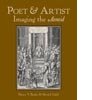 These same ideas can work for students reading more complex Latin. I was intrigued when I first picked up a copy of Poet and Artist: Imaging the Aeneid. This book has text of the Aeneid, while an accompanying CD offers illustrations keyed to the text. The illustrations originally accompanied John Dryden’s translation of the Aeneid. The authors include questions that ask the students to consider how the artist interpreted the Latin text. For example, after the description of Fama, they ask “In what way has the artist paid particularly close attention to Vergil’s description of Fama?” This activity asks the students to look at the Latin closely while examining how a visual artist interpreted the text. These same ideas can work for students reading more complex Latin. I was intrigued when I first picked up a copy of Poet and Artist: Imaging the Aeneid. This book has text of the Aeneid, while an accompanying CD offers illustrations keyed to the text. The illustrations originally accompanied John Dryden’s translation of the Aeneid. The authors include questions that ask the students to consider how the artist interpreted the Latin text. For example, after the description of Fama, they ask “In what way has the artist paid particularly close attention to Vergil’s description of Fama?” This activity asks the students to look at the Latin closely while examining how a visual artist interpreted the text.
You can notch it up a bit and have the students use their Latin skills. Have the students read Vergil’s description of the storm in Book I, then show them the images corresponding to that selection. Project one of the images—either the main image or one of the three enlargements—and create an activity where the students have to use their Latin.
(1) Ask the students to label the image with words from Vergil’s text. You could begin by having them label what they remember. Have in reserve a few words they may have forgotten (such as puppis) to give as prompts.
(2) Have the students write three simple Latin sentences describing the image, without referring to the Latin text. They will write clunky prose, but again they are choosing to describe what caught their eye.
(3) Ask them to look at the Latin text and find phrases from the Latin that describe what the artist has captured. Then ask them to find phrases from the Latin that the artist has omitted. They may offer some obvious answers, but that’s fine—they are interacting with the text and an image—an excellent activity that reinforces their understanding of the text.
These examples are both student- and teacher-friendly. Students appreciate this active employment of the Latin they are learning. In turn, they develop a more positive attitude towards their Latin studies. They are themselves more likely to continue with their Latin and often are eager to recruit their friends and/or younger siblings. So, everyone benefits!
Whenever I work with teachers I enjoy hearing about the activities they do with their students. What are some of the great activities in your repertoire that have student actively use Latin? Share your ideas with me and I will share them in future columns.
Felicem annum novum omnibus!
Sherwin Little
slittle6@cinci.rr.com |
|
|
|
Teaching Tip
A New Derivative for Vita |

Abbott spinoff AbbVie's corporate logo.
January 1, 2013 marked the launch of the new corporation AbbVie. Abbott, one of the world’s leading pharmaceutical companies, created AbbVie as a separate corporation for its research-based pharmaceuticals. Richard A. Gonzalez, previously executive vice president, Global Pharmaceuticals, is chairman and CEO of AbbVie.
The new company’s name is derived from a combination of Abbott and “vie,” which references the Latin root “vi” meaning life. “The beginning of the name connects the new company to Abbott and its heritage of pioneering science,” said Mr. Gonzalez. “The 'vie' calls attention to the vital work the company will continue to advance to improve the lives of people around the world.”
A fun derivatives exercise is to have students find other company or product names that also consciously reference or employ Latin roots and/or words. Some are rather fanciful—Calvin, of Calvin Klein, has been explained as a compound of the Greek kallos and the Latin vin from vinco—“beautiful conqueror”! Students will love making fun of such explanations. For presentation to their peers, a mini power point that includes the logo containing the Latin or related image will work well.
(The above note about AbbVie is adapted from an Abbott press release.)
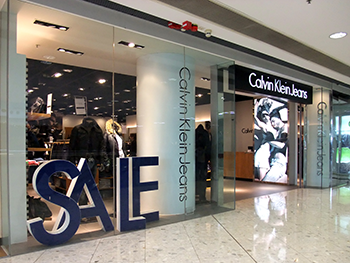
Calvin Klein Jeans store at Citygate Outlets, Tung Chung, Hong Kong.
Photo Courtesy of Wikimedia Commons.
The Trial of Socrates
As a special fundraiser, the Hellenic National Museum in Chicago has enlisted several of Chicago’s most celebrated attorneys to conduct a reenactment of Socrates’s trial on January 31. Let's hope they videotape it. In the meantime, for a good resource on this famous trial, check out: The Trial and Execution of Socrates.
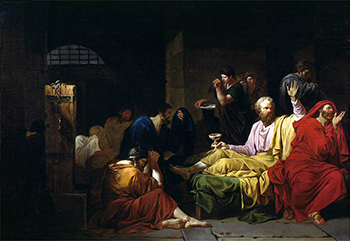
Jean-Francois Pierre Peyron’s Death of Socrates.
Photo Courtesy of Wikimedia Commons. |
|
|
|
For high school teachers, we are pleased to announce a special series of webinars on Caesar and Vergil scheduled for February and March 2013.
For college instructors, Milena Minkova, coauthor of Latin for the New Millennium, Levels 1 and 2, will provide tips for using the new College Exercise Book for LNM.
Mark your calendars and register now as these are sure to fill fast!
LNM for the College Classroom: Integrating the College Exercise Book - January 29, 2013, 12:30–1:30 p.m. (Eastern Time)
Presented by Milena Minkova, Professor of Classics, University of Kentucky
Milena Minkova the coauthor of Latin for the New Millennium, Levels 1 and 2, will offer an overview of using the new introductory series Latin for the New Millennium, Levels 1 and 2, at the collegiate level with particular emphasis on how to integrate the new College Exercise Book. Dr. Minkova is Professor of Classics at the University of Kentucky. She has published on Latin literature in its continuity, 12th century Renaissance, Latin Composition, Latin Pedagogy, and Active Latin.
Themes Connecting Caesar and Vergil - February 5, 2013, 6:00–7:00 p.m. (Eastern Time)
Presented by Mary Pendergraft, Classics Professor, Wake Forest University
Professor Pendergraft is much respected by her university colleagues, her students, and her high school colleagues for her scholarship and her insights into pedagogy. Her presentation will explore themes that connect Caesar and Vergil, the two writers united by the new AP curriculum. Dr. Pendergraft has served as a state and national consultant on Latin curriculum and standards. She performed yeoman service as the Chief Reader for AP Latin for four years and as a contributor to the development of the new curriculum. Her topic was suggested by fall webinar participants and promises to be an excellent learning opportunity as teachers gear up for the second semester of AP Latin.
Casus belli: Caesar and the Use of Force - February 19, 2013, 6:00–7:00 p.m. (Eastern Time)
Presented by Hans-Friedrich Mueller, Classics Professor, Union College
Hans-Friedrich Mueller, popular classics professor and department chair at Union College, is recognized for his scholarship and insights on Caesar. For the past couple years, Dr. Mueller has been immersed in Caesar as he worked on Caesar: Selections from His Commentarii De Bello Gallico, a text written to address the new AP* Latin curriculum. In the Teacher's Guide for this text, he provides a comprehensive set of discussion and analysis questions for the Latin passages and a series of questions that make connections between Caesar and Vergil. With Rose Williams, he is the coauthor of Caesar: A LEGAMUS Transitional Reader, which introduces students to both De Bello Gallico and De Bello Civili.
In this webinar, “Casus belli: Caesar and the Use of Force,” Professor Mueller asks apart from good grammar and a clear Latin style, what political, cultural, and historical lessons will Caesar bring with him in his recent return to the high school classroom? How can teachers productively lead discussions about his legacy, which remains as controversial as ever? This webinar will take up one important thread in Caesar's career, his use of force, review its role in his private and public life, and invite participants to a wider discussion about how we, as teachers, can discuss important ethical, legal, and political issues from a variety of points of view.
Pius Julius: Julius Caesar and the State Religion - March 12, 2013, 6:00–7:00 p.m. (Eastern Time)
Presented by Hans-Friedrich Mueller, Classics Professor, Union College
“Pius Julius: Julius Caesar and the State Religion,” illuminates Caesar's religious persona from his role as pontifex maximus to that of general referencing Fortuna in his narrative. This webinar provides a fuller context for understanding the complex individual who was Julius Caesar.
Conquering and Creating Gaul: Geography and Narrative in the Bellum Gallicum - March 26, 2013, 6:00–7:00 p.m. (Eastern Time)
Presented by Debra Nousek, Classics Professor, Western University, Ontario
Professor Nousek is a specialist in Roman history and the republic and has published on Caesar as well as delivered papers on a variety of topics including Caesar. Dr. Nousek serves as the director of graduate studies at Western. Her current research and writing projects include “The Commentarii” for the Cambridge Companion to Caesar; “The Literary Caesar” for Landmark Caesar's Gallic Wars; On Writing Caesar: The Historical Monograph in the Late Republic, a book length study of Caesarian prose and the writing of history; and an article on the significance of wordplay in Caesarian prose. She is the coauthor (with Rose Williams) of A Caesar Workbook and its teacher's guide (Bolchazy-Carducci, 2012). Dr. Nousek was named to the “Teaching Honor Roll” by the Students' Council of the University of Western Ontario.
Professor Nousek's webinar “Conquering and Creating Gaul: Geography and Narrative in the Bellum Gallicum” addresses Caesar's Commentarii from a literary perspective. Nousek theorizes that Caesar's use of geography serves a larger purpose than simple cartographic reference. She delivered a similar presentation to the Classical Association of Western New York this past fall to great acclaim.
Click here to register for FREE Webinars
To participate in Bolchazy-Carducci Publisher sponsored webinars you will need high-speed internet access, computer speakers / headphones, current web browser with updated “Flash Player”*, and the link to the webinar virtual meeting space, which is provided in your webinar invitation.
*Current web browsers: Internet Explorer 8, FireFox 3, Google Chrome, Safari 4 or 5. Flash Player available from Adobe.com: http://get.adobe.com/flashplayer/. Consult your school IT dept.
Webinars for Professional Development
Participation is free. All webinars provide opportunity for participants to ask questions. Learn lots – attend each presentation. Sign up for this professional development webinar. Bolchazy-Carducci Publishers will provide documentation for your participation. |
|
|
|
Latin for the New Millennium
Levels 1 and 2 Teaching Tip |
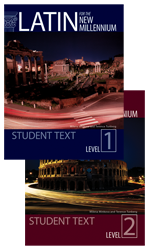
Aural/oral Aspects of LNM
Feedback from teachers and students alike tells us that they both enjoy the Talking dialogues in LNM 1 and the Talking about a Reading repartee in LNM 2. From such discussions, consider the following suggestions.
- Do you have students play parts and read aloud from their desks?
- What about having volunteers come to the front of the classroom and act out the roles?
- Other students might enjoy filming their rendition for a special class showing. Indeed, this could serve as a great review activity. The class could vote on the best video and launch it on YouTube. Teachers could share it in the LNM Teachers' Lounge.
- Classroom teachers, please share your experiences and ideas about aural/oral activities and other LNM topics with your colleagues and us in the Teachers' Lounge.
Authors Milena Minkova and Terence Tunberg constructed a battery of teacher-friendly aural/oral activities and exercises that, given their nature, could not be printed in the student text but are printed in the Teacher's Manual for both LNM 1 and 2. Teachers are invited initially to pick and choose among these terrific activities. They are carefully explained so that even a novice will be comfortable using them in class. Gradually, teachers can use more of these activities. Check them out . . . give them a try . . . they're a great way to meet the National Standards. |
|
|
|
Special Title Discounted for eLitterae Subscribers |
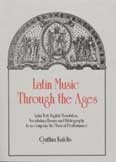
Latin Music Through the Ages
By Cynthia Kaldis
Clayton Lein conducts The Lafayette Chamber Singers
Explore the beauty of Latin music through the ages. The book provides the Latin text, English translation, and vocabulary for each of the selections on the CD along with background essays and a bibiliography. The CD includes 17 Latin selections.
xli + 87 pages, paperback, 1991, reprint 1999
ISBN 978-0-86516-242-6 $25.00 $20.00 PLUS free media rate shipping in the USA
or
CD with 17 selections; running time 41:03
ISBN 978-0-86516-706-3 $25.00 $20.00 PLUS free media rate shipping in the USA
or
both the paperback and the CD
$50.00 $35.00 PLUS free media rate shipping in the USA
(no returns, not available to distributors.
This offer expires 1/31/13)
Make sure to mention that you are an eLitterae subscriber if you place your order by phone or fax. If you place your order via www.BOLCHAZY.com the special eLitterae offer pricing will be charged at checkout. |
|
|
|
|
|