Classical Conferences and Meetings in 2012 and 2013 |
NB: As best as possible, we also note presentations by B-C authors.
CAAS – Classical Association of the Atlantic States
in conjunction with
CAES – Classical Association of the Empire State
October 4–6, 2012
New York Marriott Eastside
New York, NY
Representative: Donald Sprague
Presentations:
“A New Option for Latin 3: Latin for the New Millennium, Level 3” – Donald Sprague (Kennedy-King College, City Colleges of Chicago & Bolchazy-Carducci Publishers)
“Pius Julius: Julius Caesar and Roman Religion” – Hans-Friedrich Mueller, author Caesar: Selections from his COMMENTARII DE BELLO GALLICO and coauthor of Caesar: A LEGAMUS Transitional Reader
“Revisiting the Latin Gerund and Gerundive: An Active Approach” – co-presenter Judith Hallett, coauthor of A Roman Women Reader
“Academic Activism in the Classics: The Public University as Springboard” – Judith Hallett, coeditor of Rome and Her Monuments
“Latin on the Rise in New York City's Public and Charter Schools: Challenges and Opportunities” – organizer and presider Ronnie Ancona, author of Writing Passion: A Catullus Reader and Horace: Selected Odes and Satire 1.9, BC Latin Readers Series editor
ICC – Illinois Classical Conference
75th Anniversary Meeting
October 5–7, 2012
University of Chicago
Chicago, IL
Representatives: Laurel De Vries and Bridget (Buchholz) Dean
Bolchazy-Carducci Publishers will celebrate ICC's 75th Anniversary with a special display of books edited, illustrated, or written by Illinois classicists.
Presentations:
‟Musical Interpretation of Homer's Odyssey” – Joe Goodkin, composer/lyricist/performer [B-C distributes his Odyssey Folk Opera, available via iPodius]
“Learning and Relearning in Latin 3” – LeaAnn Osburn, editor/contributor Latin for the New Millennium, Level 3, coauthor of Vergil: A LEGAMUS Transitional Reader
“An On-Line Latin Course: Using My Latin Lab” – Thomas J. Sienkewicz, coauthor of Vergil: A LEGAMUS Transitional Reader
“Gaul Was Divided into a Lot More Than Three Parts: Caesar for His Time as well as Ours” – Nicholas Young, consultant/pilot teacher for Latin for the New Millennium, Level 3
OCC - Ohio Classical Conference 2012 Meeting
October 26–27, 2012
Fawcett Center, The Ohio State University
Columbus, OH
Representative: Sherwin Little
CAMWS-SS – Classical Association of the Middle West and South – Southern Section
November 1–3, 2012
Florida State University
The Doubletree by Hilton Hotel
Tallahassee, FL
Representatives: Bridget (Buchholz) Dean and Donald Sprague
Presentations:
“A New Option for Latin 3: Latin for the New Millennium, Level 3” – Donald Sprague, Kennedy-King College, City Colleges of Chicago & Bolchazy-Carducci Publishers
“Custom Textbooks” – Bridget (Buchholz) Dean, Bolchazy-Carducci Publishers College Editor
“Caesar’s Language of War: Prose Style in De Bello Gallico” – Jane W. Crawford, coauthor of A Cicero Workbook
“Integrating Latin Teaching Standards into a Latin Course” – Thomas J. Sienkewicz, coauthor of Vergil: A LEGAMUS Transitional Reader
“Greece and Africa in Changó, el Gran Putas” – Madeleine M. Henry, author of Horace Satire 1.9: The Boor
TFLTA - Tennessee Foreign Language Teaching Association Fall Conference
November 2–3, 2012
Franklin Cool Springs Marriott
Greater Nashville, TN
Representative: Sherwin Little
AIA/APA – American Institute of Archeology/American Philological Association Joint Meeting
January 3–6, 2013
Washington State Convention Center and Sheraton Seattle Hotel
Seattle, WA
Representatives: Marie and Allan Bolchazy, Bridget (Buchholz) Dean, Donald Sprague
CANE – Classical Association of New England Annual Meeting
March 15–16, 2013
University of Connecticut
Storrs, CT
Representative: Donald Sprague
CAMWS – Classical Association of the Middle West and South
April 17–20, 2013
Sheraton Iowa City Hotel
Iowa City, IA
Representatives: Marie and Allan Bolchazy, Bridget (Buchholz) Dean, Donald Sprague
Information taken from www.BOLCHAZY.com |
|
 |
|
Interesting Classics Related Tidbits |
In the season opener for NCIS LA (September 25, 2012), headquarters and team manager Hetty Lane, played by Linda Hunt, proclaims “fortune favors the brave”—Vergil's famous line “audentes fortuna iuvat” (Aeneid 10.284). The phrase originates with Ennius and is later reported by Pliny the Younger to be the words of his uncle, Pliny the Elder, as he set off to rescue some friends from Vesuvius's eruption.
The phrase metamorphoses into the song “Fortune Favors the Brave” in Elton John and Tim Rice's musical Aida. Click on the following to hear the song in a Vegas production http://www.youtube.com/watch?v=UuwURS9bRzk or the Youth Musical Theatre Association's version http://www.youtube.com/watch?v=utjN5X_zc1I
Wedding Bells at Bolchazy-Carducci Publishers
Congratulations to college editor Bridget Buchholz who recently married Adam Dean. She is gradually transitioning to her married name Bridget Dean. Editorial assistant Laurel De Vries married Jack Draper and will similarly transition to her married name Laurel Draper. The B-C staff celebrated each of these life-changing transitions with a shower and cake in the office library.
nostra culpa!
In the September issue of eLitterae, we misspelled the last name of Dianne Costanzo, author of Seeding Your Soul. We are humbled and apologize.
|
|
|
|
Important Classics Deadlines |
Oct. 15, 2012: Deadline to register for National Classical Etymology Exam
Nov. 9, 2012: Deadline to register for CAMWS Latin Translation Contest
Dec. 1, 2012: Deadline to register for SCRIBO writing contest
Jan. 21, 2013: Deadline to register for Classical Literacy Exam
Jan. 15, 2013: Deadline to register for National Mythology Exam
Jan. 15, 2013: Deadline to register for National Greek Exam
Jan. 18, 2013: Deadline to register for National Latin Exam
Feb. 1, 2012: Deadline to register for National Roman Civilization Exam
Feb. 9, 2012: Deadline to register for Medusa Mythology Exam
Mar 1, 2012: deadline to register for Exploratory Latin Exam for fall 2012
(NEED LINK) |
|
|
Check out the following tracks from The Odyssey: A Folk Opera (see interview with composer/lyricist/performer Joe Goodkin for discussion of these choices).

Track 4: Blues in B, Free Again, I Can Feel You
Track 8: Live in Me |
|
|
Bolchazy-Carducci
Links of Interest |
Preview Bolchazy-Carducci Titles

Preview Bolchazy-Carducci titles before you buy using Google Preview.
Downloadable Products
iPodius - Bolchazy-Carducci Publishers online shop for: audio, software, video, and a treasure trove of teacher created materials in the Agora.

BCP Facebook Fan Page
Become a FAN of Bolchazy-Carducci Publishers, visit our Facebook Fan page for the latest news from BCP.
*AP is a registered trademark of the College Entrance Examination Board, which was not involved in the production of, and does not endorse this product |
|
|
Bolchazy-Carducci textbooks are now available through GooglePlay and Xplana eBookstores, with more titles going digital every day! Each eBook offers a variety of tools to enhance the learning process, and eBook distributors are continually adding new features.
What do B-C eBooks currently offer?
eBooks have the same content as our traditional books in print, with these enhancements:

• Searchable
• Adjust text size, typeface, line space
• Free samples of books
• Worry-free archive
• Available on any computer with an internet connection
• Readable on:
- the web (via Windows or MAC computers)
- iPhone, iPad and iPod touch
- Android
- eBook Devices: Barnes & Noble Nook and Reader™ from Sony
GooglePlay ebook information: http://books.google.com/help/ebooks/overview.html
GooglePlay ebook store: http://books.google.com/ebooks
• Searchable
• Adjust text size, typeface, line space
•Add notes, customized highlights, and other annotations—all of which are added to the embedded annotation manager for convenient access
• Worry-free archive
• Available on any computer with an internet connection
• Readable on:
- the web (via Windows or MAC computers)
- tablet computers
Xplana ebook information: http://tinyurl.com/4qlyhye
Xplana ebook store: http://shop.xplana.com/
How do I purchase a B-C eBook?
Simple! When you are browsing through www.Bolchazy.com, any time you see GooglePlay or Xplana eBook logo, click on the logo, and you will automatically be directed to a webpage where you can purchase the eBook.
Can I purchase direct from the distributor?
Yes! If you prefer, you can link directly to our eBook providers’ websites and search by title, by author, or by Bolchazy-Carducci Publishers to locate the title you would like to purchase. The GooglePlay ebooks store offers a preview of the book, including the table of contents and select pages.
What hardware is required?
You can read eBooks on a Mac, PC, iPhone, iPad, Android, or a variety of eReaders. |
|
|
|
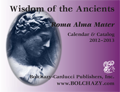
Annually Bolchazy-Carducci publishes a Roman Calendar that includes key dates in Roman history and literature as well as a significant Latin quote for each day of the month. If you didn't receive one, email info@bolchazy.com to request one. We'll send you the 2012–2013 calendar and put you on our mailing list. Or better yet, download it. |
|
|
|
|
Interview with Joe Goodkin, Composer, Lyricist, Performer
The Odyssey: A Folk Opera |
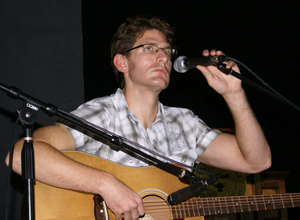
This folk opera interprets the story of The Odyssey in song, invoking the spirit of the Ancient Greek bards who originally brought forth the timeless story. The Odyssey consists of 24 short songs sung by Joe Goodkin while playing the acoustic guitar. The performance is continuous and runs about 30 minutes. The Odyssey is especially suited for high school and college classes reading The Odyssey, whether in English or Greek, but can be adapted for audiences of any age with any level of familiarity with the story. A libretto of songs with commentary on the relevant books of The Odyssey is also available for download.
DES: How did you become inspired to create this folk opera based on The Odyssey?
JG: It's funny because just recently I came across the journal in which I wrote the piece. I thought it had been destroyed in a flood (which would have been poetically appropriate). My first entry is notated as follows: “This is a sketchbook for a new project: a contemporary musical reading of Homer's Odyssey to be written in XXIV (or perhaps XXV) short parts, with each "song" representing a book's theme(s). I'm not sure this can be done . . . so I must begin with the prologue, with the invocation . . .”
I think it was a situation where I decided to see if I could create something that connected the two things I had worked on most in my life at that point—Classics and music—and I had some notion, some instinct that The Odyssey was the story that most suited my particular agenda. And once I started digging in and doing the work necessary to understand my source material at an even deeper level, I found that I was more moved and emotionally connected to the story than I thought I was when I started.
DES: Sounds like the Muses helped you pull things together! In what context did you first encounter The Odyssey?
JG: Like many students, I read The Odyssey (or parts of it) in high school as part of a unit on mythology. As a Classics major at the University of Wisconsin - Madison, I encountered it numerous times in varied academic environments: in a Greek Myth class, in a Comparative Literature class specifically dedicated to reading stories connected to The Odyssey tradition—James Joyce's Ulysses and Derek Wolcott's Omeros among others—and in a Greek Language class.
DES: And how do you keep current with your interest in the classical world?
JG: One of the many benefits of performing The Odyssey at universities and colleges is the opportunity to connect with current scholarship through professors and students. Often I'll get to sit in on and participate in classes after I perform, which is really fun and keeps my brain sharp. Additionally, I'm still in touch with a number of former student-colleagues from Madison, who have gone on to great things in Classics field.
DES: For those of us who are not as musically talented, describe the steps that went into the creation of the folk opera. What's the musical inspiration behind its songs?
JG: What a great question. For The Odyssey, the biggest initial musical decision I made was to retune the guitar into a non-standard tuning. Conventional guitars are tuned from low to high E A D G B E. For The Odyssey, I settled on B F# B F# B C# . . . I thought it gave the guitar a more exotic sound and also provided more range. I'd like to say I invented this tuning, but I'm fairly certain it's derived from the Led Zeppelin tune “Rain Song.” The other thing the altered tuning did was to take me out of my comfort zone and force me to write with my ears rather than my brain and muscle memory. The second big decision was to write the piece with no proper names and few narrative elements, to try to capture emotions and relationships more than story. With my musical and intellectual framework in place, I went through the poem book by book—using the Fitzgerald translation as well as the original Greek at times—and just started writing about particular episodes that struck me. Once I got up to four or five, I began to see the types of themes around which my writing was coalescing and it became a little bit easier. So I essentially wrote on instinct until I found something concrete and then wrote based on what I discovered, which, in my opinion, leads to the organic feeling of the piece. Its very creation was an act of interpretation on my part.
DES: Please share with us two songs and how you created them. We’ll provide those tracks so eLitterae readers can listen to them.
JG:
BLUES IN B (TRACK 4)
This song is a great example of the challenges I faced in writing The Odyssey. A good quarter of the poem is Odysseus at a dinner on Phaiakia retelling his exploits after the Trojan War. While this is largely a narrative device in the story, I had to figure out a way to work it into my non-narrative approach. So I decided that Odysseus’s retelling was akin to an old Delta-blues musician singing a song about his life and tried to work in as many references to Odysseus’s exploits (“tempted by sweetness” is the Sirens episode, “I saw the ghosts” is the trip to the Underworld) as possible. It also connects Odysseus and my song to the larger American blues tradition.
LIVE IN ME (TRACK 8)
As this piece has aged, I find myself more and more drawn to the songs about Penelope and the character of Penelope in general. This song is a reprise of an Odysseus song “Strange Place” sung in a higher register. Penelope is a mirror of and foil to Odysseus in so many ways, I thought it appropriate to have her sing a song first sung by her husband.
DES: Why do you think Odysseus's story is relevant for today's students?
JG: Because the story is first and foremost about identity and what is more relevant to high school and college students (and even adults for that matter) than the question “Who Am I?”
DES: What aspect/story of The Odyssey do you like most?
JG: Well, that changes from time to time, but I'm currently really enjoying and appreciating the character of Penelope and what she says about the author/poet/editor of The Odyssey. And in general I'm continually and repeatedly blown away by the sophistication of the narrative and how modern the whole poem is. It's easy to forget that a piece of art is usually considered a masterpiece for good reason.
DES: What suggestions would you offer a teacher for incorporating your folk opera into their curriculum?
JG: I've had teachers do a number of different things with my piece. A couple of my favorites include writing a song/poem for an episode of the story about which I didn't write and also doing a detailed exegesis of one of my songs. In general, I find that teachers can use my performance to talk about broader and more diverse themes around the poem and also about the act of interpretation and how it relates to critical reading.
DES: When not working on your music, what do you most enjoy doing?
JG: Not working on music? What's that? Kidding . . . sort of. I also write and record for the original rock band Paper Arrows. We have a new EP that came out September 25 on Slothtrop Records and available on iTunes. And I fancy myself an amateur triathlete and distance runner, having completed a number of marathons and triathlons, including the 2011 Wisconsin Ironman in Madison, WI. Talk about an epic journey over sea and land!
Joe Goodkin has been performing his unique interpretation of The Odyssey for high school and college audiences since 2003. Drawing on his Bachelor's Degree in the Classics from the University of Wisconsin - Madison, his extensive experience teaching and giving private music lessons, and his years of writing and performing original rock and acoustic music, Joe has created a 30-minute-long composition for solo acoustic guitar and voice, which tells the story of The Odyssey in song. A 21st century bard, Joe will entertain banquet guests at the 75th Anniversary Meeting of the Illinois Classical Conference in October. |
|
|
|
Teaching Tips: The New AP* Curriculum |
The new AP* curriculum has prompted much discussion among teachers. Here follow two reflections on the new curriculum. First, veteran teacher Rose Williams suggests how to sequence the two AP* authors Vergil and Caesar. The opportunity to teach Caesar found a ready advocate in our founder, the late Dr. Lou Bolchazy. Lou penned an imaginative address to students in which Caesar explains the value of reading his work in the original Latin. Feel free to share the full piece or excerpts from it with your AP* Caesar students.
Vergil Before Caesar
As secondary teachers try to rearrange classwork to take into account the new AP readings, it may be advisable to reconsider the traditional approach to classical authors. In the Dark Ages, some fifty years ago, the first unadapted (or almost unadapted) author taught in late second year classes was Caesar, with perhaps a bit of Nepos as an introduction. The next major author was Cicero, usually taught in the third year, perhaps in conjunction with some Sallust, and Vergil appeared in the fourth year. Various poets were scattered here and there in the standard texts.
But as I dutifully followed this order in the textbooks of the day, I came to the conclusion that all the poets, up to and including Vergil, use much simpler grammar than do the major prose authors. Vergil's vocabulary is very large, but with a few simple word formation rules and a good dictionary, students can deal with his vocabulary with very little trouble. Moreover, if one uses either Barbara Weiden Boyd’s Vergil’s Aeneid: Selected Readings from Books 1, 2, 4 and 6 or the famous Pharr’s Aeneid, the frequency vocabulary pull-out and the same-page vocabulary minimize problems with Vergil’s vocabulary. His grammar is rarely more taxing than noun, pronoun and adjective declensions, indicative verbs, and participles and infinitives.
Meter, scansion, and figurative language need to be covered, but again, these are much simpler to present to students than are the grammatical gymnastics found in Cicero and to a lesser extent in Caesar. When considering preparing students for the AP test, or even when simply moving forward with them toward a fuller understanding of the language, “Vergil First” is my battle cry.
Teachers who use Hans-Friedrich Mueller’s Caesar: Selections from his Commentarii De Bello Gallico will appreciate the AP Connections found in the teacher’s guide. These notes link Caesar to Vergil and raise questions about similarities and differences.
Rose Williams
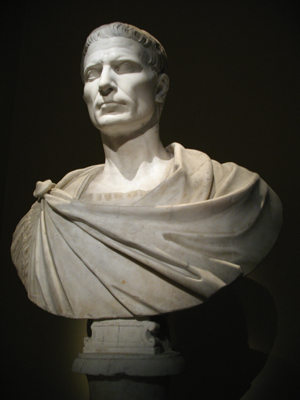
Salvete!
I, Caesar, greet you!
I, Caesar, am happy that you will read my Gallic Wars in the language in which I wrote— Latin!
I, Caesar, am called the Colossus of Italy. I deserve this title.
I, Caesar, would be stoned by many people and charged with genocide if I were still alive in your time and culture. But you be the judge of whether or not I deserve condemnation!
I, Caesar, am an outstanding writer. Millennia of people have enjoyed my magnum opus and learned a lot from me.
The Greeks invented sophistry; but I practiced it successfully. I can make white appear as black, and vice-versa. You will benefit from analyzing my propaganda. Use it for good and not for evil.
I, Caesar, was, in my belief, the super man, the savior come down from the sky, to impose Roman peace upon people by means of my virtus or my clementia.
Now, you be my judge!
Have I killed a greater percent of Europeans than Hitler and Stalin? Have my soldiers been happy to be paid by me with booty and women, like some of your own contemporaries? Are any in your current terra firm a bigger killer of innocents than I?
You must learn what made me tick so you can identify the likes of me in your world, lest you, too, become a victim.
Am I not one of many saviors who is above any law and who, like the lion in the jungle, who will take everything I want with disregard for private property and personal sovereignty? (Look for me—that is, the likes of me—in your midst.)
All the “would be” super men justified their conquests by referring to the concept of “justice according to nature.” (Let the rest divide the leftovers on their principle of “justice according to convention.”) All the czars, all the kaisers, all the kings and emperors, and all the conquerors and generals studied me and imitated me in the practice of “justice according to nature.”
Why not? If their people let them!
Does your society now have a greater respect for and commitment to the principle of “the social contract,” that is, to the normative principle of “enlightened self-interest” or of “reciprocal altruism”? Of course! If not in personal practice, at least in their written laws.
Don’t judge me according to your values! Values were different two thousand years ago. (Might makes right! That’s what nature teaches!) To what extent have you progressed beyond the law of the lion?
I am Caesar! I will teach you a lot that is important to you, the “keeper of the values and wisdom and the literature of the classical world.” Some tools for my success are to be imitated, like good publicity, in order to be more successful in your mission to ameliorate the human condition; some to be avoided as monstrous. Above all, become acquainted with me in order to save yourself and the world from the likes of me.
It is your duty to try to be a colossus. Ability to aim at greatness, skill in convincing others, facility in expressing yourself in writing—these are the tools I can teach you.
Come to me, study me, and conquer the evils in this world.
I am Caesar—writer, philosopher, leader, politician, statesman, conqueror, and father of Europe! At what price have I Romanized the Gauls? You do the accounting!
I, Caesar, am “ad admirandum, ad imitandum, et ad condemnandum”!
Professors Hans-Friedrich Mueller, Rose Williams, and Debra Nousek will lead you through this exciting, new adventure via my magnum opus. You will learn the culture of your predecessors, my style, and, most of all, my modus operandi!
Enjoy working with these three scholars and teachers whose editions of my writings you’ll be reading!
Vale, and thank you.
Julius Caesar (deus ex deo et filius dei)
(per Lou J. Bolchazy, PhD Classics) |
|
|
|
As many of you may know, I have been working on the Latin Reading Proficiency test, which we hope to roll out before too long. Because of this work, I have spent a lot of time learning about the different types of assessment and their purposes. For this column, I would like to examine assessment, specifically reading assessment. Like so many aspects of education, this is really just a different way to look at a familiar topic, but I found it a useful exercise reflecting on my portfolio of assessments.
Achievement testing assesses how well a student learned what was taught. A typical example is a chapter test to see if the students have learned the perfect tense endings and what to do with them, and to see if they have learned the vocabulary. The context is highly familiar, usually based on the textbook, so that you can see how well the students understand the new information. The students have had plenty of practice on the specifics being tested.
Performance testing begins to look at skill assessment. It measures what the student can demonstrate, not necessarily bound by the textbook. The context is still familiar—for example if students have read in their textbook about food and meals—on the performance assessment you might give them a passage that is set at a meal. The difference from achievement testing is that you will not ask grammatical or vocabulary questions and no questions which can be answered out of context. An example might be “What surprised character X?”
In proficiency testing the context is not lesson specific, but can be anything appropriate for that level. An example of this type of passage might be the reading selections on the National Latin Exam. Another example for advanced students would be the sight passages on the multiple-choice part of the AP* Latin exam. Your students have to use their grammatical and cultural knowledge to make sense of something they have not read previously.
In the September column, I looked at the Bolchazy-Carducci products geared towards to the Caesar selections on the new AP* Latin exam. So this month, let’s look at the products available for the Vergil selections. These texts have a lot to offer even if you are not preparing your students for the AP* exam.
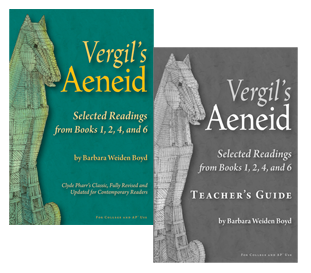
The readings are presented in Vergil's Aeneid: Selected Readings from Books 1, 2, 4, and 6. The format is similar to that of the Caesar text, with text and the necessary vocabulary and notes on the same page, along with a foldout general world list. The introduction includes information about Vergil and his works, and I especially liked the discussion of the authors whose works influenced Vergil and authors whose works Vergil influenced.
The accompanying Teacher’s Guide provides you with plenty of support for teaching. For each selection of text a literal translation is offered, along with questions for analysis and discussion. I am pleased again, as I was with the Caesar text, that the manual provides a clean copy of the text of all the Latin so that you can give your students practice reading without relying on notes.
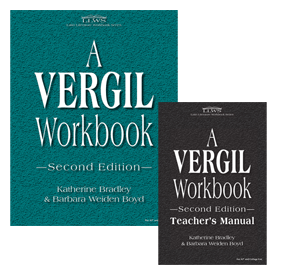
The revised version of the Workbook provides students with practice on all types of questions: comprehension, multiple-choice, translation, essay and scansion. The introduction gives a description of each question type and describes how best to answer them. A few question types are used occasionally, but deserve mention. Translation and analysis questions ask students to translate a sentence or phrase, then to show how the Latin can support the analysis of the text. Occasionally the scansion questions ask the students to go beyond simply scanning to answer questions such as “how does the scansion show what case _____ is.” Short answer questions on grammatical forms and functions, rhetorical devices, and names of important characters and places make sure the students are learning the details.
A welcome addition to the student workbook is a series of twelve sight passages (four are from the original Workbook TM), prose and poetry, from various authors. The first three begin with practice with pre-reading strategies, and all twelve have some vocabulary supplied and a dozen or so multiple-choice questions. I hope this format will inspire you to pick your favorite poems or passages that are no longer on the syllabus and turn them into sight practice.
Finally the Teacher’s Manual to the workbook supplies the answers to all questions, literal translations and suggestions for chunking the translation questions, and possible responses for the essays.
What can we learn about assessment from the new Vergil texts? First and foremost is that teachers need to plan for all three types of assessment. Achievement testing finds out how well the students have learned the nuts and bolts needed, such as vocabulary and inflected forms. Performance assessment lets your students show how well they have mastered the text they have studied, putting the nuts and bolts together into a solid structure. Proficiency assessment gives them a chance to use their skills to read new text, a “sight” passage, and shows what they have learned from that “sight” reading.
For specific examples, follow this link to bring up Lesson 9 from the student Workbook. I will use this lesson to make specific references. Sound pedagogy tells us that students need practice with the question types on which they will be assessed, so using the exercises in Lesson 9 gives students that practice.
Since these exercises, and the assessment you would give your students, are based on a reading the students have studied, they fall into the category of achievement and performance assessments. The multiple choice, short answer, and scansion questions can largely be classified as achievement, while the comprehension and essay questions allow students to demonstrate their performance skills. The translation question is hard to categorize because it really isn’t a reading skill, but I would put it halfway between achievement and performance. I hesitate categorizing it as performance because students don’t have to show any specific reading skills.
So if your tests are a combination of the above question types, as most of our tests are, you only need to include some sight reading to ask students to read a new passage and learn from it. You will then have a full range of assessments that will give you useable data. The whole issue of “sight” reading versus “sight” translation is the topic for a future column!
Teachers need to employ a variety of assessments, and understand what that data can show you. An achievement test will not tell you or your students where they are on the development of their reading skills. By the same logic, a proficiency style test cannot help you determine what area is causing the student problems. Your curriculum needs to include places where this whole range of information is measured. Then you can help your students make progress.
I promise that the next column will look beyond the AP-level materials. I can think of plenty of topics I can touch on, and I would love to hear your thoughts and ideas. My digital door is always open, so send your thoughts to me at slittle6@cinci.rr.com.
As always, bene doceatis!
Sherwin Little
Slittle6@cinci.rr.com |
|
|
|

Google Earth for the Latin Classroom - October 16, 6:00–7:00 p.m. (Eastern Time)
Presented by Laurel De Vries
Learn how to enhance lectures, class discussions, and student projects using Google Earth, a program that allows users to view satellite imagery, maps, and terrain. This presentation focuses on ideas for student projects to accompany Latin for the New Millennium and the AP* Latin syllabus that debuts in 2012–2013. The presentation concludes with an overview of how to use the tools and features of the Google Earth program.
Quia: A Quiz Resource—How to Use the LNM Question Bank, to Use the Umiker Question Bank, to Use One You Make Yourself - November 6, 6:00–7:00 p.m. (Eastern Time)
Presented by Charles Umiker
Charles Umiker, Latin teacher at the Tatnall School in Wilmington, Delaware has been a Latin for the New Millennium devotee and frequent contributor to the LNM Teachers' Lounge. He will show you how to navigate Quia using the LNM test bank and his own questions for a couple of the LNM enrichment texts. And, better yet, he’ll show you how you can make your own set of questions.
Click here to register for these FREE Webinars
To participate in Bolchazy-Carducci Publisher sponsored webinars you will need high-speed internet access, computer speakers/headphones, current web browser with updated “Flash Player”*, and the link to the webinar virtual meeting space, which is provided in your webinar invitation.
*Current web browsers: Internet Explorer 8, FireFox 3, Google Chrome, Safari 4 or 5. Flash Player available from Adobe.com: http://get.adobe.com/flashplayer/. Consult your school IT dept.
Webinars for Professional Development
Participation is free. All webinars provide opportunity for participants to ask questions. Learn lots – attend each presentation. Sign up for this professional development webinar. Bolchazy-Carducci Publishers will provide documentation for your participation. |
|
|
|
Latin for the New Millennium,
Level 3 Development Notes |
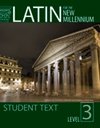
Click cover image to see samples from the new LNM 3, a text designed for students coming from various Latin 1 and Latin 2 backgrounds.
LeaAnn Osburn and Helena Dettmer are diligently putting the final touches on the Teacher's Manual for Latin for the New Millennium, Level 3. The Teacher's Manual was constructed at the same time as the student text and its contents received the same scrutiny from the team of consultants as the student text. Subsequently, Dettmer and Osburn have been adding teaching tips and suggested activities to the TM and, in consultation with editor Don Sprague, have been working on format to make the TM as teacher-friendly as possible —putting the TM to the test of Osburn's mantra “teachers' time is precious.” The Teacher's Manual will include an overview of each reading's components, a literal English translation of the Latin reading, answers to all the exercises and vocabulary builders, an overview of and prompts for each reading's figures of speech, Teaching Tips, Teacher by the Ways and background information, suggestions for oral Latin activities, derivative lists for students, derivative notes for teachers, and multiple choice questions for the derivatives, and more! Based on teacher feedback, the TM is planned to be same physical size as the student text and will not include the full student text. |
|
|
|
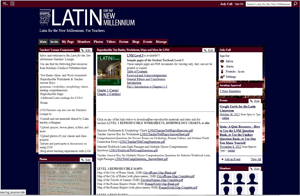
Check out the Teachers' Lounge. Bryan Baker has recently posted his test for the LNM 1 Review 1. Charles Umiker has shared his Quia quiz/test questions for the LNM enrichment texts on Roman history and the classical heroes. This seasoned LNM teacher will be giving a webinar on using Quia, creating your own Quia questions, and related topics. Kelly Northrup has posted all of her lesson plans for Latin 1 and Latin 2. A number of LNM teachers have posted activities and suggestions on the Teachers' Lounge. Have you? Please do! Every classroom teacher has a favorite activity or worksheet that others would love to have. |
|
|
Specials for eLitterae Subscribers |
Show your students the full legacy of Latin literature. Peter Martyr's primary source about Columbus' voyage of discovery is a perfect enrichment lesson for October. Carpe diem! Get yourself a classroom set at this special rate and you can make this an annual enrichment activity.
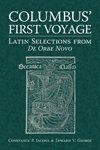
Columbus' First Voyage
Latin Selections from De Orbe Novo
Constance P. Iacona and Edward V. George
xvi + 40 pp. (2005) Paperback
ISBN 978-0-86516-613-4 $25.00 $17.00 and free media rate shipping
(1 copy, no returns, not available to distributors.
Classroom sets of 10+ at $15.00 each, plus shipping.
This offer expires 10/31/12)
Make sure to mention that you are an eLitterae subscriber if you place your order by phone or fax. If you place your order via www.BOLCHAZY.com the special eLitterae offer pricing will be charged at checkout. |
|
|
|
|